BYD's Two-Door Mini Takes Aim at Smart #2
A design patent published on 10 November shows BYD has drawn a two-door, two-seat city car with a face that looks like it is smiling. Five days earlier, Smart put a price on exactly that car.
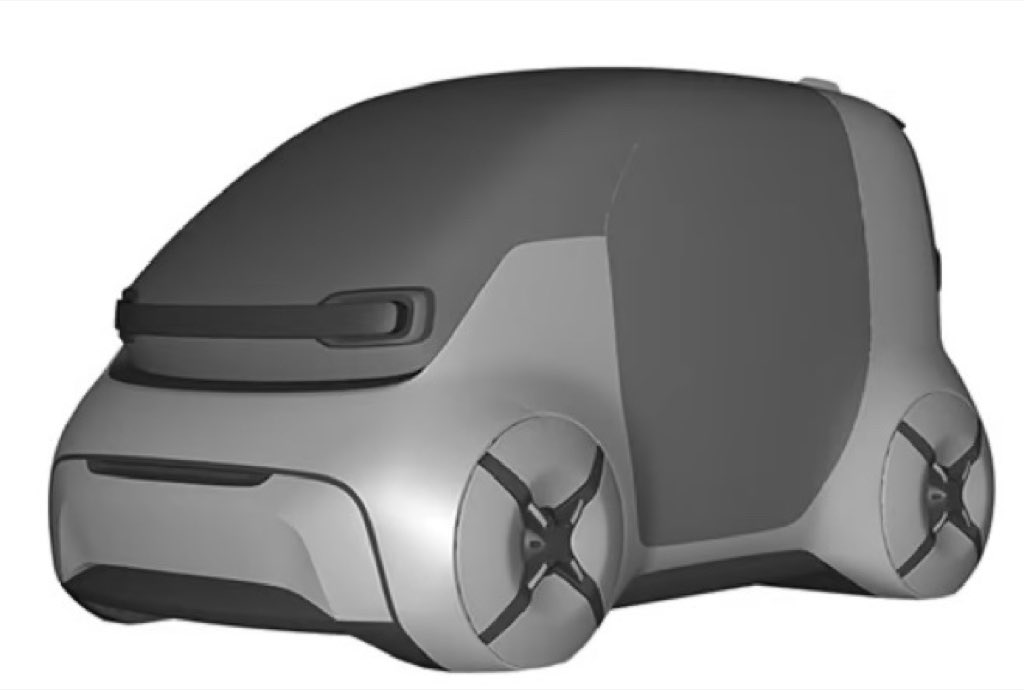
Front three-quarter view from the design patent filing. Image: CNIPA, design patent CN 310308323 S.
What the patent actually says
On 10 November 2026 China's National Intellectual Property Administration (CNIPA) granted a design patent to BYD Co., Ltd. under grant number CN 310308323 S. The application, number 202530748612.8, was filed on 18 December 2025. The product name on the cover is two characters long: 车辆, "vehicle". The filing contains seven views and one page of brief description.
The list of designers is what makes this more than routine paperwork: Zhao Binggen, Wolfgang Egger, Xu Ziyan, Huang Xi and Zhang Xi. Egger is BYD's global design director. Carmakers file design patents in bulk every year and most are defensive stock — but when the person who signs off on the whole brand's styling is named on a microcar, the drawing is usually not a placeholder.
One clarification matters, because most of the coverage in China this week got it wrong. These are design patent drawings, not spy shots. The distinction is not pedantic: spy shots mean a car is already running on public roads and production is months away. A design patent means the surfacing is finalised and legally protected — and nothing more. It can sit in the registry forever. BYD has not confirmed the car exists, and the filing discloses no powertrain, no dimensions, no seating count and no production commitment.
The wheels in the drawings support the scepticism: they are almost fully closed, with barely any opening for brake cooling. No production car in this class ships wheels like that.
What it looks like
Read across the three views, the design language is not a shrunken Seagull. The nose is completely closed — no grille at all — and split horizontally by a full-width light bar, leaving a second volume underneath. In the front view the curve below the bar reads as a smile, and the tail deliberately repeats it.
The body is built almost entirely from continuous curves and large radii. There is barely a straight line anywhere, which separates it from the Seagull's sharp creases or the Dolphin's shoulder line. The proportions are the part that matters at this size: wheels pushed hard into the four corners, very short overhangs front and rear, the wheelbase stretched to the limit inside a body under 2.8 metres. The A-pillar is blacked out, the B-pillar is close to vertical, the door outline is polygonal and the arches are visibly flared. With the two-tone body and the flared lower cladding, it reads as a rounded toy rather than a scaled-down family car.
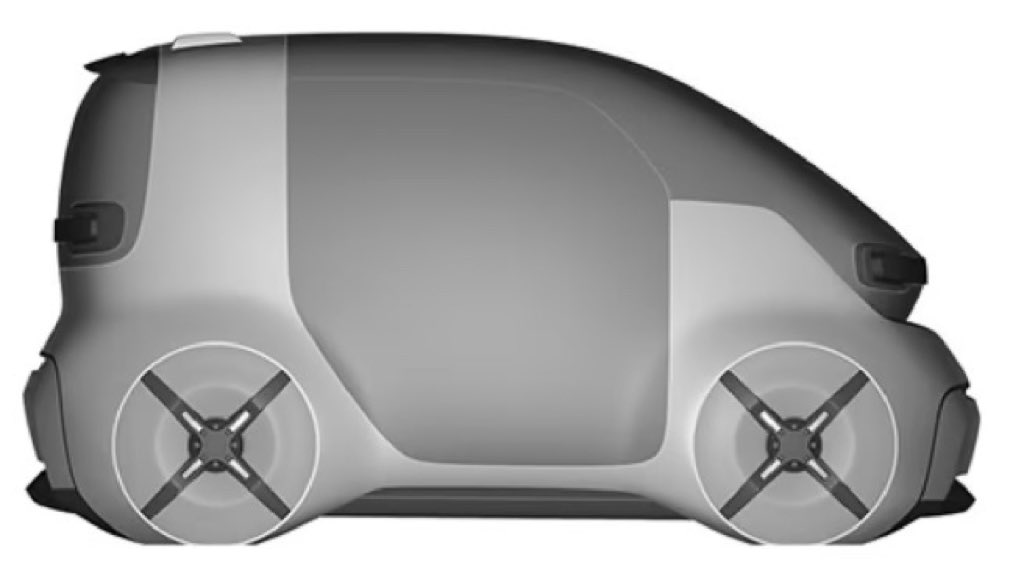
Side view. Image: CNIPA, CN 310308323 S.
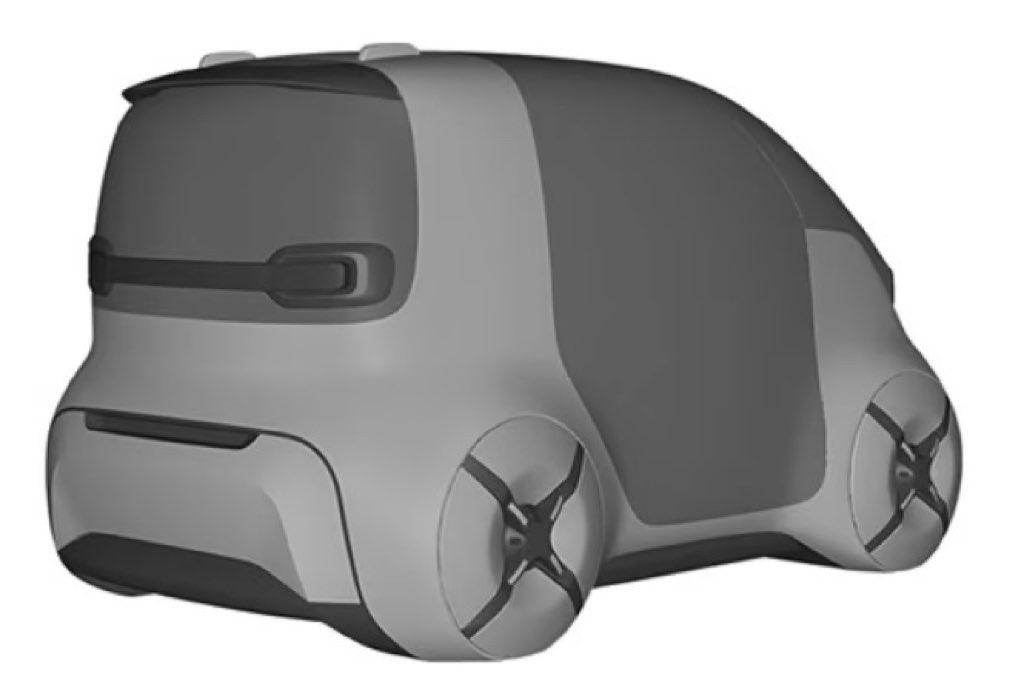
Rear three-quarter view. Image: CNIPA, CN 310308323 S.
Two existing cars are the honest reference points. One is the Smart #2, heir to the fortwo line. The other is the Baojun KiWi EV — and its numbers are worth a separate sentence. KiWi EV sold 69 units in China in the first ten months of 2026. Being visually radical in this segment does not convert into orders on its own.
Why the target is Smart #2, not the Seagull
Put the two on the same page and the overlap is not the obvious one. On size, this BYD is likely to land in the 2.7–2.8 metre band — the same bracket as the Smart #2's 2,751 mm. Both are two-door, two-seat, four-corners-at-the-wheels city cars. That box was drawn by fortwo more than two decades ago and nobody has escaped it since.
The real overlap is price.
Smart launched the #2 in China on 5 November 2026 in Guangzhou. One trim only, the Premium: list price RMB 102,900, limited-time benefit price from RMB 99,900. European order books had opened on 13 October, ahead of the Paris Motor Show debut, with four trims: Pure at €19,990, Pure+ at €20,990, Premium at €24,490 and the Couture Edition at €25,690. Deliveries start in Q2 2027.
That last number is the interesting one. The Couture Edition was capped at 999 units and sold out across every European market within 14 days of the 13 October opening. Two weeks — before a single journalist outside the Paris show floor had driven the car.
Now look at where BYD currently sits in Europe. The Seagull sells there as the Dolphin Surf, listed at €19,990 in Germany and €19,790 in Italy, at 3.99 metres long with four doors and four seats. It holds the line marked "electric car under €20,000". What it cannot hold is the other line: a car designed specifically to be somebody's second vehicle in a city. The overlap between "buyers who want the smallest possible car that parks anywhere" and "buyers who want a cheap four-door EV" is not large.
BYD does not lack a cheap car in Europe. It lacks a small expensive one — and Smart wrote the price for that on a spec sheet five days before the patent published.
How much car €19,990 actually buys
To judge how BYD can attack, you need to know where the bar sits.
The #2's headline change is not its size but its architecture. Smart did not shorten an existing model. It developed a dedicated two-seat EV platform called ECA — Electric Compact Architecture — which it calls the first architecture designed from scratch for a production two-seater. The programme ran seven years and, per the company, several billion yuan.
The most concrete proof of forward development sits at the rear axle. To free up an uninterrupted volume for the battery, engineers used a five-link independent rear suspension, which Smart says no other car in the 3-metre class currently offers. Add rear-wheel drive, close to 50:50 front-to-rear weight distribution, staggered tyres (185/50 R16 front, 205/45 R16 rear) and a 60 kW / 130 Nm motor, and the numbers stop resembling a microcar: 0–50 km/h in 3.8 seconds, 140 km/h top speed, a 3.35 m turning radius and a 78 km/h moose-test result. Smart quotes a 6.95 m turning circle in Europe; the two figures reflect different measurement conventions rather than a contradiction.
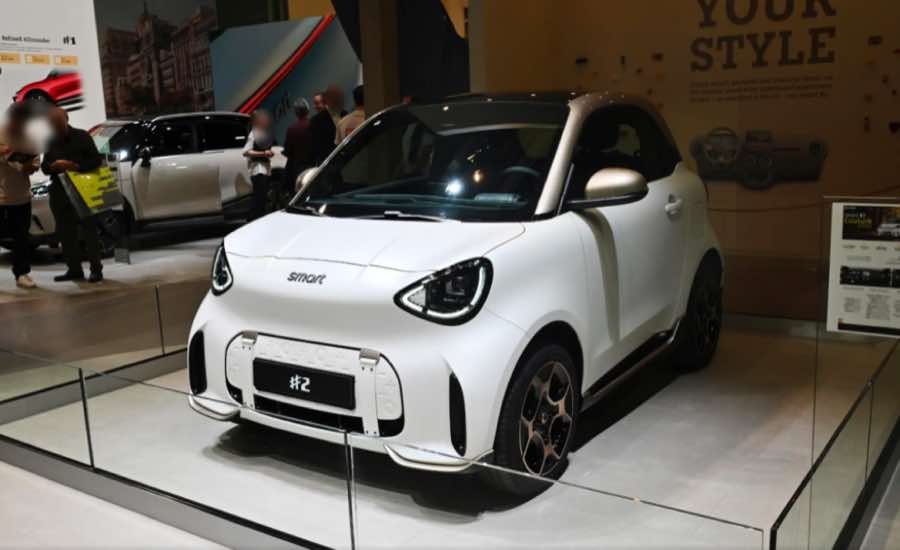
Smart #2 on the show stand. Image: Smart.
The battery is a 35.8 kWh LFP pack from CATL — 290 km WLTP, 410 km CLTC in China. DC charging peaks at 65 kW and takes 10–80% in under 20 minutes; AC is 7.4 kW on the base Pure and 11 kW above it. That closes the single biggest gap of the old EQ fortwo, which had no DC charging at all. V2L is supported, though in Europe it needs a separately sold adapter.
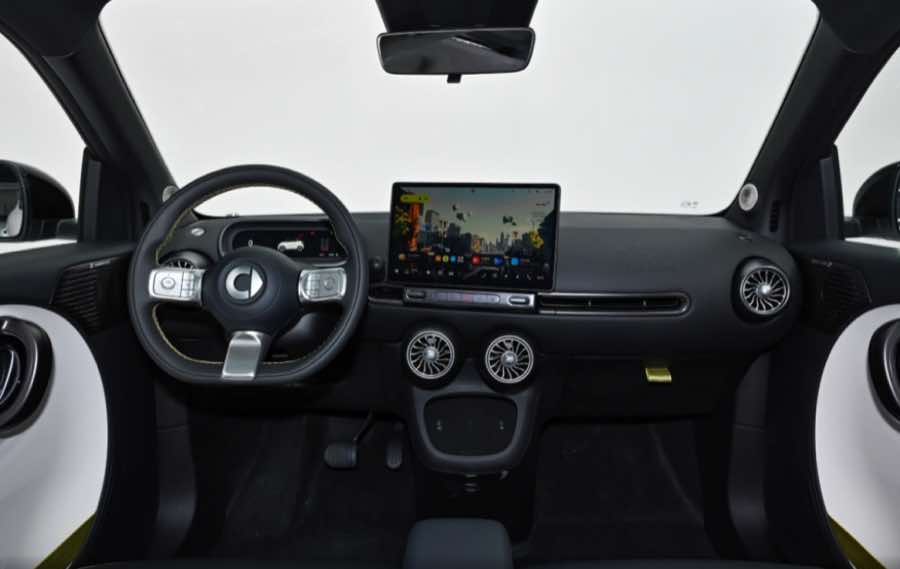
Cabin. Image: Smart.
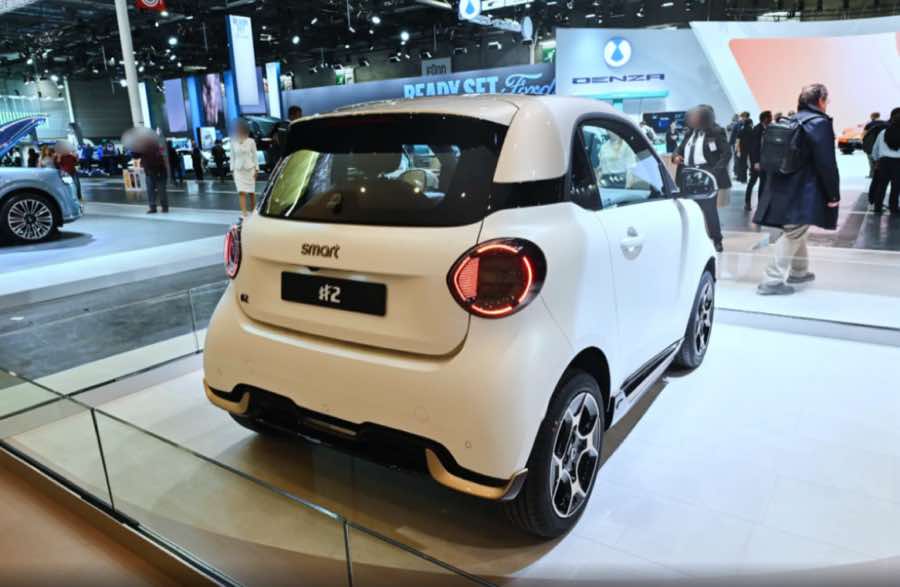
Rear: split tailgate, 305 litres standard and 527 litres with the seats folded. Image: Smart.
On equipment, Smart did something unusual for the price point in China: it offered one trim and filled it. Sennheiser seven-speaker audio, heated seats and steering wheel, panoramic glass roof, L2 assistance, 360-degree cameras, remote parking, seven airbags including a front centre airbag, more than 78% high-strength steel in the body-in-white, 39,000 Nm/deg torsional rigidity and roughly 4 tonnes of roof crush resistance. The tailgate's lower half carries 120 kg; the boot runs 305 litres, or 527 with the seats down.
In Europe that "one trim, fully loaded" logic does not apply — the €19,990 Pure is a different car from the €24,490 Premium. Which is precisely where a price argument becomes available to BYD.
Three cards BYD can play
One: charging speed. The #2's 65 kW is strong for a microcar, but it is squarely inside BYD's comfort zone. Battery (FinDreams), power electronics, thermal management and boost charging are all in-house. Lifting peak DC above 80 kW and pulling 30–80% under 15 minutes is not a technical stretch. More importantly, it is the kind of claim a buyer can verify at a public charger on a test drive — ideal material for a "more car for the same money" story.
Two: equipment density. BYD's habit is not to win any single spec but to be the fullest at a given price: rotating centre screen, DiLink, larger pack, V2L, heat-pump air conditioning, DiPilot assistance. All of those are existing modules in its line-up and can be pushed down-market. Against Smart's European ladder, an obvious counter is more trim levels with a loaded top spec priced under the #2's Premium.
Three: price — but the room is narrower than it looks. This is the part most commentary skips. The two cars have remarkably similar cost structures: Mercedes-led design, Geely-system manufacturing and a CATL pack on one side; Egger-led design, BYD manufacturing and a FinDreams pack on the other. One is a European brand built on Chinese supply chains, the other a Chinese brand on Chinese supply chains. The material cost gap is much smaller than the brand premium gap. Anyone expecting BYD to undercut Smart by half is going to be disappointed.
A more defensible inference is one step down, not two. In China, that points to roughly RMB 79,800–96,800. In Europe there is an extra constraint: with the Dolphin Surf already at €19,990, a two-door car cannot sit at the same number without cannibalising it. It has to be lower, and lower for a reason. €16,990–18,990 is where that logic lands.
Known and inferred, side by side
The left column is what Smart has published. The right column is inference, and not one line of it comes from BYD.
| Item | Smart #2 (official) | BYD two-door (inferred) |
|---|---|---|
| Status | China launch 5 Nov 2026; Europe Q2 2027 | Design patent only, no production commitment |
| Body | Two-door, two-seat, split tailgate | Two-door, two-seat (read from drawings) |
| L / W / H | 2,751 (Couture 2,764) / 1,669 / 1,555 mm | 2.7–2.8 m class, slightly narrower |
| Wheelbase | 1,875 mm | 1,750–1,850 mm |
| Architecture | ECA, developed for two-seat EVs | e-Platform 3.0 Evo derivative, or a small-car platform |
| Drive | Rear-wheel drive | Front-drive likely, rear not excluded |
| Motor | 60 kW / 130 Nm, 140 km/h | 50–70 kW, slightly more torque |
| 0–50 km/h | 3.8 s | 3.5–4.0 s |
| Battery | 35.8 kWh LFP (CATL) | 30–40 kWh Blade (FinDreams) |
| Range | 410 km CLTC / 290 km WLTP | ~400 km CLTC |
| DC charging | 65 kW, 10–80% under 20 min | 80 kW+, 30–80% under 15 min |
| AC charging | 7.4 kW base / 11 kW above | 6.6–11 kW |
| V2L | Yes (adapter in Europe) | Yes |
| Suspension | MacPherson front, five-link rear | MacPherson front, torsion beam rear |
| Screens | 12.8-inch centre (China) + 8.8-inch cluster | 12.8-inch rotating centre + digital cluster |
| Assistance | L2, 360 camera, remote parking | DiPilot base, highway assist on upper trims |
| Safety | 78% high-strength steel, 39,000 Nm/deg, 7 airbags | CTB body integration, airbag count unknown |
| China price | RMB 102,900 (RMB 99,900 limited-time) | RMB 79,800–96,800 |
| Europe price | €19,990 Pure to €25,690 Couture | €16,990–18,990 |
| Build | Geely-Mercedes JV, developed to Chinese and European standards | Domestic base plus European localisation |
Smart #2 figures: official launch information, Paris Motor Show materials, MIIT filings and European presale pricing. The Chinese car is quoted on CLTC and the European car on WLTP; the two cycles are not comparable. Every BYD figure except "design patent only" is this article's inference.
China: a category filler, not a volume car
Here is the counter-intuitive read. If this car reaches China, BYD is unlikely to treat it as a volume model.
The price structure explains why. China's micro-EV mainstream sits at RMB 40,000–60,000. In October 2026 retail, the Wuling Hongguang MINIEV moved 24,518 units and the Bestune Pony 17,887 — both on pure value. The A0-class leader, the Geely Xingyuan, did 50,190 on four doors, four seats and a conventional two-box shape. A RMB 99,900 two-seater competes in a different race entirely: it sells an emotional, urban, treat-yourself purchase, and it was never going to be a volume car.
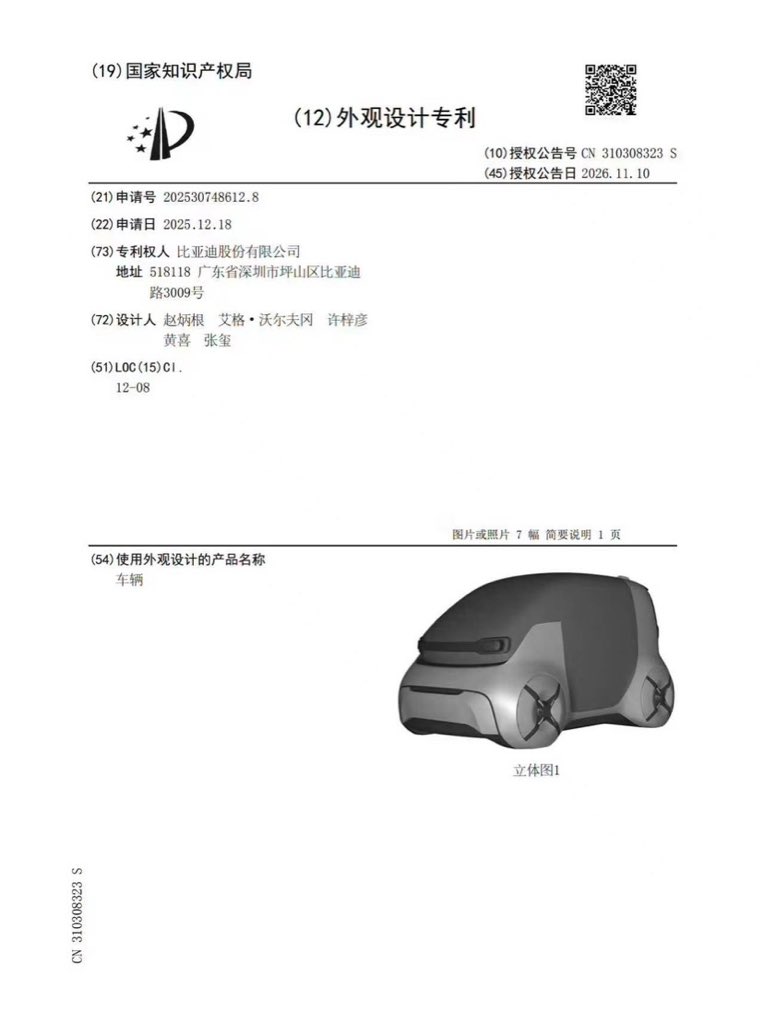
The filing's cover page. Image: CNIPA.
For BYD the more plausible role is completing a category and lifting brand tone, not chasing units. The market that actually needs it is Europe. And the KiWi EV's 69 units in ten months is the clearest available measure of how low the ceiling is for design-led microcars inside China, where buyers want four doors, four seats and a rear bench — a Seagull or a Dolphin.
Europe is the real battlefield
The logic in Europe runs the other way. In the old quarters of Milan, Paris or Munich, a car under 2.8 metres parks in gaps nothing else fits. In the A-segment, road access rules, insurance groups, parking tariffs and company-car taxation all tilt toward small vehicles. That is why fortwo survived in Europe for two decades while the same formula never became mainstream in China.
Demand exists and some of it pays a premium: 999 Couture Editions at €25,690, gone in 14 days.
The background explains the urgency. BYD sold 178,000 vehicles in Europe in the first half of 2026, up 79.9% year on year, making Europe its largest and fastest-growing overseas market, according to MarkLines. At that volume, line-up density matters more than any single hit: one more nameplate covers one more layer of buyers.
BYD has also already proven the engineering route. The Racco, its Japan-only kei car, packages the inverter and other power electronics inside the battery case through a strategy called X-PACK, freeing cabin and crash space inside an extremely small body. If the two-door reaches production, that compact electric drive is the answer to the cost-versus-space problem.
Three variables that decide it
Patent is not production. Between a drawing and a car sit chassis tuning, interior development, multiple crash rounds and durability testing. Any one of those can move the schedule or shelve the programme permanently.
Tariffs and localisation. The Dolphin Surf reaches €19,990 through vertical integration, but that price still carries EU duty and logistics. A two-door has a lower material cost, yet if European localisation does not keep up, duty eats the advantage.
Brand tone. Europeans buying this class are not only buying cheap. They are buying design character, driving feel and a brand they want to be seen in. BYD can already sell cars in Europe; premium small cars are a different narrative, and it needs to make people want the car, not just find it sensible.
What it means if you are shopping
Nothing yet — there is no car to order, and BYD has not confirmed one exists. What is actionable is the reference point: the Smart #2 is the first two-seat EV in years to arrive with a five-link rear axle, 65 kW DC charging and a fully equipped cabin at a mainstream price. If you are cross-shopping small EVs, that is now the specification floor to measure everything else against, including whatever BYD eventually builds.
The broader signal is that the segment itself is coming back. Premium electric microcars were commercially dead for nearly a decade. As Chinese brands pushed into European show floors through 2026, that changed. For buyers, more competition in a category that had one credible option is the best news in this whole story.
Sources
- CNIPA design patent publication CN 310308323 S, granted 10 November 2026, application 202530748612.8 filed 18 December 2025 — https://www.cnipa.gov.cn
- Smart official launch release, Guangzhou, 5 November 2026 — https://media.smart.com/zh-CN-CN/274240-smart-2-premium-9-99/
- electrive, "Smart #2 limited edition sells out prior to market launch", 2 November 2026 — https://www.electrive.com/2026/11/02/smart-2-limited-edition-sells-out-prior-to-market-launch/
- MarkLines, BYD Europe H1 2026 sales report, September 2026 — https://www.marklines.com/cn/report/rep3071_202609
- Yiche, smart #2 configuration database — https://car.m.yiche.com/smartjingling2/peizhi/
- IT之家 / 电动知家 patent coverage, 10 November 2026 — https://news.qq.com/rain/a/20261110A0ATTY00
- CPCA October 2026 passenger-car retail data, via public reporting
Image credits
BYD two-door drawings: CNIPA design patent CN 310308323 S, reproduced for news reporting and commentary. Smart #2 photographs: Smart official press materials and Paris Motor Show coverage.
中文简报
2026 年 11 月 10 日,国家知识产权局授权公告比亚迪一项外观设计专利(CN 310308323 S,申请号 202530748612.8,申请日 2025 年 12 月 18 日),产品名称仅"车辆"二字,含七幅视图。设计人包括比亚迪全球设计总监艾格·沃尔夫冈,另有赵炳根、许梓彦、黄喜、张玺。图纸是一台双门两座、全封闭前脸、贯穿式灯带、前后"笑脸"呼应的城市微型车。
五天前的 11 月 5 日,smart 精灵#2 在广州上市,中国仅一款 Premium 豪华版,指导价 10.29 万元、限时权益价 9.99 万元起;欧洲四档定价 Pure 19,990 欧元至 Couture 25,690 欧元,2027 年二季度交付,999 台 Couture 版开放预订两周内售罄。
本文核心判断:这台比亚迪真正对位的是精灵#2,而不是海鸥。但两者成本结构高度接近,"半价打 smart"不现实;更合理的落点是低一档——中国 7.98–9.68 万元、欧洲 16,990–18,990 欧元,且欧洲价必须低于已售 19,990 欧元的 Dolphin Surf。中国市场它更可能是补品类而非走量车,真正的主战场在欧洲。所有比亚迪侧数据均为推断,官方未确认该车存在。
Back to all articles · View comments & share on the interactive page