The Same LFP, a Different Battery: How BYD's Blade Differs from Other LFP Packs
Everyone in the EV world now agrees on one thing: LFP (lithium iron phosphate) is the most important battery chemistry of the next decade. It is cheap, it is safe, and it is the reason an electric car can be sold for under $20,000. What people forget, however, is that "LFP" describes a cathode material — it tells you almost nothing about the cell, the pack, or the cooling system around it. Two LFP batteries can be as different as a flat-pack and a cabinet.
BYD's blade battery, launched in March 2020, is the clearest demonstration of how much engineering sits behind that label. The chemistry is LFP. The cell, the pack, and the thermal chain, however, are all redesigned. Four differences, in particular, separate it from the LFP cells other car makers buy.
Not all LFP is the same: the electrolyte and the recipe
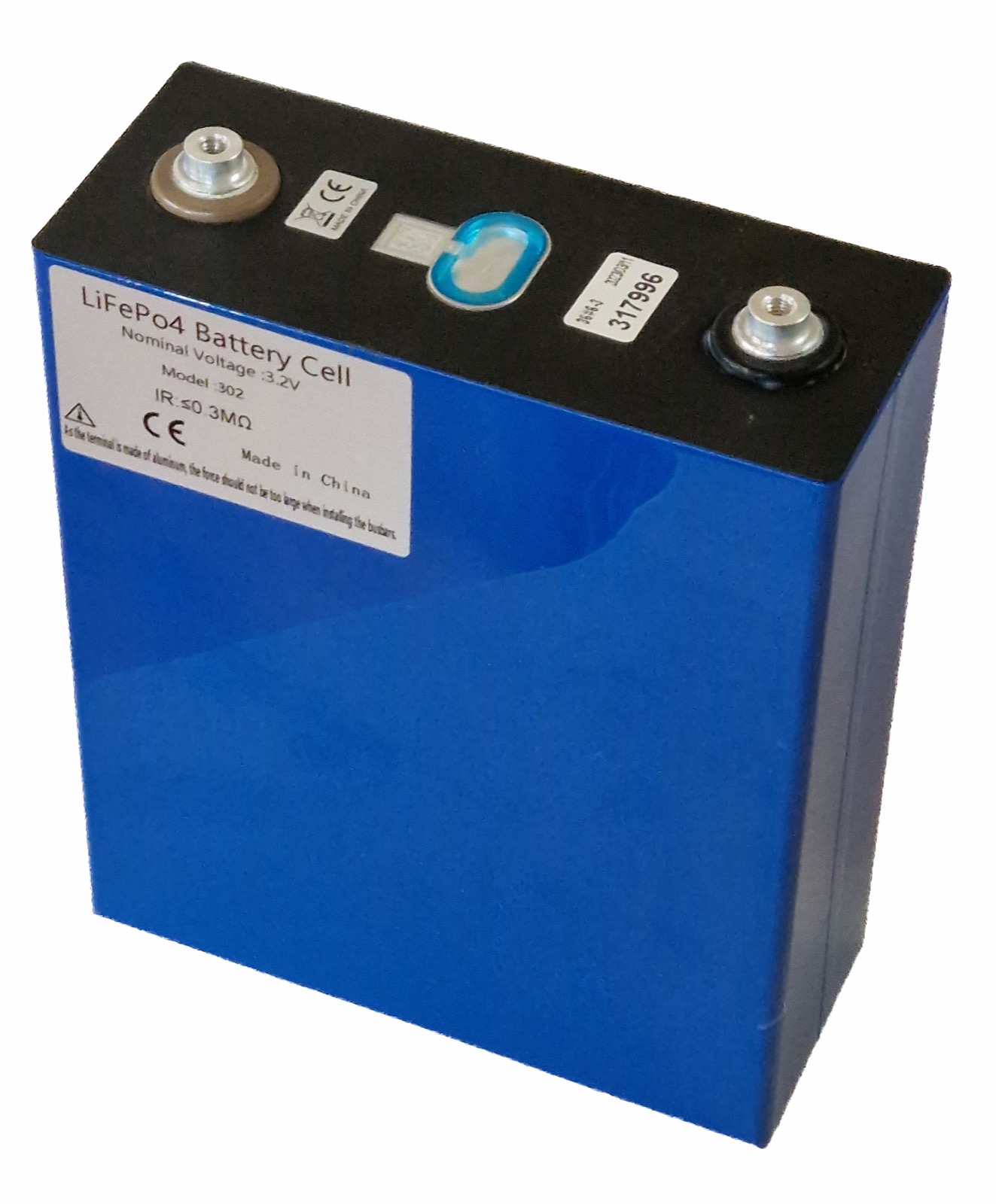 A typical competitor LFP prismatic cell — a CATL 302 Ah LiFePO₄ cell at 3.2 V nominal. The same cathode chemistry as BYD's blade, but a different cell, a different recipe, and a different manufacturing process. (Image: Wikimedia Commons, CC BY-SA 4.0, Aeroid)
LFP means the cathode active material is lithium iron phosphate. That is where the similarity ends. Inside a finished cell, the cathode is only one ingredient. The electrolyte salt, the solvent mix, the additive package, the separator coating, the binder, and the anode formulation are all proprietary recipes, and each maker tunes them for a different trade-off — energy density, low-temperature performance, cycle life, swelling, cost.
BYD's blade cell is engineered to be very thin and very long — roughly 13.5 mm thick and over 900 mm long. That shape, by itself, is a torture test for the electrolyte: a thin cell has less room for swelling, less margin for gas, and a worse surface-to-volume ratio. So the formula behind the blade is not a generic LFP recipe — it is a low-viscosity, swelling-tolerant, long-cycle recipe designed specifically to live inside that geometry. You will not find this recipe on a CATL or an EVE data sheet, because the cell shape forces a different chemical brief.
This is the first sense in which "BYD's LFP" is a different battery: the chemistry label is shared, the liquid inside it is not.
Stacking instead of winding
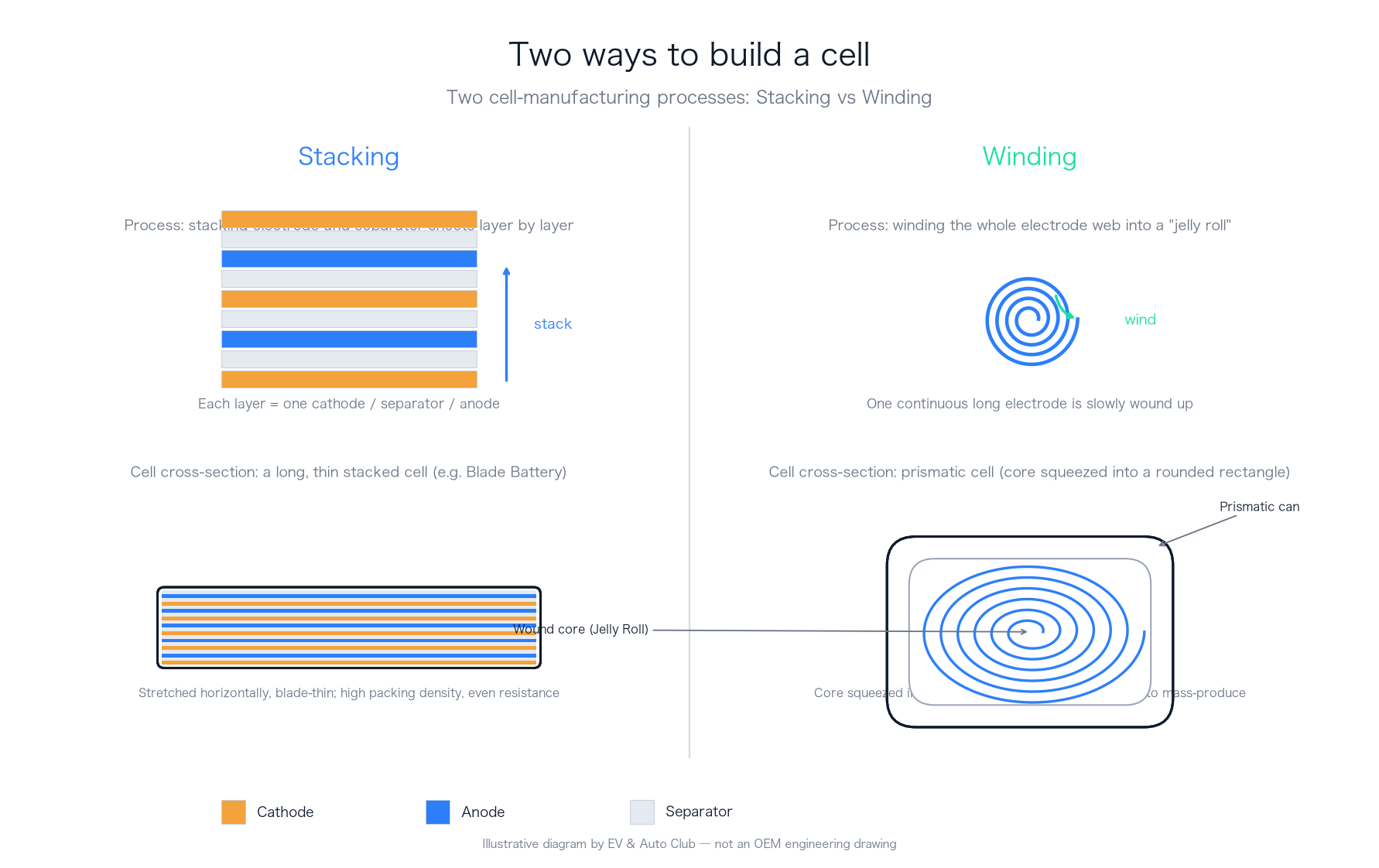 Schematic comparison of the two cell-manufacturing processes: stacking (left) builds a long, thin cell from stacked electrode sheets, while winding (right) rolls one continuous electrode web into a 'jelly roll' inside a prismatic can. (Diagram: EV & Auto Club)
For most of the LFP era, cells have been wound. Cathode, separator, and anode come off three rolls, are sandwiched together in a long jelly-roll, and are then either flattened into a pouch or stuffed into a rigid prismatic can. Winding is fast, and it is what most Chinese cell makers — including CATL, EVE, and Gotion — still do at scale for their LFP cells.
The blade cell is not wound. It is stacked.
A stacking machine lays individual electrode sheets on top of each other, layer by layer, with a separator between every one. Compared with a jelly-roll, this brings four concrete advantages:
- Consistency. Every layer sees the same pressure, the same current path, and the same reaction window. A wound cell is slightly tighter on the inside of the curve and slightly looser on the outside, which means cell-to-cell consistency is inherently worse.
- Cycle life. A wound cell develops stress at the bend of the jelly-roll as it charges and discharges, and that stress drives fatigue over thousands of cycles. A stacked cell has no bends. Blade cells are commonly rated for 3,000–4,000 full cycles, well above the typical 2,000 cycles of wound LFP cells of the same generation.
- Cell-level energy density. Because stacking removes the curvature dead zones, more active material can be packed into the same volume. BYD's official figure for the blade is around 180 Wh/kg at the cell level — competitive with wound NCM cells of the same generation.
- Thermal behaviour. A flat, uniform current distribution means heat is generated more evenly. There are no hot spots along the bend of a jelly-roll.
In short: same LFP, but the cell is built as a stack, not a roll — and the whole downstream design (consistency, life, energy density, and heat) follows from that single process choice.
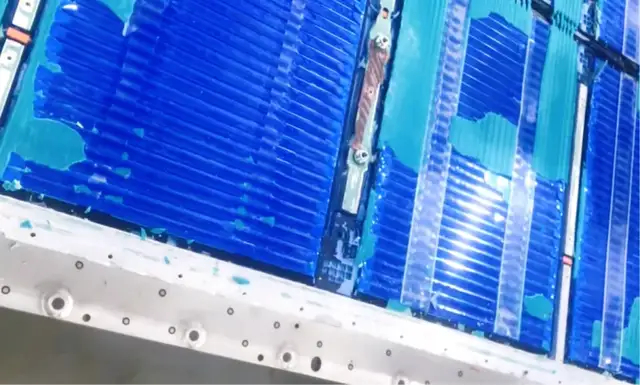 A disassembled BYD Blade battery pack showing the long, flat LFP cells stacked side by side inside the pack, with aluminium side plates and cell-to-cell busbars visible. (Image: via QQ Public / Tencent Auto teardown report)
No modules: cell-to-pack, and cell-to-body
A traditional EV pack is built in three layers: cells, then modules, then pack. A module is a metal box that holds a few cells in series and parallel; a pack is a bigger box that holds the modules. The structural metalwork, the wiring, the busbars, and the cooling manifold are stacked around the cells, and that stack — typically 40–50% of the pack volume — is not storing any energy.
BYD was the first car maker to commercialise cell-to-pack (CTP) at scale with the blade cell. There is no module. The long, flat blades are arranged directly inside the pack, with an aluminium housing and a composite top plate providing the structure. Volume utilisation climbs from the 40–50% range to around 60% or higher, which is a major reason the blade pack reaches the energy density of a wound NCM pack while staying with LFP chemistry.
Then BYD went one step further. On the e-platform 3.0 cars that began with the Seal in 2022, the pack is no longer a separate box that bolts into the floor — it is a structural member of the body. This is called cell-to-body (CTB): the top of the pack becomes part of the floor, the side rails of the pack are tied into the car's crash structure, and the whole pack helps the body resist bending. The result is a lower, flatter floor, more cabin space, better torsional rigidity, and a simpler, lighter manufacturing process.
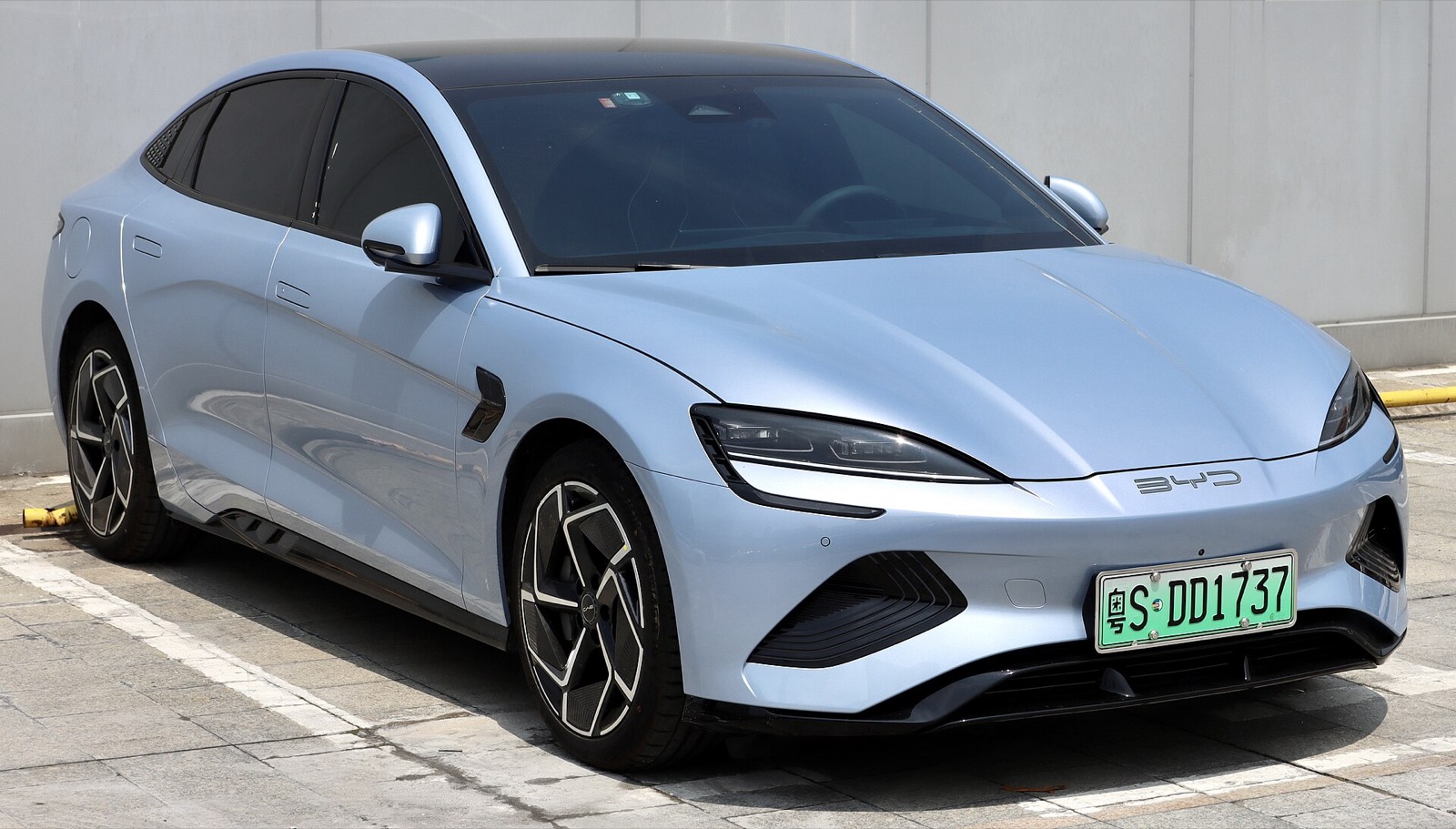 The 2022 BYD Seal — the first production car on BYD's e-platform 3.0 to use the cell-to-body (CTB) architecture, in which the blade battery pack is integrated into the floor as a load-bearing part of the body. (Image: Wikimedia Commons, CC BY-SA 4.0, User3204)
This is the second structural difference. Other LFP packs — including excellent ones from CATL's CTP 3.0 and the CATL Qilin pack — have largely caught up on CTP. Almost none of them have gone to CTB at scale, because going to CTB means co-designing the car body and the battery together. That is something only a maker that produces its own cells, its own pack, and its own car body in-house can do cheaply. Vertical integration is not a slogan here — it is the prerequisite for the architecture.
Thermal management: refrigerant direct cooling
The last, and possibly the most under-rated, difference is thermal. LFP is famously tolerant of high temperature and famously intolerant of temperature non-uniformity. A pack where some cells sit at 35 °C and others at 45 °C will degrade much faster than a pack where every cell sits at exactly 40 °C. The thermal management system, in other words, decides how long the battery will last.
Most LFP packs in the industry use one of two approaches:
- Air cooling. A fan blows cabin or ambient air across the cells. Cheap and simple, but coarse. Used in some entry-level micro-EVs and in early-generation packs.
- Liquid cooling (indirect). A water-glycol loop runs through a cold plate under or between the cells. The cold plate never touches refrigerant directly; instead, a chiller transfers heat between the coolant and the AC refrigerant in a separate heat exchanger. This is the mainstream approach for most modern EVs — Tesla, Volkswagen, Hyundai, and the majority of CATL-supplied packs all use some form of indirect liquid cooling.
BYD's blade pack does something different. Because BYD makes its own electric compressors, its own heat-pump system, and its own battery cooling plates, the company can short-circuit the secondary loop: refrigerant from the AC system evaporates directly inside the cooling plate under the cells. This is called refrigerant direct cooling (sometimes "冷媒直冷" in Chinese). There is no water-glycol intermediary on the battery side, no chiller, and no second pump. The system responds faster, weighs less, and removes more heat at high C-rate — exactly the regime where LFP fast-charging starts to struggle.
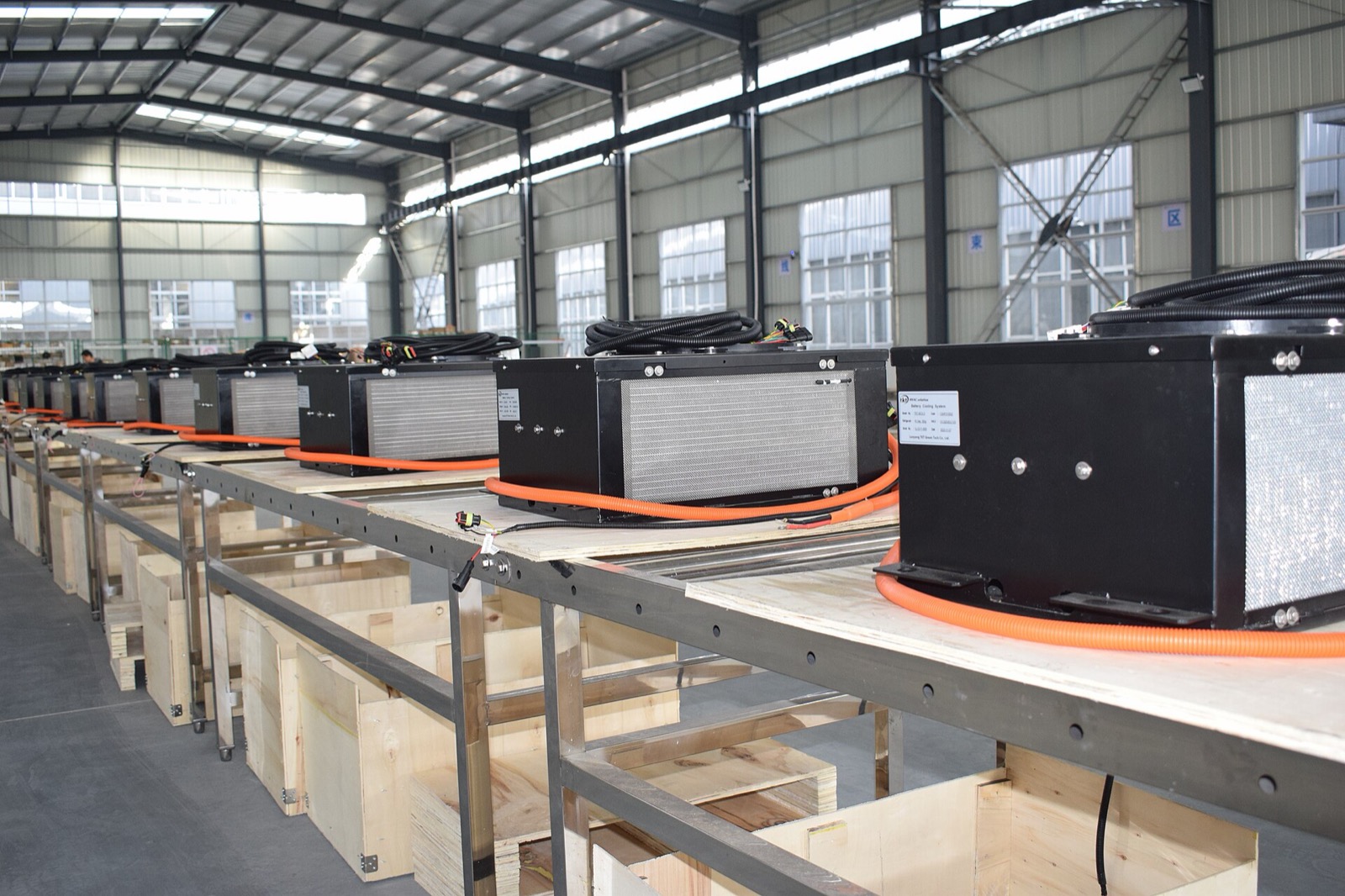 Battery thermal management hardware — a bank of integrated battery cooling units, the kind of subsystem that BYD designs and builds in-house, paired with its own compressors and heat pump, to enable refrigerant direct cooling on the blade pack. (Image: Wikimedia Commons, CC BY-SA 4.0, Tank.xing)
The same vertical integration that allows CTB also allows direct cooling: the compressor, the heat pump, the cooling plate, and the battery management software are all developed in the same engineering loop. The result is not just faster charging or better low-temperature performance, although it does both. It is a more uniform pack temperature, which — for an LFP cell that lives or dies on uniformity — directly translates into longer cycle life.
Conclusion
LFP is LFP at the cathode. Everything else — the electrolyte recipe, the manufacturing process, the pack architecture, and the thermal chain — is engineering, and engineering is where BYD has chosen to compete. Stacking rather than winding. Cell-to-pack, and then cell-to-body. Refrigerant direct cooling rather than air cooling or indirect liquid cooling. These are not the result of a better cathode, because the cathode is the same commodity. They are the result of a company that can design the cell, the pack, the cooling system, and the car body together, because it makes all of them in-house.
That is why two LFP batteries, sold next to each other on a spec sheet, can be very different products in the owner's driveway ten years later.
Back to all articles · View comments & share on the interactive page