BYD Racco: An Architecture Revolution in the Micro-EV Segment
BYD's Japan-only kei car shows what happens when a manufacturer stops stuffing the front bay and starts treating the battery pack as the chassis.
BYD launched the Racco (海獭, "sea otter") — its first car developed exclusively for a single overseas market — in Japan on July 28, 2026. The headline numbers are already well-covered elsewhere: JPY 2,145,000 to JPY 2,497,000 (~USD 14,200–16,500 / approx. RMB 88,800–103,300) in Japan, a 35.84 kWh Blade Battery with 320 km of WLTC range on the top variants, and a debut-week order book of about 5,000 units — more than BYD sold in the entire Japanese market across all of 2025. What most press coverage has skipped is the architectural story behind those numbers: the Racco debuts a packaging strategy, called X-PACK, that reorders how the components of an EV are physically distributed. In a segment where every millimeter counts, the architecture is the product.
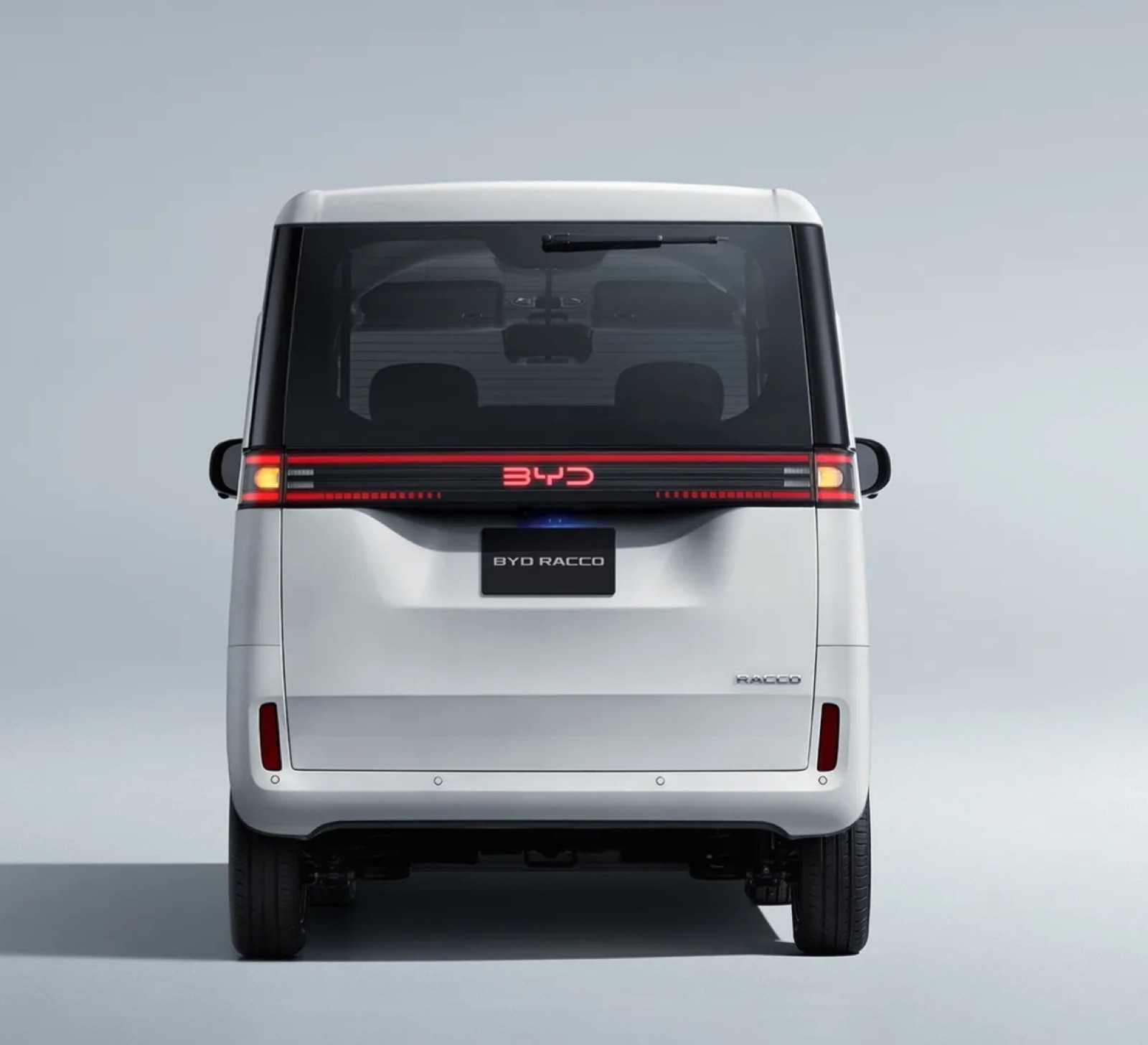 BYD Racco — the micro-EV whose architecture this article breaks down. (Image: EV & Auto Club)
The Micro-EV Safety Dilemma
The dominant direction in EV design over the last decade has been "additive integration" — three-in-one, six-in-one, eight-in-one drive units, all designed to save space by collapsing multiple components into shared housings. This logic served the compact and mid-size segments brilliantly. In a kei car, it runs into a wall.
By Japanese regulation, kei cars are capped at 3,400 mm long, 1,480 mm wide, and 2,000 mm tall. The Racco squares the limits at 3,395 × 1,475 × 1,800 mm — only 5 mm of length and width margin. Inside that envelope you must fit four seats, a battery pack large enough to be useful, an electric drive unit, a high-voltage electrical system, HVAC hardware, and a crumple zone. The fundamental physics haven't changed since internal combustion: the more hardware you concentrate in the front bay, the less room is left for the front structure to deform and dissipate crash energy.
For historical context, BYD's own F0 — a gasoline kei-class car sold in China years ago — earned just three stars in C-NCAP testing, with documented steering-column intrusion that cost it chest-protection points. Switching from petrol to electric solved the tailpipe problem but did nothing about the front bay geometry. The premium real estate in the front of a tiny car is crumple space, and the largest, heaviest components traditionally want to live there.
X-PACK: Moving Components Into the Battery
 A BYD Blade Battery (LFP) pack — the cell-to-pack architecture behind RACCO's X-PACK logic. (Image: Wikimedia Commons, public domain)
The Racco's answer is a structural concept BYD calls X-PACK. Instead of packing the front bay, BYD inverted the usual layout: the drive battery is the chassis, and the high-voltage electrical components all live inside that pack.
Concretely, X-PACK consolidates the following functional blocks into a single battery-pack assembly:
- Traction battery (22.4 or 35.84 kWh LFP Blade cells)
- ECU (electronic control unit)
- VCU (vehicle control unit)
- DC/DC converter
- OBC (on-board charger)
- PDU (power distribution unit)
- BMS (battery management system)
- PTC / HVAC controller
The motor and reduction gearbox still sit in the front bay — physically they have to, because the Racco is front-drive — but everything else that used to occupy that bay has migrated rearward into the pack. Coupled with Cell-to-Body (CTB) construction, where the battery pack itself acts as the floor structure, BYD claims X-PACK frees up approximately 128 mm of additional front-cabin length for crash-energy absorption compared with a conventional EV layout of similar specification. Internally, BYD says the crumple zone grew by 39% and pedestrian head-impact loads dropped by 35% relative to a comparable gasoline kei configuration. The body uses about 70% high-strength steel panels joined with laser welding rather than spot welds at the roof-to-side seams — a fairly aggressive body-in-white spec for a kei.
It is worth saying out loud: this is not a trivial packaging exercise. Integrating the PDU, BMS, and HVAC controller inside a lithium-ion pack creates a long list of problems that have to be solved at once.
Why It Was Hard To Build
Thermal management. A battery pack is already a sensitive thermal environment — it needs precise temperature control to deliver cycle life and usable range. Adding heat-generating power electronics inside the same enclosure is an entirely different thermal problem. The Racco uses BYD's full-domain thermal management system to keep cells, PDU, and HVAC components within their respective operating windows under all ambient conditions, including the cold-soak low-voltage-charging scenarios Japanese winters create.
Serviceability. Higher integration means longer mean time to repair. A fault in a discrete PDU used to be a swap-out of an obvious box. When that PDU is inside the pack, diagnostics have to be smarter and workflows have to change. BYD's argument — and the industry's — is that integration also takes whole-system failure modes off the table, so the trade-off leans positive.
Electromagnetic compatibility. High-voltage switching power electronics running literally centimeters from sensitive analog signal lines require serious shielding and isolation work. This is the kind of issue you don't notice when it's done right, and you notice immediately when it isn't.
The reason BYD can pull all three off is the same reason X-PACK exists in the first place: vertical integration. BYD makes its own Blade cells, its own motor-and-reduction assemblies (it produces 8-in-1 electric drive units for its larger cars), its own BMS electronics, and increasingly its own silicon. When a company controls every link in the powertrain chain, it can rehearse this kind of architectural pivot in a single internal engineering review, rather than waiting for half a dozen Tier 1 suppliers to align on interface specs. Most kei manufacturers — including the incumbents that have built engines and CVTs for decades — do not have this option. The Racco is, in this sense, an architectural argument about industrial structure as much as it is about safety.
The Market Is Voting Already
The numbers, three months in, are hard to ignore. In the first seven days of pre-orders, the Racco took about 5,000 confirmed deposits, completing roughly half of BYD's full-year Japan sales target of 10,000 units — and exceeding BYD's 2025 Japanese deliveries of 3,731 across all models. For comparison, the Nissan Sakura, the dominant battery-electric kei before the Racco arrived, opened with roughly 3,000 orders in its first month and now sells around 600 a month in steady state.
The product brief that lands on the price/equipment matrix is sharp:
| Vehicle | Battery | WLTC range | Starting price (Japan) | Starting price (USD) |
|---|---|---|---|---|
| BYD Racco 200 (entry) | 22.4 kWh LFP Blade | 210 km | JPY 2,145,000 | ~USD 14,200 |
| BYD Racco 300 Plus / Premium | 35.84 kWh LFP Blade | 320 km | JPY 2,398,000 / 2,497,000 | ~USD 15,900 / 16,500 |
| Nissan Sakura (reference) | 20 kWh | 180 km | JPY 2,333,000 | ~USD 15,400 |
The Racco 200 undercuts the Sakura by about JPY 190,000 (USD ~1,250) while delivering 30 km more range. The top-trim Racco out-ranges the Sakura top trim by 140 km and costs roughly JPY 440,000 less. On top of that, the Racco brings equipment no Japanese kei has offered together before: dual power sliding doors, V2L (vehicle-to-load, 100 V AC output) and V2H (vehicle-to-home) for disaster-preparedness — meaningful in a country with frequent typhoons and earthquakes — across all trims. Even after the JPY 150,000 national CEV subsidy, the price gap remains.
And in a small-correction to the standard "China copies Japan, now Japan copies China" narrative: Forward Engineering Japan, a well-known Japanese automotive engineering consultancy, has launched a public Racco teardown program. The scope covers body structure, custom Blade battery pack, integrated e-Axle, materials and joining, manufacturing methods, and cost model. This is the same consultancy that tore down the BYD Atto 3, Seal, and Sealion 7 before. Twenty years ago, Chinese OEMs were disassembling Japanese cars in basements to learn. Now Japanese engineering firms are publishing structured teardown reports on Chinese kei EVs because the design space has flipped.
A Different Definition of "Integration"
The dominant conversation in EV engineering circles is how many components can be integrated. The Racco reframes the question. Three-in-one and eight-in-one drive units are designed for the mainstream EV segments where chassis length isn't the binding constraint. In a 3,395 mm kei car, the binding constraint is the chassis length, and the answer isn't more integration in the front — it's less material in the front, and more of it absorbed into the structural battery pack.
That doesn't make X-PACK universally applicable. A car with 2,900–3,100 mm wheelbase and 4,700–5,000 mm length has plenty of front-bay real estate to spare, and the cost of integration has to be justified on efficiency grounds instead. The Racco is specifically a kei-class answer to a kei-class constraint. But it shows what happens when a manufacturer tries to design from the safety outcome backward rather than from the component list forward.
The Japanese microcar incumbents — Suzuki, Daihatsu, Honda — now have to respond. Suzuki's chairman has already publicly described the Racco as a significant threat. The architectural play here isn't just "BYD makes a cheaper kei." It's that BYD now has a chassis architecture the incumbents cannot build without either developing a comparable in-house battery-pack supply chain or contracting out what has historically been their deepest competence. Either path is expensive and slow.
The boring answer to "why is the Racco interesting" is the price. The interesting answer is that it took a kei car to demonstrate that the next architectural frontier in EVs may not be more cells or more motors — it may be fewer components in the front bay.
Sources: BYD Auto Japan press information, July 2026; CarNewsChina teardown imagery (BYD official press images); Electrive / CarNewsChina coverage of the 2025 Japan Mobility Show debut; Forward Engineering Japan teardown program announcement (Aug 2026); Nissan Japan Sakura product page (reference pricing and spec). Cover image: BYD official press image, via CarNewsChina.
Back to all articles · View comments & share on the interactive page