BYD Owners: Stop Adjusting Kinetic Energy Recovery — the Brake Pedal Is the Real Switch
Applies to: BYD passenger EVs and PHEVs with the BSC brake-by-wire system (Dolphin, Seal, Atto 3/Yuan Plus, Song Plus, Tang, Han, Qin and newer models).
If you have just bought your first BYD — especially if you are switching from a Tesla or another car with strong lift-pedal regen — you have probably already asked: "Which kinetic-energy-recovery setting should I use? Should I turn it up to save electricity like Tesla owners do?"
The answer is simple: do not worry about it. In a BYD, you drive like you would a gasoline car — and you use the brake pedal.
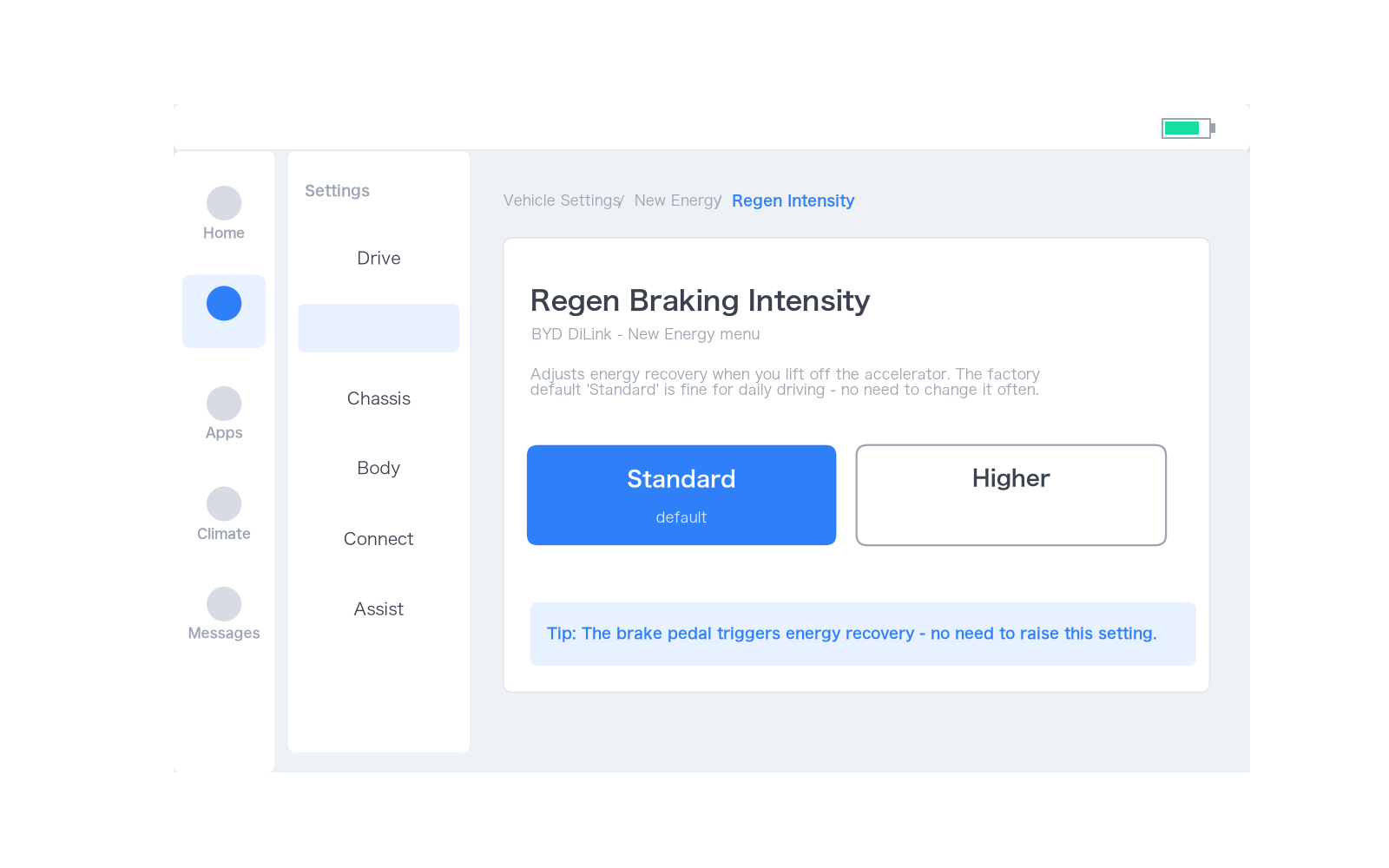 A stylized representation of the BYD DiLink menu path: Vehicle Settings → New Energy → Regen Braking Intensity. Default "Standard" is all most owners need.
Where the confusion comes from
The misunderstanding is mostly Tesla's fault.
Tesla's early and current "one-pedal" logic ties strong deceleration to the accelerator pedal: lift off, and the car slows down hard while regenerating. If owners want stronger energy recovery, they set regenerative braking to "Standard" or "Hold." Lift-pedal deceleration can reach around 0.3 g — enough that many drivers rarely touch the brake pedal in normal traffic, although the pedal is still needed in an emergency.
This design is now under regulatory scrutiny. In 2024 China's Ministry of Industry and Information Technology (MIIT) issued a draft revision of Passenger Car Braking System Technical Requirements and Test Methods that proposes, in the default driving state, a vehicle should not be able to slow to a complete stop just by lifting the accelerator. The goal is to keep the brake pedal firmly in the driver's mental model as the real stopping control.
Because of this, many EV owners have internalized a false equation: "kinetic energy recovery = lift-pedal deceleration, so turning it up saves electricity." That assumption is true for some cars — but it is not how BYD works.
BYD's logic is completely different
BYD takes a different route, centered on its in-house BSC (Brake Safety Control) brake-by-wire system.
The idea is straightforward: recover energy with the electric motor first, and add hydraulic friction braking only when the motor cannot provide enough deceleration. The key is that the split between electric and mechanical braking is handled automatically by the system. It does not depend on how hard you press the pedal, and it does not depend on whether you have selected "Standard" or "Higher" in the energy-recovery menu.
BSC development started in 2014, and the production-ready BSC 2.0 system reached the market in June 2021 on the Dolphin, the first model built on BYD's e-Platform 3.0. The "OneBox" package replaces the conventional electronic-vacuum-pump brake setup with a single integrated unit measuring roughly 180 × 200 × 230 mm and weighing about 6.5 kg. A 600 W motor spins at up to 9,000 r/min and can build maximum braking pressure in about 140 ms — more than four times faster than a traditional fuel-car booster and enough to cut 100 km/h-to-stop distance by roughly 3–5 m.
When you press the brake pedal, the BSC system first asks the drive motor to slow the car and recover energy. At the same time it calculates the total braking force requested from pedal travel and vehicle speed. If the motor alone cannot deliver enough deceleration, hydraulic calipers blend in seamlessly. The driver just feels linear, conventional brake-pedal travel.
Crucially, lifting the accelerator and coasting does not trigger strong regen in a BYD. The recovery signal comes from brake-pedal displacement, not from the accelerator-pedal release. So there is no need to "turn regen up" to save electricity — pressing the brake pedal is already the most efficient way to recover energy.
Why you really can leave the setting alone
Beyond the automatic electric-hydraulic blending, BYD has a few other regen tricks that make the setting almost irrelevant:
No wasted energy when the battery is full or cold. In some systems, when the battery cannot accept high charge power, regen is simply lost as heat in the brake discs. BYD's 2026 patent proposes a different approach: surplus recovery electricity is diverted to accessories such as the air-conditioning compressor, the PTC heater, audio and lighting. Those loads act like a "sponge" that absorbs the excess instead of wasting it.
No need to toggle strength. Because recovery authority sits on the brake pedal, the "Standard / Higher" menu is not something you need to optimize every morning. For normal urban commuting, pressing the brake normally is the optimal choice. Contrast that with Tesla-style interfaces where drivers choose "Low / Standard" on a screen, or use steering-wheel paddles to switch between D0 / D1 / D2.
Easier on passengers. Strong lift-pedal regen can make occupants carsick. BYD's default "Standard" mode balances efficiency and comfort: the car coasts naturally when you lift off, and it only decelerates when you intentionally press the brake. The tolerance for driver error is higher, which matters for family cars.
Bottom line
One sentence: drive your BYD like a gasoline car — use the brake pedal, and forget the energy-recovery setting.
That is not a compromise or a missing feature. It is the opposite. BYD moved energy recovery from "something the driver has to learn and adjust" to "something the system handles automatically." No menu diving, no one-pedal adaptation, no decision fatigue — get in, drive, and press the brake when you want to slow down. The car does the energy recovery for you.
Sources: MIIT draft GB 21670 Passenger Car Braking System Technical Requirements and Test Methods (2024); chebrake.com / Fudi Power BSC 2.0 technical briefing (2021); Sina Auto / Toutiao BYD DiLink regen-setting guides (Vehicle Settings → New Energy → Energy Recovery Intensity); BYD 2026 accessory-load energy-absorption patent disclosure.
Back to all articles · View comments & share on the interactive page