ZYT's One Brain for Cars, Trucks and Robots Lands in 2027
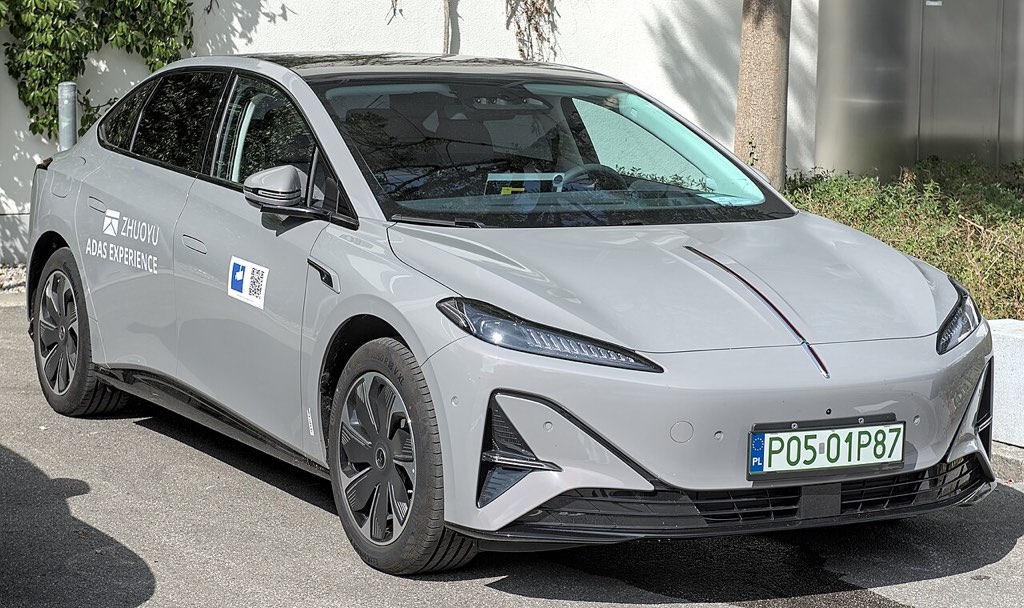
A grey Hongqi Tiangong 05 with Polish plates and a ZHUOYU ADAS EXPERIENCE decal on its door is the least abstract proof of ZYT's central bet: that one model can drive a sedan, a 40-tonne truck and, eventually, a robot. That model reaches paying cars in the first quarter of 2027 — not this year, as the company said in April.
The bet in one sentence
ZYT is not taking a driver-assist stack and trimming it for robots. It is arguing that a car and a robot face the same underlying problem — build a usable model of three-dimensional space, predict what happens next, pick an action — and that a single foundation model trained on that problem beats two specialist models trained separately.
The money question for anyone shopping for a car is not philosophical. If one model really serves sedans, trucks, buses and robots, the software cost per vehicle falls and the features get cheaper. If it does not, the buyer is amortising a research programme across passenger cars alone. Everything else in this article is downstream of that.
ZYT's CEO Shen Shaojie put the survival version of it at the China EV100 high-level forum on 11 April 2026: "Intelligent driving is only the initial form of physical AI, never the end state. Every driving company that survives will become a mobile physical AI company."
From DJI's car unit to a mobility AI company
The lineage matters because it explains the cost culture. ZYT started as DJI's automotive division, was spun out as an independent company in 2023, and took the ZYT brand name in June 2024. Its reputation was built on squeezing urban navigation assist out of mid-range compute — the pitch that a car at roughly 150,000 yuan could have city-wide point-to-point driving without high-definition maps or lidar. Customers have included SAIC-GM-Wuling's Baojun line, Chery, Volkswagen's Chinese joint ventures, FAW and Dongfeng.
The ownership has changed in ways most coverage has not caught up with. BYD took a 3.95% stake in December 2024. In November 2025, FAW Group became a strategic shareholder at 35.8%, with the original holder NewTerritory dropping from 70.65% to 34.85%, leaving the two in joint control. A state-owned OEM now co-owns the supplier that other OEMs are being asked to buy from — a governance fact worth remembering when we get to the risks.
The strategy arrived in two steps. Late in 2025 came the "mobile intelligence base" concept; on 24 April 2026, at the Beijing auto show, ZYT published its first native multimodal foundation model alongside a strategy it calls "intelligence for all mobility", plus a deep partnership with FAW covering Hongqi's Shenan assist system, the Tiangong 05 and 06, and the Tiangong S concept, which uses the new architecture with L3/L4 hardware.
By the 29 October 2026 commercial-vehicle launch, the passenger-car numbers were: 22 customers, more than 60 models in production, more than 110 nominated, and new customers including Toyota and Hyundai.
What "native" actually buys you
ZYT describes three generations, and the scoring is its own, which we will come back to.
In the first, rules plus high-definition maps plus small perception models gave a general capability ZYT rates at about 40 out of 100, which heavy regional customisation could push to 80 — at the cost of rebuilding the map and the rules for every new city. That "open a new city" treadmill is the whole history of Chinese urban navigation assist in one sentence. In the second, end-to-end models lifted the starting point to roughly 70, with light rule-based patching to 90; ZYT's 4.0 generation sits here, with model sizes in the tens of millions to low hundreds of millions of parameters. This is the same generational shift that turned Horizon Robotics from a chip supplier into a one-stage end-to-end stack vendor.
The third generation is the native multimodal model, and "native" carries four specific technical claims.
First, unified representation: video, text, action, voice and map inputs are encoded in one framework rather than five encoders bolted together. Second, generalisation happens during pre-training rather than after it — ZYT's argument is that post-training, distillation and deployment are engineering, and the ceiling is set in pre-training. Third, the data mix is not just driving: it includes internet video and first-person logs from mobile robots, plus traffic rules and driving habits across countries. Fourth, and this is the distinction ZYT leans on hardest, it is not a VLA in the usual sense. A vision-language-action model translates sensor input into language tokens and then into actions, and that explicit translation step costs latency and loses information. Training every modality inside one framework, ZYT says, removes the seam.
So on the road, what does that mean? Not "smarter" in a way you would notice on your commute tomorrow. It means portability: an end-to-end model meeting a different right-of-way culture has to be largely retrained, which is exactly why Chinese driver-assist exports have moved slowly. A model that learned following distance and right-of-way as general physical relationships is supposed to need activation rather than retraining. ZYT's stated target is Zero Shot — knowledge transfer with no new data — and its own targets for that are "works out of the box across vehicle classes", "little to no re-generalisation abroad" and "one model for paved road, unpaved road, indoor and outdoor".
The 70-to-95 claim, and what it is worth
ZYT says the end-to-end generation starts at 70 and the native model starts at 95 out of the box. Here is what that number is and is not.
It is an internal score on a scale the company defined itself, with no published test set and no third-party replication. It is not comparable across suppliers — a 95 from ZYT and a 95 from another vendor measure nothing in common. Treat the 70 and the 95 as an internal before-and-after, not a market ranking.
There is one externally checkable data point: ZYT ran media test rides in the native model at the Beijing show, in a car built on Nvidia's Thor platform with an 11-camera setup and its own Jimu 2.0 in-cabin lidar-vision sensor. A test ride with a company driver is not your commute, but it is at least not a slide.
A second figure circulates in Chinese trade coverage — a claim of more than 40% higher pass rate on long-tail scenarios than the previous end-to-end generation, attributed to ZYT's internal testing. We could not verify it independently, and it is the kind of number that should be re-measured after delivery, not before.
The honest test of any of this is takeover rate on the same roads six months after customers have the software. That has not happened yet.
The academic evidence, stripped of hype
Two open papers published in the same window make the shared-base argument concrete, and their numbers are more useful than the strategy language.
ACE-Brain-0 (arXiv 2603.03198, March 2026) comes from Daxiao Robotics — a Shanghai company chaired by SenseTime co-founder Wang Xiaogang — with Shanghai Jiao Tong University, Nanyang Technological University and the Chinese University of Hong Kong. It is an 8B-parameter multimodal model trained on a 1.5 billion-token corpus that unifies four domains, not three: spatial cognition, autonomous driving, low-altitude drone sensing, and robot manipulation. It takes state-of-the-art among embodied models on 19 of 24 benchmarks, scoring 92.0% on the SAT spatial test, 82.1% on MindCube, 91.7% on NuPlanQA for driving planning, and 64.6% on RoboVQA for long-horizon robotic reasoning.
The ablation is the interesting part. Initialising each domain specialist from spatial-pretrained weights improved results by 19.3% on autonomous driving, 16.5% on drone tasks and 5.4% on manipulation. Spatial-centric initialisation gave a 25.6% gain over standard instruction tuning.
MiMo-Embodied (arXiv 2511.16518) is Xiaomi's version, open-sourced on 21 November 2025 under MIT: a 7B vision-language model covering 17 embodied benchmarks — task planning, affordance prediction, spatial understanding — and 12 driving benchmarks covering perception, state prediction and planning. Xiaomi's conclusion is that the two domains transfer positively and reinforce each other. The project lead is Chen Long, Xiaomi's chief scientist for intelligent driving, which tells you this is a car programme as much as a robotics one.
Now the boundary, because these papers are honest about it. Both are 7B–8B models that output reasoning and plans as text. Neither outputs a steering angle or a joint torque. What they demonstrate is that the understanding layer can be shared. What a car company needs is the control layer. That step is not in these papers.
Where sharing stops
The strongest evidence that sharing is not free comes from ACE-Brain-0's own training experiments. Straight joint training across domains produced gradient interference — driving and manipulation competing for the same parameters, diluting both. Straight sequential training produced catastrophic forgetting, where learning the new domain degraded the old one. That is why the paper needs a three-stage scheme: build a spatial scaffold, train separate specialists, then merge them without the original data and refine with reinforcement learning.
Read that as a warning label. A model that genuinely transfers across embodiments is not what you get by pointing one training run at mixed data. It requires architecture designed for the split. ZYT's "one brain, two bodies" line is a claim about having solved that, not a description of default behaviour.
There is a second boundary, and it is physical. Vehicle dynamics — tyre grip, steering geometry, braking distance that changes with load — and robot joint control are not the same problem. Shen's own framing accepts this: unified foundation, scenario-specific augmentation, engineering adaptation. What is shared is world understanding and task reasoning. What stays local is execution.
Pansing: the same brain on a 40-tonne truck
On 29 October 2026 in Zhuhai, ZYT launched Pansing, the commercial-vehicle counterpart to its Chengxing passenger-car line. Shen's line was that the same brain now grows in two different bodies.
It ships in two tiers, and the split is the clearest public statement of the strategy. PDS 4 maps to the 4.0-and-later high-comprehension model, does highway navigation assist, and is aimed at long-haul heavy trucks; it is already in production on multiple brands. PDS 5 maps to the native multimodal foundation model, adds urban navigation assist, and targets buses, light trucks and vans. A Yutong Yuwei E9 PRO city bus on Nvidia Thor hardware will carry PDS 5.
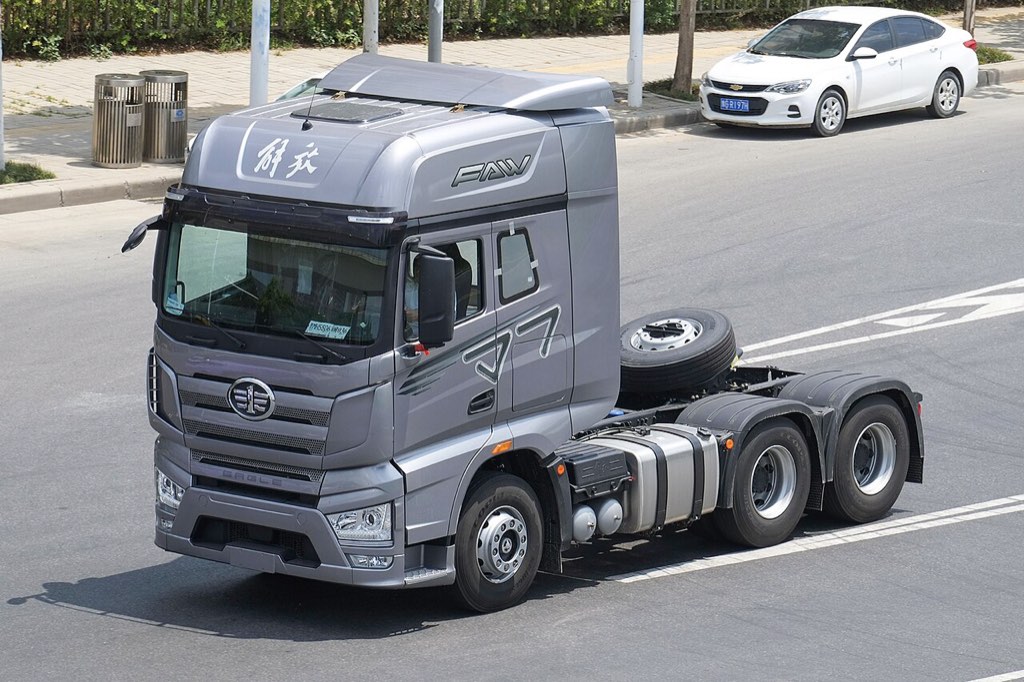
The customer roster covers six of China's top heavy-truck makers — XCMG, Shacman, Sinotruk, FAW Jiefang, Foton and Dongfeng Commercial Vehicle — which together hold more than 93% of the domestic heavy-truck market. A Shacman Delong X5000 is already in production and running parcel trunk routes.
This is the best test bed ZYT has, and the reason is accounting rather than technology. A heavy truck is a production tool, so the buyer can put the claim on a purchase order: ZYT's figure is 20,000 to 30,000 yuan of fuel saved per vehicle per year from its reinforcement-learning fuel-saving algorithm, before counting driver-productivity gains and lower accident-driven insurance premiums. Its launch pitch is a one-year payback. A fleet owner running 150,000 km a year can check that arithmetic against his own fuel logs.
A private car buyer cannot check "95 out of 100" against anything. That asymmetry is why the truck line matters to the car line: if the commercial business validates the model and spreads its cost, passenger features get cheaper. If it does not, the cost comes back to the car.
If you are shopping for a car with this inside
Five things worth knowing before a salesperson uses the phrase "foundation model".
You cannot buy it yet. The native multimodal model is scheduled for production in Q1 2027. What you can buy in 2026 is the end-to-end generation: 4.0 rolled out by over-the-air update from April 2026 on Qualcomm 8650 and 8775 platforms, 4.1 is already on multiple models, and 4.2 arrives in the fourth quarter of 2026. Cars on TI's TDA4-VH mid-to-low compute platform move to the 3.0 system, which ZYT itself describes as 80% end-to-end.
Do not pay a premium for a future upgrade you have not verified. The demos ran on Thor with 11 cameras and the Jimo 2.0 sensor. Whether a car on an 8650 platform can be upgraded to the native model depends on compute headroom and the sensor list, and nobody in a showroom will compute that for you. Ask for the current domain controller's TOPS rating and the exact sensor count, in writing.
"100% end-to-end" is not a capability grade. It is ZYT's description of how much of the driving decision comes from the learned model rather than hand-written rules. Two cars both sold as end-to-end can behave very differently depending on sensors and compute.
ZYT is skipping L3 on purpose. Shen's argument is that L3's liability boundary is too vague, and that one foundation model can serve L2 and L4 states with sensor redundancy and remote fallback. Practical consequence: if you are waiting for an "L3 car" label, this route will not carry it. ZYT has published an L3 architecture and is pursuing pilot licences in several cities, with meaningful progress expected in the first half of 2027.
Regional differences are the point of the whole exercise. If Zero Shot works, the first beneficiaries are markets outside China, where the expensive part of driver assist has never been the hardware but the retraining forced by different right-of-way conventions. Europe is the test: a car on Polish plates carrying that decal is evidence of a European programme, but it is a test fleet, not a configuration in a European showroom. For Japanese buyers the variable is different again — narrow urban roads and pedestrian priority patterns that a Chinese-trained model has seen rarely.
The risks that decide this
Nobody has published the training bill. Shen says foundation-model training is expensive and that the only way to a healthy cost cycle is cross-scenario reuse with multi-domain data feeding back. He does not put a number on it. Comparable public commitments set the scale: Xpeng raised its 2026 physical-AI research budget to 7 billion yuan; Qingzhou Zhihang put a $100 million Series D into world models plus reinforcement learning; Li Auto showed MindVLA-o1 at GTC 2026; Geely published its WAM world-action model. This is a contest in which every participant burns cash, and ZYT's production base is concentrated in mid- and low-priced passenger cars.
The date has already slipped once. In April the model was to be pushed to passenger cars and heavy trucks within the year. By October it was Q1 2027 for passenger cars. Slipping is not fatal, but it is a measurement: the engineering complexity of multi-class deployment was underestimated by roughly two quarters.
The transfer gain shrinks as you move away from driving. This is where the academic numbers are more useful than any strategy deck. ACE-Brain-0's ablation gains were 19.3% for driving, 16.5% for drones and 5.4% for manipulation. Driving and drones are both the same task the model was built around — moving through space and predicting motion. Manipulation is not. A 5.4% gain is real, and it is also a fifth of what driving got. Anyone extrapolating from "cars and robots share a brain" to "cars make robots easy" should sit with that ordering.
No in-house silicon. Shen has said explicitly that ZYT does not develop its own chips and focuses on the solution and the ecosystem. That sits alongside the integrated-hardware pitch, which covers domain controllers from 200 to 1,400 TOPS and in-house lidar, but not the SoC. The upside is not betting on a process node. The downside is that compute cost and supply timing sit with Nvidia and Qualcomm.
The ownership question. FAW holding 35.8% in joint control with NewTerritory brings order stability and a very large captive customer. It also raises a neutral-supplier question that rival OEMs will ask privately: do you want your driver assist roadmap co-owned by a competitor?
FAQ
Is the native multimodal model in any car I can buy today? No. It is scheduled for Q1 2027. Cars sold now run the end-to-end generation, at 4.0, 4.1 or 4.2 depending on model and platform.
Does "one model for cars and robots" mean my car will gain robot features? No. The shared part is the understanding layer. Your car's behaviour comes from the control layer, which stays vehicle-specific.
Should I wait for a 2027 model instead of buying now? Only if driver assist is your main reason for buying. The 2026 end-to-end cars do highway and urban navigation assist today; the 2027 generation's advantage is portability across regions and vehicle types, which shows up more in new markets than in your daily route.
Can my current car be upgraded over the air? Ask specifically which platform it is on. Qualcomm 8650 and 8775 cars get 4.0 and up; TI TDA4-VH cars get 3.0. The native model's hardware floor is higher — the demos used Thor with 11 cameras — and no supplier has published a retrofit path.
Does any of this affect my insurance or resale value? Not directly today. It becomes relevant if L4 systems with published safety records start shifting premium calculations, which is a 2027-onwards question, and if software generation becomes something used-car buyers can verify.
China Angle
The notable thing here is not that a Chinese supplier has a foundation model. It is that a Chinese supplier is selling the model as the product and the vehicle categories as deployment targets — the reverse of the usual arrangement where a tier-one sells a function per platform.
Three routes now coexist in China. ZYT runs model plus domain controller plus its own manufacturing, with no in-house SoC. Horizon Robotics runs chip plus its own HSD stack, and is now inside BYD's God's Eye B tier — the two are competing for the same OEM programmes from opposite ends of the stack. Huawei sells the whole vertical. All three are arguing that scale in model training, not feature count, decides who survives.
The embodied side is denser in China than the strategy talk suggests. ACE-Brain-0 came out of a Shanghai robotics company working with three universities; MiMo-Embodied came out of Xiaomi's car division. Both appeared between November 2025 and March 2026. Cross-embodiment foundation models here are company programmes with shipping hardware attached, not conference papers.
For buyers outside China the practical consequence runs both ways. If the cost-per-vehicle argument holds, the same driver-assist capability should keep arriving on Chinese cars at a price European and Japanese buyers cannot match. If Zero Shot holds, Chinese cars entering Europe should need less localisation time than the current two-to-three-year pattern — which is the difference between a model being available in a new market at launch or two years later.
Sources
- Shen Shaojie's remarks at the China EV100 high-level forum, 11 April 2026, including the "initial form of physical AI" quote, 50+ models in production, 22 customers and the decision to skip L3 — China Securities Journal, https://www.cs.com.cn/ssgs/01/2026/04/12/detail_2026041210003271.html
- First systematic explanation of the native multimodal foundation model, Zero Shot target and the three-generation scoring — Science and Technology Daily, 13 April 2026, https://www.stdaily.com/web/gdxw/2026-04/13/content_501373.html
- Three-stage history (small model 40 points, end-to-end 70, native model 95) and the VLA comparison — China Economic Times, https://www.cet.com.cn/wzsy/szjj/10336005.shtml
- Beijing auto show launch on 24 April 2026, unified multimodal representation, pre-training-era generalisation, Thor test rides with 11V and Jimo 2.0, Hongqi Tiangong S concept, 34 customers and 130+ models — https://www.chinatopbrands.net/s/1450-5694-59903.html and https://inabr.com/news/22665
- Claim of 40%+ higher long-tail pass rate, attributed to ZYT internal testing — China Automotive News, 27 April 2026, https://www.cnautonews.net/index.php?s=/Index/artical/aid/15055/
- Pansing launch on 29 October 2026, PDS 4 and PDS 5 tiers, top-six truck makers holding 93%+ share, Yutong E9 PRO, Shacman X5000 in production — Science and Technology Daily, 31 October 2026, https://www.stdaily.com/web/gdxw/2026-10/31/content_606062.html
- Passenger-car figures as of October (22 customers, 60+ models, 110+ nominated, Toyota and Hyundai, 4.1 in market, 4.2 in Q4, native model Q1 2027, L3 pilot licences in H1 2027) — Shanghai Securities News, https://www.cnstock.com/commonDetail/820341
- Fuel saving of 20,000–30,000 yuan per truck per year and the one-year payback pitch — China Economic Net, 30 October 2026, http://m.ce.cn/qc/qyw/202610/t20261030_3276992.shtml
- Changzhou plant and the 200–1,400 TOPS domain controller range — Xinhua, 25 July 2026, https://app.xinhuanet.com/news/article.html?articleId=202607251d4bb377a6a54683b79473b2cdcac756
- ACE-Brain-0, SSR paradigm, ablation gains of 19.3% / 16.5% / 5.4% and the 25.6% spatial-initialisation gain — arXiv 2603.03198, https://arxiv.org/abs/2603.03198
- MiMo-Embodied technical report, 17 embodied plus 12 driving benchmarks, MIT licence — arXiv 2511.16518, https://arxiv.org/abs/2511.16518
- ZYT's own-chip position and the "not a price war" framing — China Securities Journal, 12 April 2026 (link above)
- Xpeng's 7 billion yuan physical-AI budget for 2026 and peer commitments from Qingzhou Zhihang, Li Auto and Geely — CNR, 22 April 2026, https://www.cnr.cn/2013qcpd/2015xc/20260422/t20260422_527594709.shtml
- Spin-out from DJI in 2023, ZYT brand from June 2024, BYD's 3.95% stake, FAW at 35.8% in joint control with NewTerritory — China Securities Journal via Toutiao, https://www.toutiao.com/article/7447178508603769395 and China Quality News, https://www.cqn.com.cn/auto/content/2025-11/24/content_9132954.htm
Image credits
- Hongqi Tiangong 05 with ZHUOYU ADAS EXPERIENCE decal, IAA 2025 — Alexander-93, Wikimedia Commons, CC BY-SA 4.0
- Baojun Yunhai — JustAnotherCarDesigner, Wikimedia Commons, CC0
- FAW Jiefang J7 tractor unit — Windmemories, Wikimedia Commons, CC BY-SA 4.0
- AGIBOT X2 humanoid robot at MWC 2026 — JJxFile, Wikimedia Commons, CC BY 4.0
中文简报
卓驭(ZYT,前身大疆车载,2023 年从大疆分拆,2024 年 6 月启用现品牌)押注的核心判断是:智驾和机器人底层是同一个问题——让机器理解三维物理世界并据此行动,因此一套原生多模态基础模型可以同时服务乘用车、重卡、客车与泛机器人。这不是愿景,是成本判断:2026 年 4 月 11 日沈劭劼在智能电动汽车发展高层论坛上说"智能驾驶只是物理 AI 的初始形态,绝非终局",理由是基础模型训练成本太高,只靠乘用车摊不平。
技术兑现分两步:4 月 24 日北京车展发布首个原生多模态基础模型(统一表征视频、文本、动作、语音、地图;泛化发生在预训练而非后训练;区别于需要显式语义翻译的 VLA),10 月 29 日珠海发布商用车方案"磐行",分 PDS 4(高悟性大模型,高速 NOA,已量产)与 PDS 5(原生多模态,含城区 NOA)两档,客户覆盖国内重卡前六名、合计份额超 93%。
但需要修正三处常见误读。第一,量产时间已滑期:4 月说"年内推送",10 月口径是 2027 年第一季度量产上车。第二,学术证据比转述更精确——ACE-Brain-0(arXiv 2603.03198,2026 年 3 月,大晓机器人与上海交大、南洋理工、港中文合作)统一的是空间认知、自动驾驶、低空、机器人操作四类任务而非三类,24 项基准中 19 项在具身模型阵营取得 SOTA。第三,共享有代价也有衰减:该论文的消融实验显示,空间预训练初始化让自动驾驶 +19.3%、无人机 +16.5%、机器人操作仅 +5.4%;且朴素联合训练会互相干扰、顺序训练会灾难性遗忘,所以必须"建空间底座—分域训专家—无数据合并"。越远离"在空间里移动"这个原任务,迁移收益越小,这是对"车做好了机器人自然就成"最硬的反证。
对买车人的直接含义:2027 年 Q1 之前买不到原生模型,现在买到的是端到端 4.0/4.1/4.2(高通 8650、8775 平台)或 3.0(TDA4-VH 平台,卓驭自称 80% 端味);不要为"以后能升级"付溢价,先问清域控算力和传感器清单;卓驭有意跳过 L3,"100% 端味"是模型占比而非能力等级。
Back to all articles · View comments & share on the interactive page