Horizon HSD Enters BYD's God's Eye B in November
BYD's mid-tier driver-assist system is about to carry a second brain. From November, some God's Eye B cars are expected to ship with Horizon Robotics' Journey 6P chip and its HSD software stack — the first time Horizon supplies both halves of a BYD high-tier system, not just the silicon.
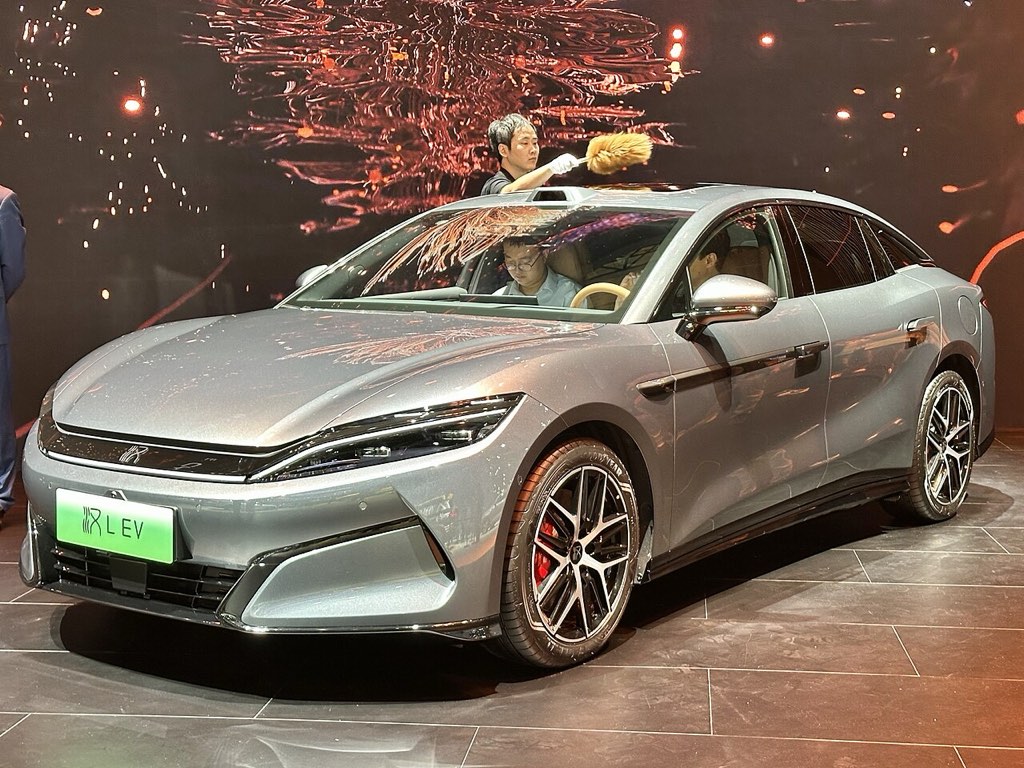
The Han L is one of the nameplates inside BYD's God's Eye B tier. Under the reported plan, some B cars built from November will run Horizon's chip and software instead of Nvidia plus a partner-written stack. Photo: Wikimedia Commons.
What the report actually says
On 30 October, Chinese outlet Lanjinger News reported, citing people familiar with the matter, that Horizon's high-compute chip plus its Horizon SuperDrive (HSD) full stack had won a place in God's Eye B — the tier that sits above the mass-market C system and below the flagship A system. The report said the first cars would launch in November, spanning Denza, the Han line, and higher-end Ocean-series models.
Two caveats matter. First, BYD has not confirmed any of this. Everything below that concerns the B-tier arrangement is reported, not announced. Second, the reporting was later corroborated on timing by a Huaxing Securities research note in September, which also put the first Horizon-based God's Eye B model in November.
There is a data point that makes the report more than plausible. Horizon's shipments into God's Eye C — the tier where it already supplies silicon — have climbed back to roughly 80,000 to 100,000 chips a month, according to the same reporting. That is a supplier with an established line into the account, not a new entrant.
How the partnership got here
The relationship is not new. BYD took a strategic stake in Horizon back in 2021, and Journey 6 silicon first landed in the God's Eye system.
When BYD launched its "God's Eye for everyone" push in February 2025, it split the system three ways: A (DiPilot 600) for Yangwang, B (DiPilot 300) for Denza and higher-end BYD models, C (DiPilot 100) for volume cars. The C tier runs a pure-vision sensor set with either a Horizon Journey 6M or an Nvidia Orin-N, rated at 84 to 128 TOPS, and — this is the part that gets lost — the software is BYD's own, fully in-house. Horizon's role was to sell compute.
That role got large fast. Horizon shipped roughly 2.5 million Journey 6 chips to BYD in 2025, according to multiple Chinese outlets, making BYD one of its biggest single accounts.
Then the ground shifted. On 28 May 2026, BYD unveiled Xuanji A3, a 4nm automotive chip rated at more than 700 TOPS per unit and around 2,100 TOPS across three chips working together. Horizon's stock fell more than 7% the next session on fears its largest customer was turning into a competitor.
What followed in June looked like the opposite. BYD chairman Wang Chuanfu was photographed testing driver assist with Horizon founder Kai Yu in a BYD Seal, and Yu posted that he had "just landed a really big one — really big." By October, the "big one" had a name.
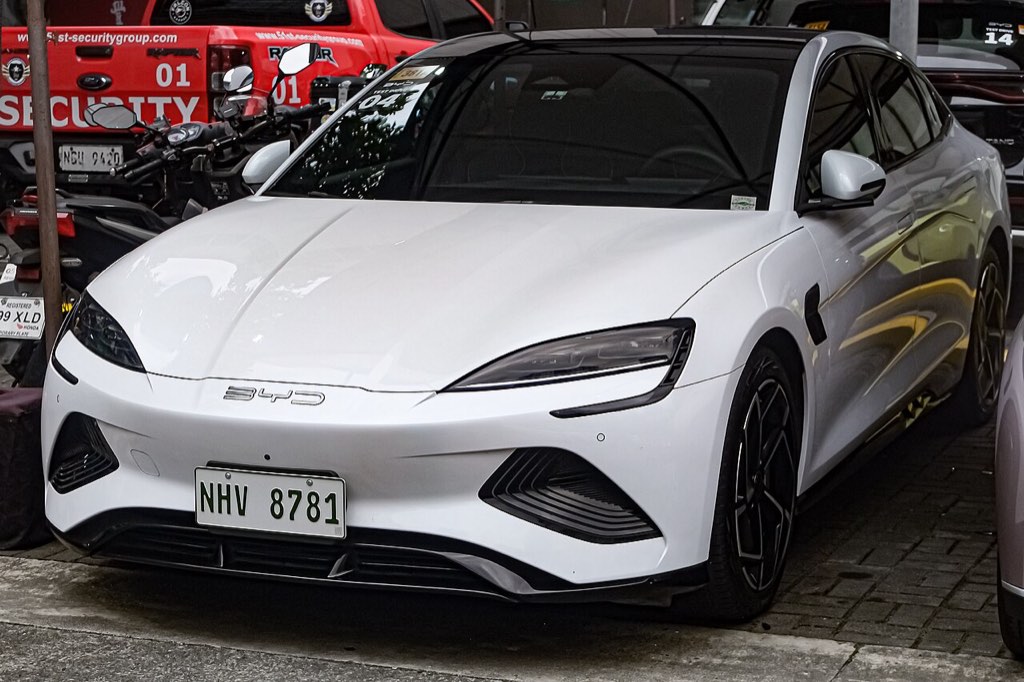
The BYD Seal, the model Wang Chuanfu and Kai Yu were photographed testing together in June — an unusual public signal from two chairmen at once. Photo: Wikimedia Commons.
What HSD actually is
HSD is Horizon's one-stage end-to-end system built on the Journey 6P, a chip rated at 560 TOPS in dense INT8 terms. "One-stage end-to-end" means a single neural network takes raw camera and radar input and outputs driving commands directly, without the hand-drawn boundary between a perception module and a planning module that older stacks relied on. Fewer handoffs means less information lost at the seams.
The weakness of that architecture is long-tail coverage: a network trained on recorded driving sees very little of what almost never happens. Horizon's answer pairs the on-car model with a world model that generates physically plausible rare scenarios in simulation, plus reinforcement learning that optimises policy inside that generated world. HSD V2.0, pushed over the air at the end of June 2026, was the first large deployment of that combination.
It is also not a slideware system. HSD has been shipping on production cars from Chery's Exeed and iCAR brands, Fengyun, and Changan's Deepal. Securities Daily reported in July that Horizon expects roughly 20 models to be designated and delivered by the end of 2026.
Three routes, not a swap
Reading this as "BYD drops its own work and buys Horizon" gets the strategy backwards.
God's Eye B today is a laser-radar system: one lidar, five radar units, twelve cameras, twelve ultrasonic sensors, and a single Nvidia Orin-X at 254 TOPS. The algorithm on top has been developed jointly with Momenta. Add Horizon's stack and the B tier ends up holding three parallel routes at once — Horizon's full stack, BYD's in-house Xuanji A3 path, and the existing Nvidia hardware.
The A tier stays where it was: three lidars, dual Orin-X, reserved for Yangwang and the top of the range.
The logic is portfolio management, not loyalty. BYD sells from roughly 70,000 yuan to over a million, and a single in-house chip cannot be the cheapest option at the bottom and the most capable at the top. Volume cars go to whoever offers the best cost-per-function with secure supply; the flagship keeps the in-house part. It is the same reasoning that put second and third cell suppliers into BYD's battery packs.
If you are shopping for a God's Eye B car
This is where the story stops being a supply-chain item and starts affecting a purchase.
Read the hardware list, not the badge. "God's Eye B" is a tier name, not a bill of materials. If three chip routes coexist inside it, two cars with the same badge on the same showroom floor may not have the same brain. Ask for the specific chip and sensor count in writing.
The option price has already moved once. BYD raised the God's Eye B laser-assisted package from 9,900 to 12,000 yuan on 1 May 2026, citing a jump in memory prices. That is a 2,100 yuan increase, about 21%, on an option that was already the cheapest way into urban NOA on a BYD.
Do not convert TOPS into an experience multiplier. Journey 6P is quoted at 560 TOPS and Orin-X at 254. On paper that reads like 2.2 times the compute. But Kai Yu himself pointed out on 30 October that the same Journey 6P can be written as 560 TOPS or as 1,960 TOPS depending on which counting convention a vendor chooses — the silicon does not change, only the arithmetic. Cross-vendor TOPS comparisons are close to meaningless, because what decides whether urban NOA feels calm or twitchy is memory bandwidth, operator support, thermal headroom and stable inference latency, not the peak number on the box.
The real difference shows up later, in two places. How often you have to take over in a messy intersection, and how fast the system improves after you buy it. Neither is knowable from a launch event; both will be visible in owner forums three to six months after the first cars are delivered.
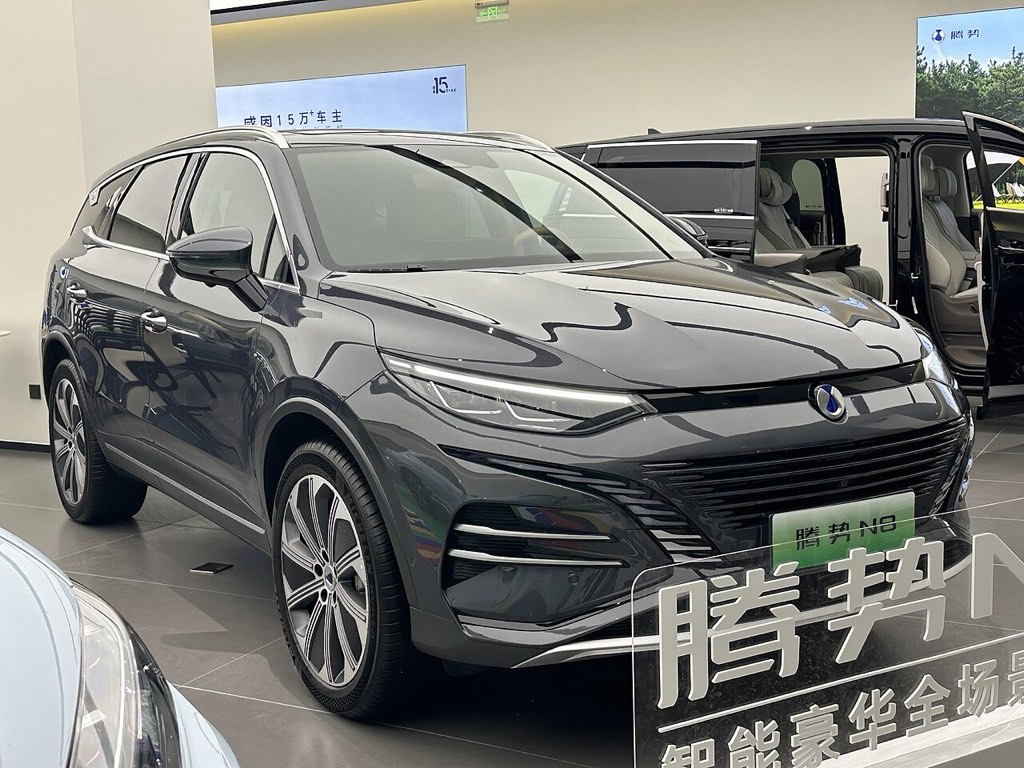
Denza is one of the brands the reported plan names for the Horizon-based God's Eye B. Photo: Wikimedia Commons.
Where Horizon actually stands
Two different "number ones" get quoted, and they are not the same claim.
In the full-range driver-assist chip market for Chinese-brand passenger cars, Horizon held 31.94% in the first half of 2026, ahead of Nvidia at 29.38% and Mobileye below 10%, according to Gaogong Intelligent Auto Research data cited by Securities Daily and the China Autonomous Driving Blue Book.
In urban NOA chips — the high-value segment — Nvidia still leads at 39.43%, with Horizon second at 22.82%, up nearly five percentage points year on year. Nvidia, Horizon and Huawei together account for close to 80% of that segment.
Horizon's cumulative Journey shipments passed 15 million units on 3 September 2026, with more than 40 brand partners, 500 model designations and over 20 million units of orders in hand, according to the company.
So the honest framing is: Horizon is the volume leader in Chinese-brand ADAS silicon and a fast-rising number two in the segment that actually carries the margin. Winning a God's Eye B slot matters less for the unit count than for what it does to that second number — and for the engineering credibility of running a full stack on BYD's fleet scale.
The other side of the trade
The risk is not hypothetical. BYD's own chip launch knocked more than 7% off Horizon's share price in a single session, and BYD's stated approach is explicitly multi-supplier. If Xuanji A3 matures and costs come down, the in-house route can absorb exactly the volume that makes Horizon's BYD business attractive.
Horizon's own framing of the answer is instructive. Executive director Jian Xu has drawn a distinction between direct market share — chips it sells itself — and what the company calls extended share, where it licenses technology so customers can build their own silicon on its architecture. That is a supplier preparing for a world where some customers eventually compete with it, and getting paid on the way.
For BYD, the calculation is simpler: three routes mean three sets of quotes, and a benchmark to hold each of them to.
FAQ
Will my existing God's Eye B car get the Horizon version? No. The chip and sensor set are physical hardware. A car built with Orin-X cannot be upgraded to Journey 6P by software. Only cars that ship with the new hardware get the new stack.
Is Horizon's stack actually better than the Nvidia one? Unknown, and anyone claiming otherwise right now is guessing. Horizon's system has a strong record on Chery and Changan models, but BYD's traffic mix, fleet size and calibration targets are different. The first honest answers will come from owner reports after delivery.
Does more TOPS mean better urban driving? Not reliably. As Horizon's own founder noted, the same chip can be quoted at 560 or 1,960 TOPS depending on convention. Bandwidth, thermal design and how well the model maps onto the silicon matter more than the peak figure.
Will the option get cheaper now that there is a domestic supplier? Do not count on it. The package went up by 2,100 yuan in May 2026 because memory prices rose. Chip sourcing is one line item among several, and BYD has not published pricing for any Horizon-based variant.
What should I check on the config sheet? The chip name, the lidar count, and whether the car is listed as supporting urban NOA at delivery or "via future OTA." Those three lines separate cars that look identical in a showroom.
China Angle
The interesting part of this story is not that a Chinese chip foundry won a socket. It is that the software moved with the chip.
For most of the last five years, Chinese OEMs bought compute from Nvidia and either wrote their own stack or bought algorithms from a domestic partner — which is exactly how God's Eye B was configured, with Orin-X silicon and an algorithm developed jointly with Momenta. Horizon's HSD pitch collapses those two purchases into one and prices it against a foreign alternative at a moment when memory costs are already pushing option prices up.
That combination — domestic silicon, domestic full stack, domestic data — is what makes a 12,000 yuan urban-NOA option viable on cars selling for well under 200,000 yuan. The Blue Book places Horizon at roughly 44% share of assisted driving in China's sub-200,000 yuan domestic-brand segment, and the cost arithmetic behind that number is the same arithmetic BYD is shopping for.
The limit is equally clear, and it is not about capability. It is about who owns the ceiling. BYD is simultaneously the largest customer and a future competitor, and its in-house Xuanji A3 exists precisely so that the top of the range never depends on an outside supplier. Horizon's response — licensing its architecture to customers who want to build their own — is an admission that in China's market, a supplier's best defence against its biggest customer is to sell that customer the blueprint.
China faces the same constraints as everyone else here: urban NOA still demands enormous validation mileage, lidar costs remain a floor on the option price, and resale values for assisted-driving hardware are unproven. Scale buys cost. It does not buy certainty.
Sources
- Lanjinger News report on Horizon HSD entering God's Eye B, as relayed by Tencent News — https://news.qq.com/rain/a/20261101A03EJD00
- Kai Yu on TOPS counting conventions, Tencent News, 1 November 2026 — https://news.qq.com/rain/a/20261101A05LWZ00
- God's Eye A/B/C specifications, Orin-X 254 TOPS, Momenta algorithm partnership and the 9,900→12,000 yuan option price, Tencent News, 29 May 2026 — https://news.qq.com/rain/a/20260529A04ESX00
- Option price increase to 12,000 yuan effective 1 May 2026, China Energy News — https://www.cnenergynews.cn/article/4RTeGo3D51V
- 2026 H1 market share, urban NOA share, HSD rollout and ~20 models by end-2026, Securities Daily, 30 July 2026 — http://www.zqrb.cn/gscy/gongsi/2026-07-30/A1785398712027.html
- China Autonomous Driving Blue Book 2026 (Xinhua CEIS) — https://idea-cp.cnfin.com/ice/2026/09/01/44d538d6e06f4825b219516513af10e1.pdf
- Journey cumulative shipments of 15 million, 40+ brands, 500 designations, 20 million units of orders in hand, Horizon Robotics press release, 3 September 2026 — https://www.horizon.auto/news/press/472
- Wang Chuanfu and Kai Yu testing together, Horizon's April 2026 domain-controller share of 13.6%, ~2.5 million Journey 6 units shipped to BYD in 2025, Tencent News / IT Home, 28 June 2026 — https://view.inews.qq.com/a/20260628A046AY00
- BYD's 2021 strategic investment in Horizon and account concentration, PCauto — https://hj.pcauto.com.cn/hj/article/3424033.html
- Jian Xu on direct vs extended market share and technology licensing, China Securities Journal, 11 September 2026 — https://epaper.cs.com.cn/zgzqb/wap/html/2026-09/11/nw.D110000zgzqb_20260911_2-A05.htm
Image credits
- BYD Han L EV — Wikimedia Commons, CC BY-SA
- BYD Seal — Wikimedia Commons, CC BY-SA
- Denza N9 — Wikimedia Commons, CC BY-SA
中文简报
比亚迪天神之眼 B 档(DiPilot 300)据报将在 11 月起搭载地平线征程 6P 芯片与 HSD 全栈方案,首批覆盖腾势、汉与海洋网高端车型。此事源自 10 月 30 日蓝鲸新闻的知情人士报道,比亚迪尚未官宣。天眼 B 现款为单颗英伟达 Orin-X(254 TOPS)加比亚迪与 Momenta 联合开发的算法;引入地平线后该档将同时存在三条技术路线,而非替换关系。对买家最实际的影响是:同一"天眼 B"名称下硬件可能不同,需看清配置单;选装价已于 2026 年 5 月由 9900 元上调至 12000 元;算力数字不可跨厂商直接比较——余凯本人指出同一颗 6P 按不同口径可写作 560 或 1960 TOPS。
Back to all articles · View comments & share on the interactive page