From Contrarian Chip Startup to China's One-Stage End-to-End ADAS Pillar: The Horizon Robotics Story
In 2015, Kai Yu (余凯) walked away from his post as a vice-dean at Baidu Research, founded a new company, and chose one of the most contrarian directions in the first AI boom. Almost every AI founder of that year was chasing a large language model, a voice assistant, or a vision API. Horizon Robotics was going to make a chip — an AI chip — for robots, including the ones that happen to be cars.
It was, by the founder's own description, the opposite of an obvious bet. Building a car-grade AI chip is slow, capital-intensive, and several years away from any revenue. "We compete where there is no competition," Yu would later say, almost word for word. "Not because it is easy, but because that is where the future is."
A startup that bet on cars when cars weren't the obvious AI bet
The first four years of Horizon were deliberately two-track. The company shipped AIoT silicon — for smart cameras, smart commercial, smart construction sites — alongside a parallel bet on intelligent-driving chips. AIoT was a real market, but each deployment was a custom project with limited value capture. Cars, by contrast, were a single platform that would ship in the millions.
In 2019, Horizon made the call that has shaped the company ever since. It shut down the entire AIoT business and concentrated all of its engineering on intelligent driving. Within months, it became the only Chinese supplier with a domestically developed mass-production ADAS chip, and in June 2020 the Journey 2 (征程2) chip shipped in the Changan UNI-T. It was the first time a Chinese-developed intelligent-driving solution had reached volume production in a passenger car, and the UNI-T sold more than 100,000 units in its first nine months on the market.
The global chip shortage of 2021–2022 turned out to be a tailwind. While the auto industry was rediscovering what semiconductors meant, Horizon had something to sell. The Journey 5, in 2021, became the first Chinese automotive AI chip to break 100 TOPS, and it shipped first in the Li Auto L8 Pro, marking China's entry into the era of high-compute assisted-driving silicon.
In October 2024, Horizon listed on the Hong Kong Stock Exchange, raising more than HK$5.4 billion and becoming the year's largest tech IPO in the city. By that point the company had the most widely deployed domestically developed ADAS chip family in China.
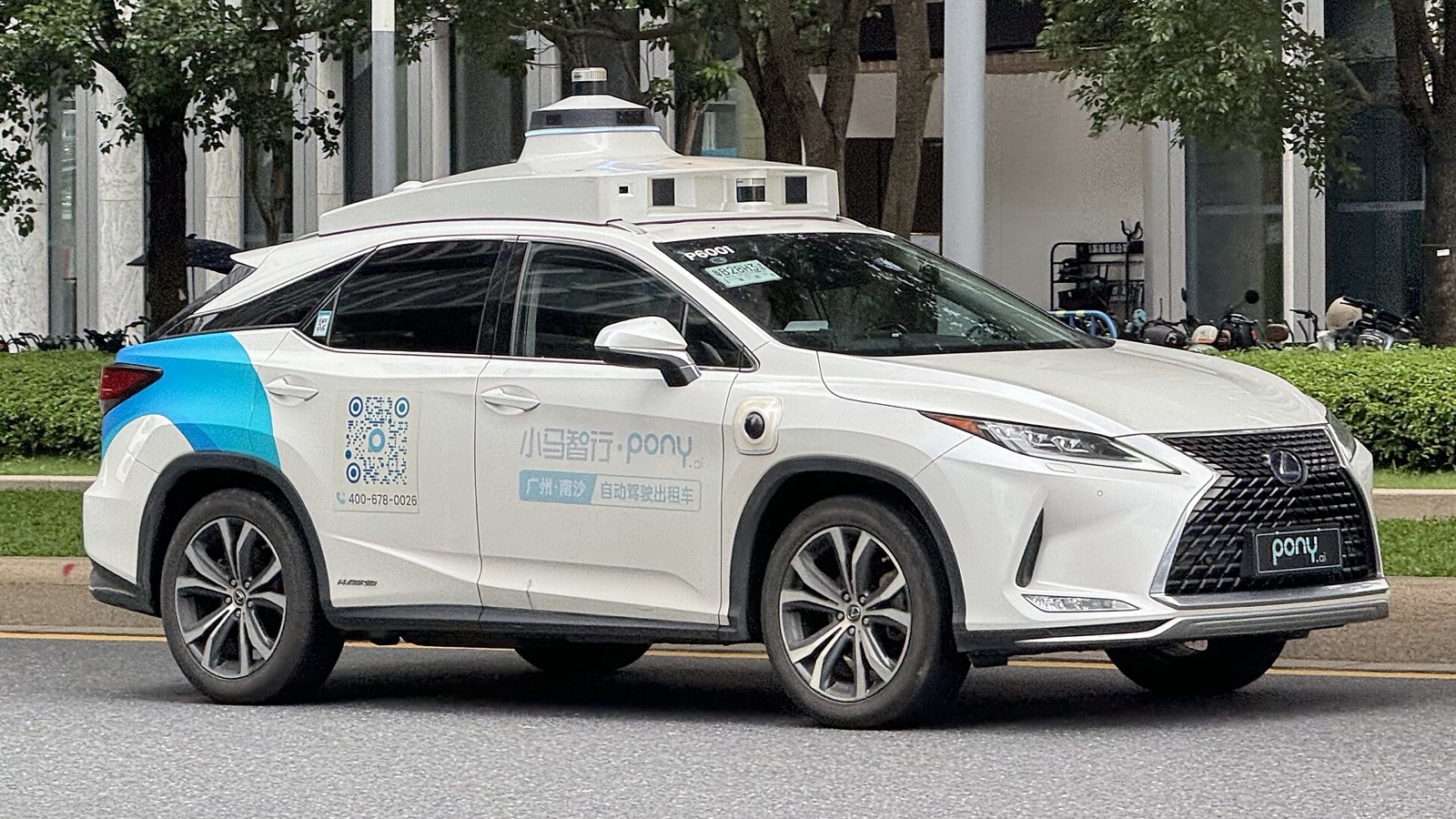 A Pony.ai robotaxi (Lexus RX450h with roof-mounted lidar) on a Guangzhou street, one of the visible public deployments of China's autonomous-driving ecosystem — the same market where Horizon Robotics' HSD is now competing, and one of the most demanding proving grounds for a one-stage end-to-end driving stack. (Image: Wikimedia Commons, CC BY 2.0, S5A-0043)
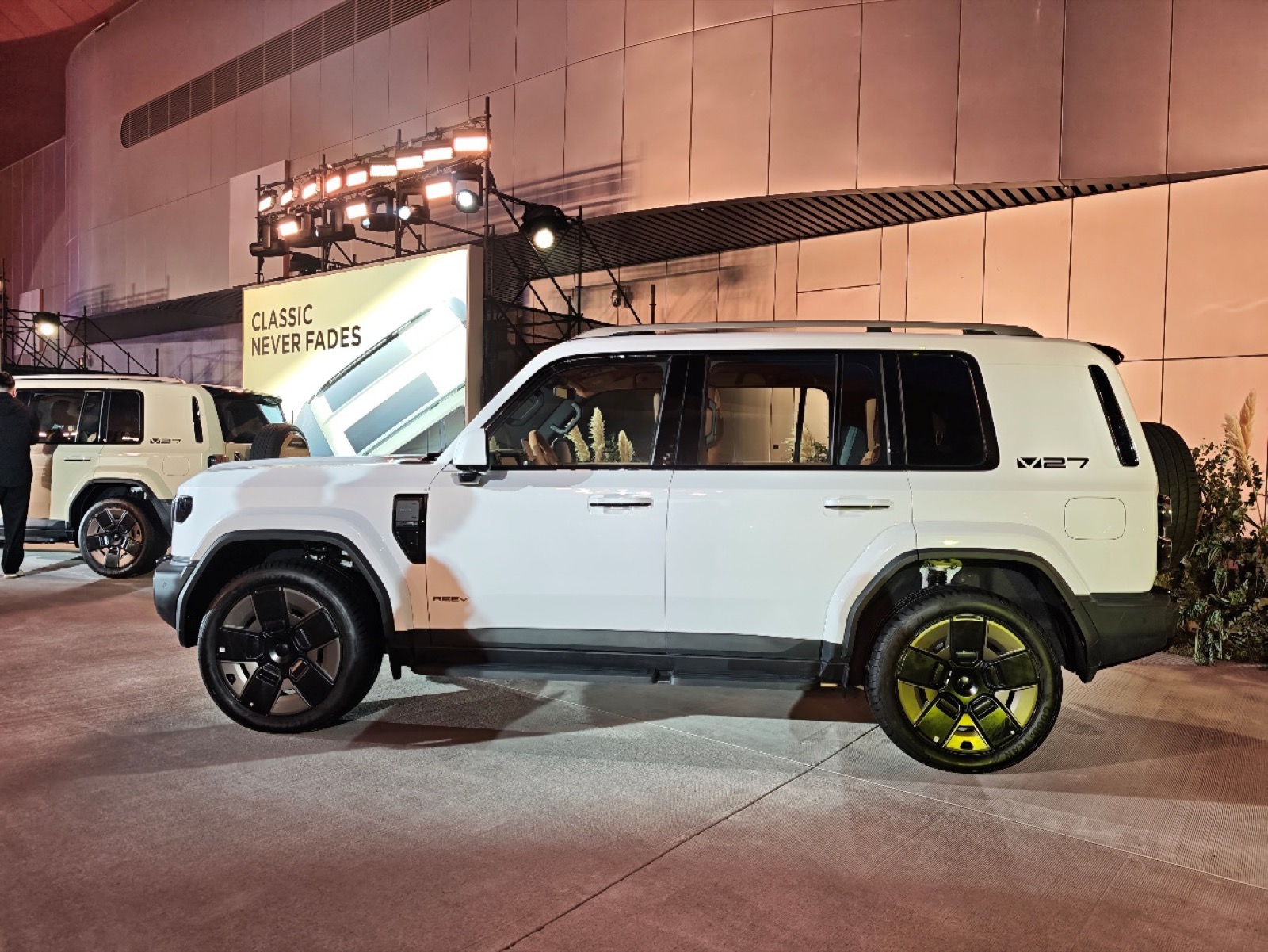 The iCar V27, the first HSD-equipped 'family hard-square' SUV — shown here at the March 2026 launch in multiple colours. (Image: iCar / corporate supply)
2024–2025: from chip supplier to full-stack provider — and the HSD bet
The bigger technical leap came in 2024 and 2025. Until then, Horizon had been a chip and tool-chain supplier. To get to one-stage end-to-end driving — the architecture in which a single neural network maps sensor input directly to vehicle trajectory, with no modular perception / planning / control split — Horizon had to ship the full stack itself.
The result was HSD (Horizon SuperDrive), a one-stage end-to-end urban pilot-assistance system running on the Journey 6P, a single chip delivering 560 TOPS of compute. HSD combined a world model with reinforcement-learning training, with end-to-end latency of a couple of hundred milliseconds and joint optimisation of longitudinal and lateral control.
In real-world testing in central Beijing — the most demanding urban pilot-assistance benchmark in China — HSD's behaviour in blind-corner right turns, ghost probes (pedestrians appearing suddenly from behind a parked car), and extreme cut-ins was markedly smoother than the previous-generation systems it was compared against. Stop-and-go at traffic lights was millisecond-precise, mid-corner behaviour was steady, and the "painted dragon" sway that plagues modular stacks was reduced by more than 90%. The industry shorthand was "the Chinese FSD", but Yu himself put it more directly: "HSD absolutely understands Chinese roads better than Tesla FSD." By the end of 2025, HSD had won design-in commitments from 10 domestic and international OEMs, and more than 20 vehicle programmes.
2026: the second inflection — BYD, a Chinese duopoly, and the reshaped market
In 2026, the second inflection point arrived. Two things happened in the same window.
The first was a structural change in the assisted-driving silicon market. According to NE Times data for April 2026, Horizon's share of China's passenger-car assisted-driving domain-controller chips jumped to 13.6% — making it the number-two player in the country, ahead of Huawei and Tesla, and behind only NVIDIA at 50.9%. Just four months earlier, in January–February, Horizon had been at 9.3% and ranked fourth. The combined share of the top two (NVIDIA + Horizon) reached 64.8%. In a year when China's overall passenger-car retail was down 18.5%, Horizon's shipments went up. "This ranking will be different next year," Yu said in his own understated way.
The second event was the deepening of the relationship with BYD. In June 2026, BYD chairman Wang Chuanfu and Horizon CEO Kai Yu were photographed together, in the same car, in the front seats of a BYD Seal fitted with Horizon's HSD. The context was that BYD had, in May 2026, just announced its own 4 nm in-house assisted-driving chip, the Xuanji A3 (璇玑A3), with more than 700 TOPS of compute — a chip many analysts had assumed would displace Horizon inside BYD. It did not. The strategy that emerged is a layered one: BYD's own Xuanji A3 covers the high-end and flagship vehicles, while Horizon's Journey 6 family and the HSD 2.0 full-scenario urban pilot-assistance solution cover the high-volume 7–20万元 range, where the Journey 6M (128 TOPS) is pushing urban NOA (pilot-assisted driving) down to 10万元 cars. The two-pronged approach is what the industry is now calling a stratified supply model — and Horizon, the analyst consensus is increasingly clear, is the buyer of choice for the volume half.
The deeper shift is in the relationship itself. Earlier collaborations between an automaker and a chip company were supply-and-buy. The BYD-Horizon collaboration being negotiated through 2026 is described, by both sides, as deep engineering co-design — including the possibility of BPU IP licensing, which would make Horizon a long-term technology partner rather than just a chip vendor. BYD's in-house "Didi Xia" (迪迪虾) intelligent-cockpit agent and Horizon's "Kaka Xia" (咖咖虾) in-cabin AI assistant are reportedly being integrated at the OS layer. The message is that the volume of China's assisted-driving market is large enough to sustain two parallel stacks, and that even the largest Chinese car maker sees the value of keeping both.
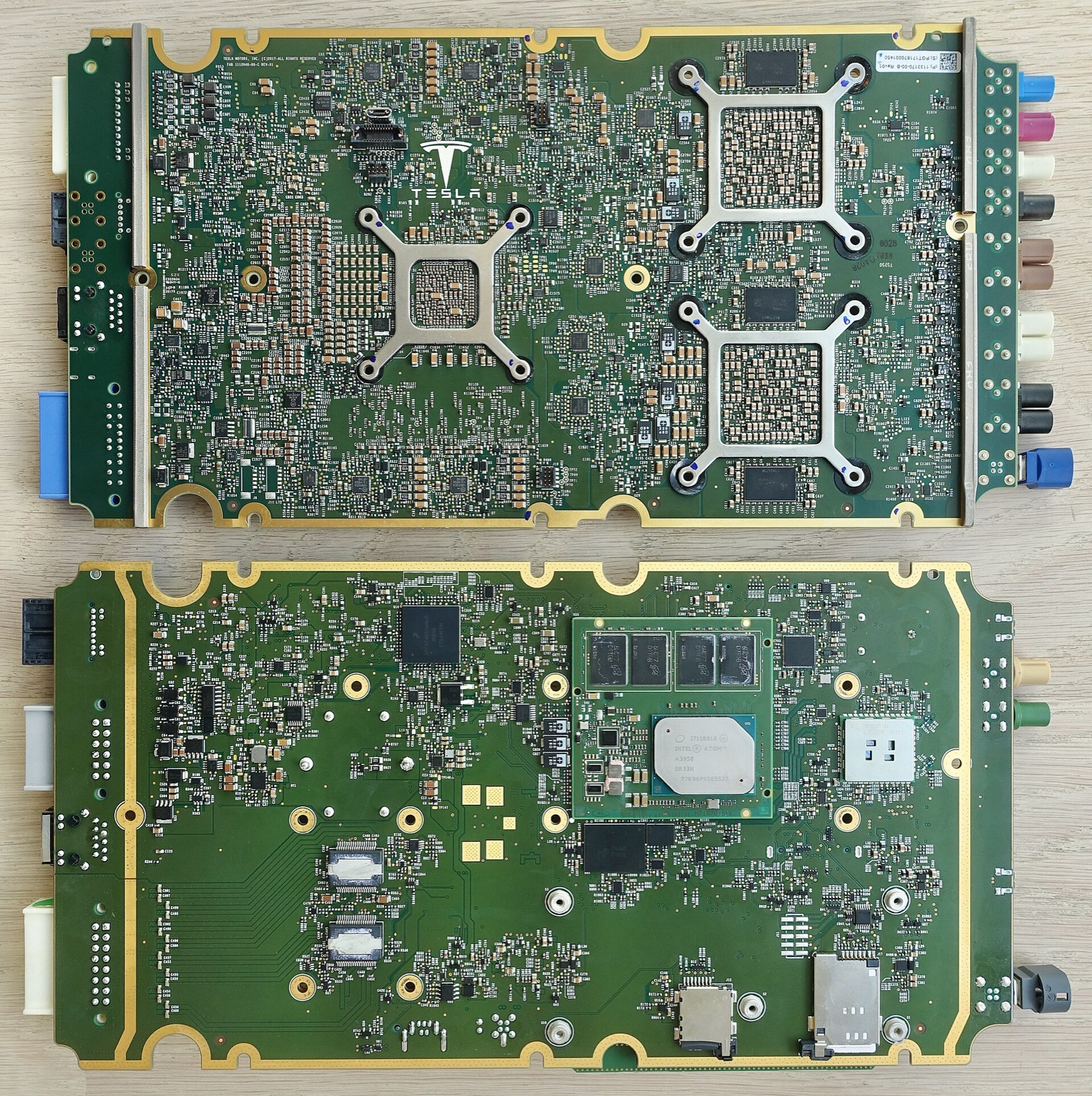 The Tesla HW 2.5 Autopilot and infotainment board, photographed from both sides — the kind of integrated compute board that lives behind every modern assisted-driving stack, including those running on chips like Horizon's Journey 6P and BYD's Xuanji A3. The scale of components and the multiple SoCs visible on a single PCB is what a one-stage end-to-end driving stack physically looks like. (Image: Wikimedia Commons, CC BY 2.0, Steve Jurvetson)
What the ten-year arc is really about
The story of Horizon Robotics is not, at heart, the story of a chip company. It is the story of a patient bet that, in a market as vast and as fragmented as Chinese cars, the way to win is not to be the biggest chip — it is to be the best open ADAS platform, the one that any Chinese car maker can adopt without having to build the entire stack in-house. NVIDIA sells silicon. Tesla sells a closed system. Huawei sells a closed system inside a closed OEM (the HIMA alliance). Horizon sells silicon, a toolchain, a one-stage end-to-end software stack, and a willingness to be the second brain inside any car maker that wants one.
That is why 2026 is a turning point rather than a destination. The Journey 6 family is the silicon. HSD 2.0 is the software. The BYD collaboration is the volume. The mass-production front, the Journey 6M, is what pushes urban NOA into the 10万元 car. If Horizon executes on all four — and the April 2026 numbers suggest it is — China's assisted-driving stack will not be a US-vs-China story, or a self-developed-vs-third-party story. It will be a duopoly between NVIDIA, for the very high end, and Horizon, for everything else.
The lesson is one that anyone who has watched a Chinese industry over the last decade will recognise. A contrarian bet only works if the contrarian is willing to wait. Horizon waited nine years between Journey 2 and the volume moment. The next three years are when the bet pays out — and the data is already showing it.
China-only context: the BYD–Horizon collaboration, the 璇玑A3 / Xuanji A3 chip, the Journey 6 family, and HSD are all China-market programmes. The Pony.ai robotaxi is also a China-market deployment. The Tesla HW 2.5 board is a US-market reference, shown only to illustrate the category of in-vehicle AI compute hardware.
Back to all articles · View comments & share on the interactive page