Why 800V EVs Charge Faster but Cost More
Ten minutes at a 350 kW stall can add around 300 km — but only if the pack is warm and the charger actually delivers. That speed is what an 800V architecture buys you, and what you pay extra for.
What you notice on the road
- A 10-minute splash charge really can add 250–300 km — but only at a 350 kW stall with a preconditioned battery. On a Taycan or Ioniq 5 you go 10–80% in about 18 minutes; that window is the whole point of the upgrade.
- Plug into an older 50–150 kW charger and the gap nearly vanishes. An 800V car there charges at roughly the same speed as a 400V car, because the stall, not the car, sets the ceiling.
- On a 400V charger your 800V car may drop to 135–150 kW (Porsche Macan) or refuse full power, then take 25–35 minutes for 10–80% instead of 18. The benefit is site-dependent, not automatic.
- You pay about $500–1,000 more for the car in Western markets, and carry a slightly more complex high-voltage harness (more contactors and insulation), before you ever see a faster charge.
How it works
Fewer, longer strings and half the current for the same power. Electrical power (kW) equals voltage (V) times current (A). To push 300 kW, a 400V pack needs about 750 A; an 800V pack needs about 375 A. Halving the current lets the copper wiring be thinner and throws away far less heat (losses rise with the square of current). So on the road, this means a lighter, cooler cable run and a pack that can accept high power without cooking itself.
400V charger compatibility via boost converter or split-pack relays. An 800V battery physically cannot take charge from a 400V stall directly. Carmakers solve it three ways: an onboard DC-DC booster (early Taycan) that steps 400V up to 800V but caps at 50–150 kW; "bank charging" that splits the pack into two 400V halves wired in parallel on a 400V stall (Macan, Audi Q6 e-tron, up to ~135 kW with no conversion); and Hyundai's trick of using the motor windings as an inductor so the rear inverter boosts without extra hardware. So on the road, this means your 800V car still works at any CCS plug — just sometimes slower, and which method you get depends on the brand.
800V only pays off above roughly 150 kW. Below that power level a 400V pack with silicon IGBTs is cheaper and nearly as good; the expensive bits that make 800V work (silicon-carbide inverters, upgraded insulation) only earn their keep when you are pulling serious watts. So on the road, this means if your regular routes are lined with 150 kW stalls, the 800V premium mostly sits unused — the speed shows up on the rare 350 kW corridor.
Insulation coordination and partial discharge. At 800V every high-voltage part — inverter, DC-DC, compressor, contactors, connectors — must be rated for the full peak (approaching 1,000 V), not just the nominal 800. Higher voltage raises the risk of partial discharge across gaps and surfaces, so creepage, clearance and the pack enclosure all get redesigned. The pack-level rework 800V forces is a close cousin of the cell-to-pack integration we walked through in our pack-structure explainer. So on the road, this means more robust (and more closely monitored) wiring — which is also why a single HV fault can shut the whole car down.
The numbers that matter
| Parameter | Typical range | Why you care |
|---|---|---|
| System voltage (nominal) | 700–820 V (vs ~400 V) | Sets how much current is needed for a given charge rate |
| Peak DC charge rate | 240–320 kW on 800V cars | 18-min 10–80% on a Taycan or Ioniq 5, not 30+ |
| 10–80% time on a 350 kW stall | 13–18 min | ~300 km back in the time it takes to get coffee |
| 10–80% time on a 150 kW stall | 25–35 min | Basically the same as a 400V car — the upgrade sleeps |
| Charge rate on a 400V charger | 135–150 kW (boost or bank) | You can still charge anywhere, just not at full speed |
| Inverter loss vs IGBT | SiC cuts ~3–5% conversion loss | ~5–8% more real-world range from the same pack |
| Extra cost vs 400V twin | $500–1,000 (Western list) | What you hand over before the first fast charge |
Who makes it
- Materials. Silicon-carbide (SiC) substrates are the foundation of the 1200 V MOSFETs an 800V inverter needs; copper and insulation compounds fill out the harness. China's share of global SiC substrate capacity passed 50% by 2025, with Infineon (Germany) and ROHM (Japan) as the other major sources.
- Key components. SiC power modules (Infineon, ROHM, STMicro, onsemi, Wolfspeed), DC-link capacitors, high-voltage contactors and 1,000 V-rated connectors. Vitesco Technologies — now Schaeffler's E-Mobility division — builds compact high-voltage inverters around SiC from both Infineon and ROHM, including an "inverter brick" in mass production for a major Chinese carmaker.
- Tier 1. Vitesco/Schaeffler supplies the e-axle inverters; ZF, Bosch and BorgWarner build competing 800V drive units. The SiC inverter bolted between the pack and the motor is the same power-electronics family we looked at in our rare-earth-free motor piece. Their choice of SiC supplier sets the cost and efficiency ceiling of the car you buy.
- OEMs. Porsche (Taycan, 2019, the first volume 800V EV; Macan on the PPE platform with bank charging), Hyundai (E-GMP, motor-as-inductor boost), XPeng (first Chinese mass-produced 800V SiC platform, up to 600 A, G9 peaking at 453 kW) and Zeekr (SEA 800V platform) are the names that ship it. How each brand handles 400V charging is decided here, in the pack and inverter design.
Where the cost sits
The architecture premium on a Western-market car runs about $500–1,000 over an otherwise similar 400V twin — that covers the SiC inverter, the upgraded insulation and contactors, and the redesigned pack. In China the incremental vehicle cost has collapsed from roughly ¥20,000–30,000 a few years ago to about ¥7,000–8,000 (≈$950–1,100) as SiC substrate supply scaled and CATL's fast-charging cells drove pack cost toward $85/kWh. The single biggest line is the SiC power devices themselves: replacing silicon IGBTs with SiC MOSFETs adds on the order of ¥2,000–3,000 per vehicle, with the battery system and liquid-cooled connector making up most of the rest. None of this is precise to the dollar — it shifts with exchange rates and volume — but the direction is clear: 800V is a few-percent price add that only pays back in time saved on high-power stalls.
What breaks
- Isolation fault from HV insulation wear → the car throws a isolation warning, refuses to charge or drive. Repair: trace and replace the damaged harness, connector or battery disconnect unit — typically $1,500–4,000; insurers treat HV damage as a total-loss flag more readily than a 12V fault.
- Bank-charging contactor or SoC mismatch → the two pack halves aren't balanced, the parallel contactor won't close, and the car can't take a 400V charge. Repair: BMS/contactor service, about $800–2,500; until fixed you're limited to 800V stalls only.
- SiC inverter module failure → rare but pricey, because 1200 V SiC modules are less common than 400V IGBT units. Repair out of warranty: $3,000–6,000 vs $1,500–3,000 for a 400V inverter — and the higher part cost nudges the insurer's write-off threshold up.
What's next
Expect 800V to slide from flagship to default between 2027 and 2030. BYD's 1,000V "Super e-Platform" and Lucid's 924V system push the ceiling higher, while cars like the Leapmotor C10 have already pulled 800V into the ¥100,000–150,000 (≈$14,000–21,000) bracket. More brands will drop the bulky onboard booster in favor of bank charging or motor-winding boost to save weight and cost. As Chinese SiC substrate capacity stays above half the global total, the $500–1,000 premium should keep shrinking — so the question shifts from "is 800V worth it" to "which charger will I actually find." Those 350 kW corridors that make 800V pay off are unevenly spread: Europe's CCS2 plugs and three-phase grids are the densest, Japan still leans on CHAdeMO with 100–200 V home charging, and in Indonesia most public AC is 220 V single-phase — so the same 800V car feels different on each grid. Whether your town even has a 350 kW stall is a separate problem; we mapped France's public fast-charging network here.
FAQ
- Is 800V worth paying extra for? Only if you regularly road-trip on 350 kW corridors. Commuters who charge at home barely touch the speed the upgrade pays for.
- Will my 800V car charge slower on a 400V charger? Yes, sometimes a lot — 25–35 minutes for 10–80% instead of 18. It still charges; it just won't hit its headline number.
- Does 800V make repairs more expensive? A bit. HV parts are pricier and an isolation fault can total a car more easily, so check whether your insurance treats EVs differently.
- Do I need a special home charger for an 800V car? No. Home AC charging is identical to a 400V car; 800V only changes what happens at a DC fast-charging stall.
- Will 800V make my battery last longer? It runs cooler in the wiring, but the fast charging you'll do still heats the cells — so follow the same care habits as any EV. See our battery-care guide.
China Angle
China is the largest adopter of 800V, not just a follower. More than 30 Chinese automakers now sell 800V models, and 800V new-energy-vehicle sales reached about 14% penetration in 2025, with industry estimates putting 2026 above 35% (Zhinen Auto / LongPort). XPeng built the first Chinese mass-produced 800V silicon-carbide platform and pushed 5C charging below ¥200,000 (the G6 claims ~450 km in 10 minutes).
CATL's Shenxing (神行) LFP battery is the enabler: its third-generation cell supports 10C flash charging, and by driving 800V cell cost toward $85/kWh it pulled the single-vehicle 800V premium down from ¥20,000–30,000 to about ¥7,000–8,000 (Tencent News, Apr 2026). China's share of global SiC substrate capacity passed 50% in 2025, which is why the premium is shrinking there faster than in Europe or the US. BYD's 1,000V Super e-Platform peaks at 1,000 kW; the brand deployed its 5,000th Flash Charger on 1 April 2026 and targets 20,000 in China plus 6,000 overseas by year-end (TechACB).
Policy is deliberately neutral: a July 2025 NDRC–NEA notice encourages high-power charging but does not mandate 800V, leaving 400V as a legal, mature route (Yiyouliao). The catch for Chinese buyers is the same as elsewhere — fewer than 8% of public chargers are 350 kW+ 800V-capable, so most 800V cars mostly charge on slower stalls.
For the consumer, China's scale in SiC substrates and CATL's battery cost curve is why you can buy 800V fast charging in a sub-¥150,000 car there years before Europe or America sees it in that price band — the same technology, at a lower entry price, just often on a slower charger.
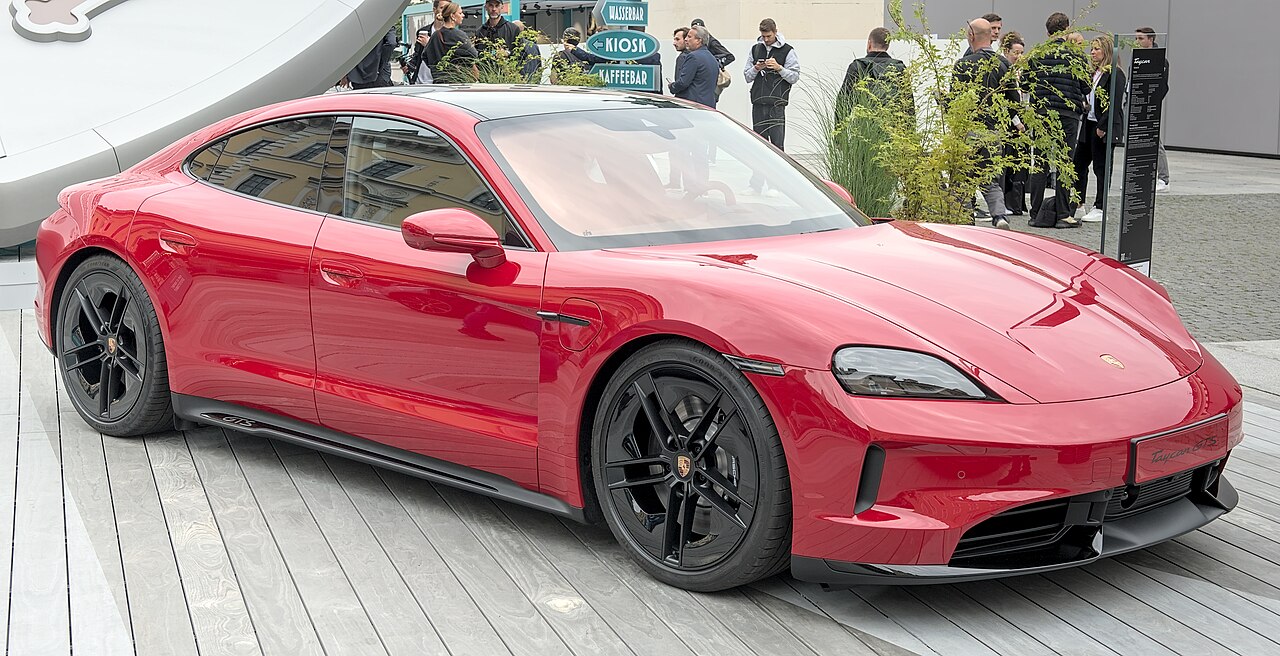
Image credits: Porsche Taycan Turbo S — Wikimedia Commons (Rhindo, CC BY-SA).
Sources:
- Battery Design, "800V Architecture" — boost vs bank-charging, component rating, insulation
- Autodoc UK, "800V Architecture in EVs" — SiC efficiency, 400V compatibility methods
- EV Central, "What's the deal with 800V?" — Macan 135 kW on 400V, Hyundai motor-boost
- Porsche Newsroom / Hyundai specs via TheFixCar — Taycan 18 min@320 kW vs 35 min@150 kW; Ioniq 5 18 min vs ~25 min
- TechACB, "Fastest-Charging EVs 2026" — XPeng G9 453 kW / ~13 min; BYD Flash Charger rollout
- LongPort / 芝能汽车, "800V fast charging 2025–2026" — China 30+ brands, 14% penetration, XPeng G6 5C
- Tencent News (news.qq.com), 2026-04-22 — CATL Shenxing 3rd-gen 10C, $85/kWh, SiC >50%, ¥7–8k incremental cost
- Sina Auto, 2026-07-09 — 800V cost breakdown (SiC +¥2–3k, battery +¥1k, connector +¥500)
- Yiyouliao — NDRC/NEA July 2025 high-power charging notice (no 800V mandate)
- Semiconductor Today, 2025-09 — ROHM 4th-gen SiC MOSFETs in Schaeffler (Vitesco) inverter brick
中文简报
800V 架构通过把电压翻倍、电流减半来实现更快的直流快充,但只有在 350 kW 超充桩上才明显见效;在普通 150 kW 桩上速度与 400V 车几乎相同。西方市场整车贵约 500–1,000 美元,中国因 SiC 衬底产能超全球 50%、宁德时代神行电池把 800V 单车增量成本压到约 7,000–8,000 元,已下探至 15 万元级车型。400V 充电桩兼容靠升压(早期 Taycan)或电池串并联切换(Macan/奥迪 Q6),前者限 150 kW、后者可达 135 kW。中国 2025 年 800V 渗透率约 14%、预计 2026 年超 35%,但 350 kW 以上超充桩占比仍不足 8%,多数 800V 车实际常跑在慢桩上。
Back to all articles · View comments & share on the interactive page