France's Public Fast-Charging Network in 2026: Coverage, Power, CCS2, Pricing, and the Reliability Catch
France crossed 200,000 public charging points in summer 2026 and is racing toward a 400,000 target by 2030, but the network's fastest chargers have become noticeably less reliable over the past year. Here is how France's public charging landscape actually looks for an EV driver today — and how it compares with China's far larger build-out.
The network at a glance
France counted 200,926 publicly accessible charging points at the end of August 2026, up 13% year on year, according to the Avere-France barometer compiled with the Ministry of Ecological Transition and GIREVE. By the end of September 2026 the total had reached 202,804 points — more than 300 per 100,000 inhabitants for the first time. The government has restated a target of 400,000 public points by 2030.
A note on counting: French statistics are expressed in "charge points" (sockets), the most granular unit — one station can hold several chargers, each with several sockets. Comparisons that mix stations, chargers and points produce discrepancies of two or three times, so the socket count is the one to watch.
Sources: Avere-France / Ministry of Ecological Transition monthly barometer (GIREVE), August edition published 7 September 2026; September 2026 barometer reported 17 October 2026.
Power tiers: most points are still slow
Despite the headline growth, the French network is still dominated by slower AC charging. As of the end of July 2026, the breakdown by power was roughly:
- About 27% single-phase AC up to 7.4 kW — residential streets, multi-hour parking.
- About 50% three-phase AC between 7.4 and 22 kW — office car parks, shopping centres, public car parks.
- About 9% DC up to 150 kW — top-up charging in roughly half an hour.
- About 13% DC above 150 kW — the high-power tier that makes long trips practical, and the fastest-growing segment.
France's first 600 kW public charger went live in February 2026 — Alpitronic HYC1000 units at Maison-Dieu on the A6 and Sorgues on the A7, operated by Ionity. Most cars cannot yet absorb 600 kW, but the capacity is there for the newest 800-volt platforms.
Source: Avere-France barometer (data as of 31 July 2026); travelinformation.eu France EV charging guide (updated 26 October 2026).
Connectors: CCS2 for DC, Type 2 for AC
France uses the European standard: CCS2 for DC fast charging and Type 2 for AC. Both are effectively universal on new French installations. Tesla Superchargers in France use CCS2 connectors, and a growing share are open to non-Tesla brands. One practical tip: many AC posts are sockets rather than tethered leads, so carrying your own Type 2 cable is worthwhile.
Motorways: the best-served part of the country
The autoroute network is the easiest part of France to cross in an EV. There are more than 3,600 fast chargers across French motorways, at close to every service area, and the September 2026 barometer counts 4,471 motorway points (about 2% of the network). TotalEnergies leads on motorways in both site count and installed power, followed by Ionity and Engie. A summer Friday on the A7 will still find a queue, so planning a second stop is sensible.
Sources: travelinformation.eu (GIREVE data, May 2025); Avere-France September 2026 barometer.
Paying: contactless is now the law, but prices vary
The EU's Alternative Fuels Infrastructure Regulation (AFIR, Regulation (EU) 2023/1804) requires contactless card payment on all new 50 kW+ fast chargers since April 2024, and on all existing 50 kW+ stations by 1 January 2027. That removes the old "you must have this operator's app" wall for the fastest chargers.
Ad-hoc pricing typically runs €0.40–0.70 per kWh. On the Electra network, app prices vary between €0.39 and €0.61 per kWh including VAT depending on demand, while paying by bank card starts at €0.64. Subscriptions (Electra+ at €1.99 or €4.99/month) shave €0.10–0.20 off each session. Set up two payment routes before a trip — a roaming app or card plus contactless as a fallback — and expect the card to be the most expensive option.
Sources: travelinformation.eu; go-electra.com pricing page; EU AFIR Regulation (EU) 2023/1804.
The reliability catch
The network is growing, but it is working less reliably. Avere-France's September 2026 barometer puts the technical availability of chargers rated 150 kW and above at 88.3%, down from 95.7% in September 2025 — downtime on the fastest chargers nearly tripled. DC chargers under 150 kW fell from 92.2% to 85.2%, and AC from 92.0% to 89.9%. Only 63% of points were available 99% of the time, and 9% were down for more than seven days in a row. Operators have been hit by a wave of copper-cable theft, among other causes. The practical takeaway: build in a backup charging stop, especially on popular holiday corridors.
Source: Avere-France September 2026 barometer via Automobile Propre (reported 17 October 2026); TeslAnt summary.
China Angle
China's public charging network is on a different scale entirely. According to the China Electric Vehicle Charging Infrastructure Promotion Alliance (EVCIPA), China had 5.207 million public charging "guns" (sockets) at the end of September 2026, up 16.3% year on year, alongside 19.570 million private (home) charging guns — a total of 24.777 million charging points, up 37.2% year on year (data published 22 October 2026). Measured at the same socket level, China's public count (about 5.21 million) is roughly 25 times France's (about 0.20 million). China's public fast-charging power is also climbing fast: average public-gun power reached 51.10 kW at the end of September 2026, and highway service areas held about 88,600 charging guns. Both countries face a shared problem, though: France's high-power reliability slipped in 2026, and China's rapid public-build-out has also left operators wrestling with utilisation and regional imbalance. The difference is mostly one of magnitude — China is building at a pace France cannot match, while France's strength is a coherent EU-wide standard (CCS2) and a clear card-payment rule.
Sources: National Energy Administration (NEA) September 2026 charging-infrastructure data, published 22 October 2026 — see 科技日报/Stdaily report: https://www.stdaily.com/web/gdxw/2026-10/22/content_600764.html (public 5.207M, private 19.570M, total 24.777M charging guns; average public-gun power 51.10 kW); CCEDIA analysis; Avere-France barometer.
中文简报
2026年法国公共快充网络要点:截至2026年9月底公共充电桩约20.28万个(同比+13%,8月底为20.09万),目标2030年40万;功率结构以交流慢充为主(7.4–22kW约占77%),150kW以上直流约13%,2026年2月IONITY在A6/A7上线首批600kW桩;接口为CCS2(直流)+Type 2(交流),特斯拉超充在法亦为CCS2且逐步开放;高速服务区覆盖最好(超3600个快充枪);AFIR法规要求50kW+快充2027年1月前全部支持刷卡/非接触支付;即充即付约0.40–0.70€/kWh。隐忧:150kW以上快充可用率从2025年9月的95.7%降至2026年9月的88.3%,停机时间近三倍。中国视角:截至2026年9月底中国公共充电枪520.7万个、私人1957.0万个、合计2477.7万个(同比+37.2%),公共枪均功率51.10kW,约为法国公共桩规模的25倍。
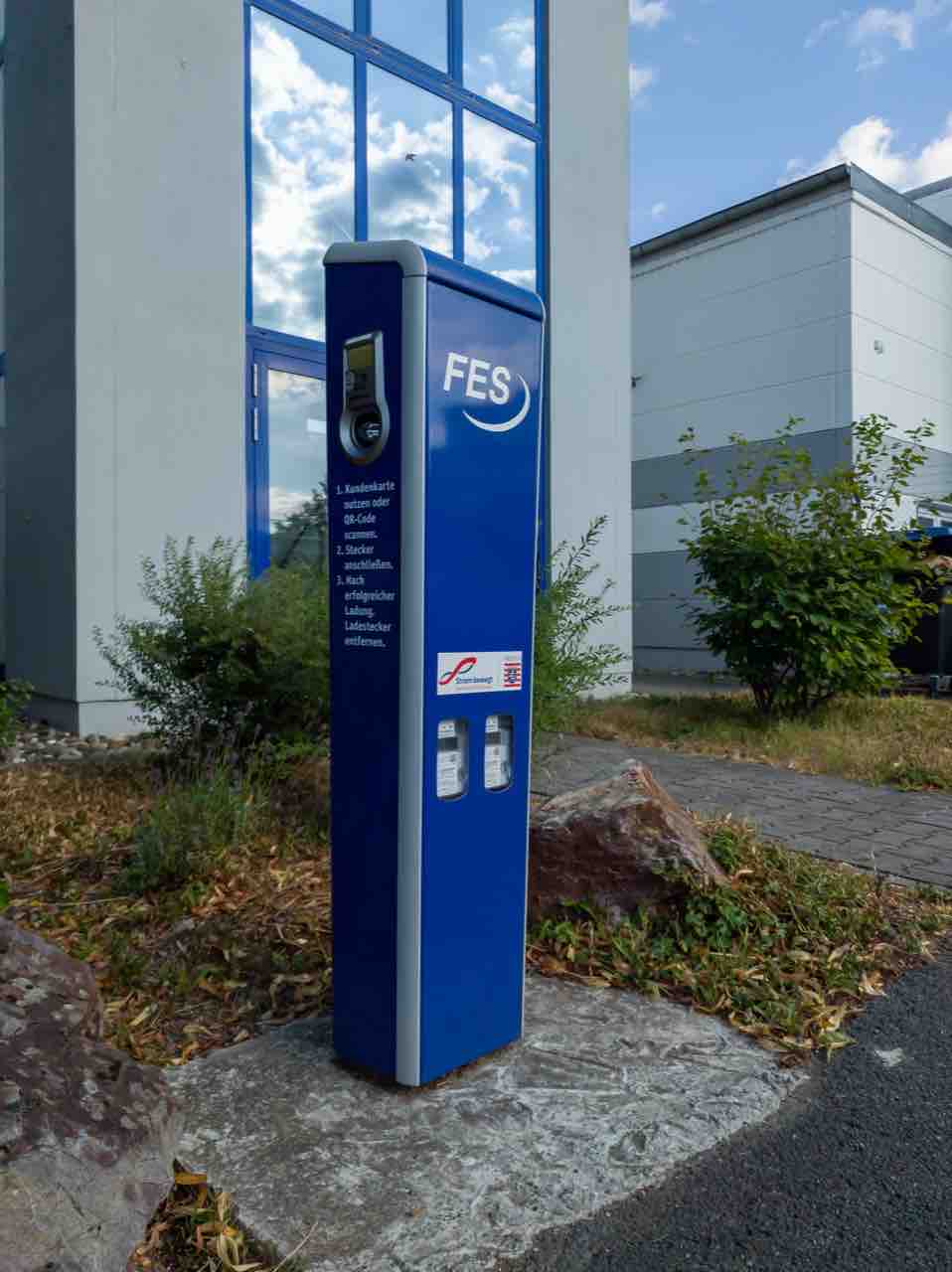
Image credit: public charging station photo via Wikimedia Commons.
Back to all articles · View comments & share on the interactive page