Buying a New EV in France in 2026: Incentives, Home Charging, and Daily Tips
France reshaped its electric-car support again in 2026, and the result is a layered set of aids aimed squarely at lower- and middle-income buyers — plus a no-deposit social lease. If you are shopping for a new EV in France this year, here is what the support looks like and how to live with the car day to day.
The 2026 purchase support: the "coup de pouce"
France replaced the old bonus écologique with a purchase aid called the prime « coup de pouce véhicules particuliers électriques », run through the energy-savings-certificate (CEE) framework. For a new 100% electric car, the amount depends on household income:
- Up to €5,700 for the lowest-income households (ménages précaires).
- Up to €4,700 for modest (non-precarious) households.
- Up to €3,500 for other households.
- Plus up to €2,000 (between €1,200 and €2,000 depending on version) if the battery is made in Europe.
The car must be a new BEV priced at no more than €47,000 and carrying an environmental score of 60 points or higher. From 1 January 2026 the income ceilings for the two lower tiers were raised to cover more families.
Sources: Taiwan Trade Bureau summary of French 2026 finance policy; evguide.uk France–UK comparison.
Social leasing is back for 2026
The leasing social scheme — a subsidised lease funded through energy-supplier certificates — reopened on 16 July 2026 for its third round, with 50,000 cars. To qualify you must be an adult resident in France with reference tax income per share of €16,880 or less, and need the car for work (home-to-work distance over 10 km, or more than 8,000 km/year for work). The deal: monthly rent capped at €200 including VAT, no deposit, a minimum three-year term, and at least 15,000 km/year included. State aid covers 29% of the purchase cost (excluding options), up to €6,500; if the car is built in Europe that rises to €9,000 (plus €500 if the motor is also European). Eligible vehicles are new BEVs under €47,000, under 1,800 kg, with an environmental score of at least 60.
Source: service-public.gouv.fr — Social leasing of electric cars (Leasing social 2026).
Charging at home is the French norm
For most French EV owners, home is the primary charger. Ademe reports that 84% of electric-car users have a charge point at or near home, and 53% at or near their workplace. That means public charging is usually a complement, not the main supply. If you have a driveway or assigned parking with power, a wallbox on off-peak electricity is by far the cheapest way to run an EV in France, where the low-carbon grid (about 46 g CO₂ per kWh) makes an EV's lifecycle emissions at least half those of a combustion or non-plug-in hybrid car.
Public charging as a backup
When you do charge away from home, set up two payment routes before you travel: a roaming app or card that covers several networks (Izivia, TotalEnergies, Ionity, Electra, Tesla) and contactless as a fallback. Ad-hoc pricing is typically €0.40–0.70 per kWh, and the card is usually the priciest option. Under AFIR, all 50 kW+ fast chargers must take contactless payment by 1 January 2027. Carry your own Type 2 cable for AC posts that are sockets rather than tethered leads.
Daily ownership tips
- Charge to 80%, not 100. The last fifth takes disproportionately long and blocks the stall behind you.
- Precondition the battery (while still plugged in) before a fast-charge or a winter mountain run — it shortens the charging stop.
- Watch low-emission zones (ZFE). Combustion cars of the wrong Crit'Air class are refused in ZFEs; an EV sails through, and many cities add free or discounted municipal parking and charging.
- Mind cold weather. Like everywhere, French winter range drops; plan a little extra buffer on long trips.
- Check the price before you plug in. Ademe specifically flags that public-charging price readability is weak — use the app to see the rate first.
Sources: Avere-France barometer; Ademe electric-car report; go-electra.com.
China Angle
China takes a different route to protecting EV buyers: it leans on battery-health regulation rather than purchase grants. Two standards now set a floor. GB/T 47136—2026, effective 1 May 2026, grades used traction batteries by health. A durability standard issued in August 2026 requires traction batteries to retain at least 82% capacity at 5 years / 100,000 km and at least 75% at 8 years / 160,000 km. A battery "digital ID" rule (effective 1 April 2026) traces each pack's history, which should make the used-EV market more transparent. Alongside this, a "warranty follows the car" (battery, motor and power-control warranty transferable) trend is spreading — brands such as Dongfeng Nissan, Roewe and Bestune now certify transferred battery/drive-unit warranties, though many makers still limit the warranty to the first owner as of late 2026. The shared lesson for French buyers: a health-graded, traceable battery is becoming the global baseline for resale confidence, even where the purchase subsidy has been withdrawn.
Sources: China industry reporting via yiche/sina/youjia. Standards verified against authoritative publications — GB/T 47136—2026 (national battery-health grading standard, effective 1 May 2026): https://openstd.samr.gov.cn/bzgk/std/newGbInfo?hcno=F493E6BDCF7210EB024E71C0BE1BA911; August 2026 durability rule (≥82% SOH at 5 yr/100,000 km, ≥75% at 8 yr/160,000 km): https://www.ce.cn/xwzx/gnsz/gdxw/202608/t20260802_3123113.shtml; battery digital-ID traceability rule (effective 1 April 2026): https://news.cnr.cn/native/gd/20260116/t20260116_527495168.shtml.
中文简报
2026年法国新购纯电车型支持:取代旧"生态奖金"的"coup de pouce"购车补贴,按收入分档——最低收入家庭最高5,700€、低收入4,700€、其他3,500€,电池欧洲制造另加最高2,000€;车型须为全新BEV、售价≤47,000€、环保评分≥60。社会租赁(leasing social)2026年7月16日重启,5万辆,家庭计税收入/份额≤16,880€,月租封顶200€、零首付、至少3年、年含15,000km,补贴最高6,500€(欧洲制造9,000€)。家用充电为主:84%用户家/近家可充电、53%工作场所可充。公共充电即付约0.40–0.70€/kWh,AFIR要求50kW+快充2027年1月前支持刷卡。中国视角:中国以电池健康法规护盘——GB/T 47136—2026(2026年5月1日生效)对退役电池分级;2026年8月耐久标准要求5年/10万公里≥82%、8年/16万公里≥75%;电池"数字身份证"规则2026年4月1日生效;"三电质保随车"趋势扩散(东风日产、荣威、奔腾等已认证过户质保)。
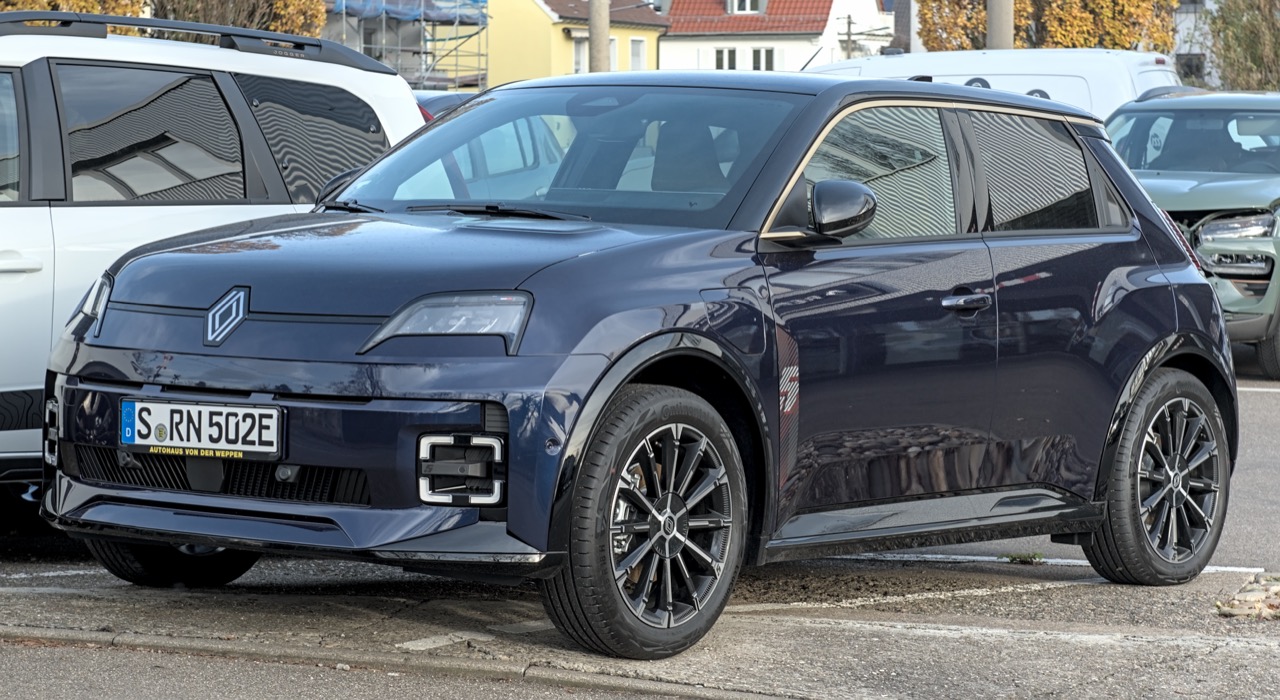
Image credit: Renault 5 E-Tech photo via Wikimedia Commons.
Back to all articles · View comments & share on the interactive page