Vehicle-to-Grid in France 2026: Why the Nuclear-Grid Nation Became Europe's V2G Lab
France is, paradoxically, the European country where plugging your car back into the grid is easiest to do today — even though its grid is under the least stress. With a single national distribution operator, smart meters in nearly every home, and a carmaker (Renault) that shipped the world's first consumer V2G offer, France has turned vehicle-to-grid from pilot to product. Here is how it works, why the structure fits, and what it means for EV owners.
What V2G actually does
Vehicle-to-Grid (V2G) is bidirectional charging: an EV can draw power from the grid and push it back. In practice it covers a spectrum — Vehicle-to-Home (V2H, powering your house during an outage), Vehicle-to-Load (V2L, running appliances from the car), and true V2G, where the car sells flexibility into the electricity system. The core requirement is a car with an onboard or charger-side bidirectional system, a compliant wallbox, and a tariff or aggregator contract that pays for the service.
The payoff is two-sided. For the owner, a car parked ~14–23 hours a day becomes a small, mobile battery that can shave peak grid demand and earn credits. For the grid, millions of EV batteries aggregate into gigawatts of flexible storage — useful for balancing supply and demand without building more peaker plants.
Why France is structurally ahead
Several structural factors make France unusually V2G-friendly:
- One grid operator to align with. France's transmission is run by a single TSO (RTE) and about 95% of distribution by Enedis, the national operator that also owns the metering points. That centralization means a V2G standard or exemption can be agreed once, not negotiated with hundreds of utilities. (By contrast, Germany has close to 900 distribution system operators.)
- Smart meters already everywhere. France's Linky smart-meter rollout finished in 2021, so the metering backbone for billing bidirectional flows has existed for years. Germany's smart-meter rollout lagged badly (under 10% penetration until recently), which is why its V2G economics stalled.
- A nuclear-heavy, low-stress grid. Roughly 70% of French electricity comes from nuclear plants, with large hydro storage. That keeps the system stable and means V2G is not yet a grid necessity — but it also means there is ample, cheap baseload to arbitrage against peaks.
- Early government framing. France's 2019 Energy and Climate Act created a regulatory "sandbox" letting the energy regulator (CRE) grant temporary exemptions from parts of the Energy Code — the legal lever that made a commercial V2G product possible.
The Renault offer: V2G you can actually buy
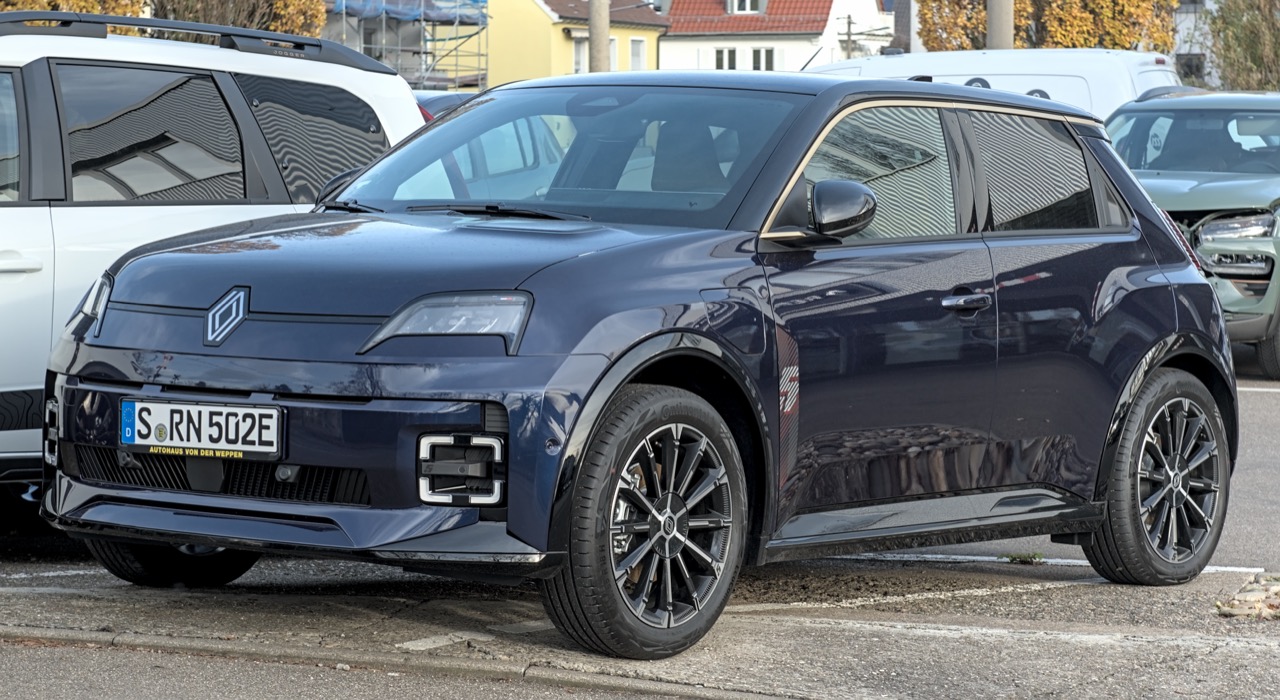
In October 2024, Renault Group, its Mobilize brand, and The Mobility House launched a commercial V2G service for private customers on the Renault 5 — the first such consumer offer in the world. It bundles a bidirectional AC charger (the PowerBox Verso), an onboard bidirectional charger in the car, a Mobilize electricity contract, and an app to schedule charging. The service has since been extended to other Renault and Alpine EVs.
The business case is real, if modest. Renault and Mobilize market savings of up to about €600 per year (claiming enough to "drive up to 10,000 km for free"); independent research by the Forschungsstelle für Energiewirtschaft (FfE) puts the realistic spot-market potential at roughly €260–370 per vehicle per year under current rules. CRE's sandbox exemption lets the contract apply a negative coefficient to grid fees during peak withdrawal windows, so feeding energy back at the right time actually lowers the bill.
The money side: countercyclical grid fees
France is now encoding V2G-friendly pricing directly into its tariff framework. Under TURPE 7 (the 2025–2028 tariff period set by CRE), optional countercyclical grid fees reward "grid-friendly" battery behavior — discharging in winter morning/evening demand peaks, or charging at midday in summer solar-injection zones. From August 2026, a regulatory-sandbox version of this countercyclical tariff was extended to V2G, letting storage owners net out charging and discharging costs. France also added a midday off-peak window in summer 2026 to pull load onto solar hours.
This is the structural advantage: where Germany still double-charges energy stored and fed back, France's sandbox actively pays V2G participants to behave well.
The caveats for buyers
V2G in France is still a niche. Only certain car-and-charger combinations are certified (Renault 5 + PowerBox Verso on the AC/ISO 15118-20 path; earlier CHAdeMO-based pilots existed from around 2020). Enedis and RTE themselves see limited near-term need to mass-integrate V2G because the nuclear grid is stable, and they prefer grid expansion and big stationary batteries. So the push is led by automakers and energy providers, not the grid operators.
For an EV owner, the practical checklist is: a compatible V2G-capable car (still a short list), a certified bidirectional charger, a supplier/aggregator contract that supports it, and a tariff that credits discharge. Battery degradation from cycling is the other open question — most warranties still treat deep bidirectional use cautiously.
China Angle
China's vehicle-to-grid path is policy-led rather than consumer-product-led, and is running at pilot scale. The top-level framework is 《关于加强新能源汽车与电网融合互动的实施意见》 (NDRC & NEA, document 发改能源〔2023〕1721号, December 2023), which set a 2030 goal of providing "tens of millions of kilowatts" (千万千瓦级) of bidirectional flexibility. That was followed by 《关于推动车网互动规模化应用试点工作的通知》 (发改办能源〔2024〕718号, August 2024), and on April 2, 2025, four ministries published the first batch of pilots — 9 cities (Shanghai, Changzhou, Hefei, Huaibei, Guangzhou, Shenzhen, Haikou, Chongqing, Kunming) and 30 projects (document 发改办能源〔2025〕241号, dated March 13, 2025).
The momentum is accelerating: in October 2025, six departments issued a "three-year doubling" action plan (2025–2027) targeting over 5,000 new bidirectional charge/discharge facilities and more than 20 million kWh of reverse discharge by end-2027; and China's 15th Five-Year power-system plan (2026) lifts the 2030 V2G aggregated adjustable-charging target to 50 GW — four times the 2025 baseline of 10 GW (People's Daily, Oct 12, 2026). Demonstration sites are already large: a Shenzhen station can serve 61 vehicles simultaneously at up to 4.21 MW.
For context on scale, China had 5.16 million public charging points and 24.22 million total (public + private) as of end-August 2026 (China EV Charging Infrastructure Promotion Alliance / National Energy Administration). Unlike France's consumer V2G offer, China's model is utility- and city-driven — but the underlying bet is the same: millions of EV batteries as a distributed grid resource.
中文简报
法国凭借单一配电运营商(Enedis 覆盖约 95% 配网)、2021 年已完成的 Linky 智能电表全覆盖、以及 2019 年《能源与气候法》设立的监管沙盒,成为欧洲最早把 V2G 从试点变成消费品的国度。2024 年 10 月,雷诺集团联合 Mobilize 与 The Mobility House 在 Renault 5 上推出全球首个面向私人消费者的商用 V2G 服务(PowerBox Verso 双向交流桩 + ISO 15118-20 + 专属电价合约),车主年省最高约 600 欧元(FfE 独立研究估算实际约 260–370 欧元/车/年)。法国 CRE 在 TURPE 7(2025–2028 tariff 周期)引入"逆周期"电网费,2026 年 8 月起以沙盒形式延伸至 V2G,放电填谷可抵扣电费。但 V2G 在法国仍是小众,仅限于少数车型+桩组合,且电网公司(Enedis/RTE)因核电为主、系统稳定,对大规模接入动力不足,主要由车企与能源商推动。
Sources
- European Commission, Directorate-General for Energy — "Guidance on regulatory sandboxes and living labs in the EU for vehicle-to-grid pilots" (2026): https://energy.ec.europa.eu/publications/staff-working-document-guidance-regulatory-sandboxes-and-living-labs-eu-vehicle-grid-pilots_en
- The Mobility House — "France vs. Germany: The Race for V2G Leadership": https://mobilityhouse-energy.com/int_en/knowledge-center/article/france-before-germany-v2g
- FfE (Forschungsstelle für Energiewirtschaft) — "V2G Integration in Europe — France, UK, Germany" (whitepaper): https://www.ffe.de/wp-content/uploads/2025/02/FfE-Whitepaper-V2G-UK-FR-DE-ENGLISH.pdf
- CRE / TURPE 7 countercyclical grid fees: https://www.watture.eu?p=464/
- People's Daily (China) — "新能源车当充电宝,城市准备好了吗" (Oct 12, 2026): https://paper.people.com.cn/zgcsb/pc/content/202610/12/content_30185176.html
- NDRC — first V2G pilot batch notice (发改办能源〔2025〕241号, published Apr 2, 2025): https://www.ndrc.gov.cn/xwdt/tzgg/202504/t20250402_1396960_ext.html
- NDRC/NEA — framework opinion on NEV-grid integration (发改能源〔2023〕1721号) and pilot notification (发改办能源〔2024〕718号)
Image credits
- Renault 5 E-Tech — Wikimedia Commons (photographer-contributed, CC license).
Back to all articles · View comments & share on the interactive page