South Korea's Solid-State Battery Race: Samsung SDI, LG, and SK On Bet on 2027
South Korea is making a national bet on solid-state batteries. In late September and early October 2026, Seoul published a government-industry technology roadmap and a green-transformation strategy that put next-generation cells at the center of the country's industrial policy. The three domestic giants — Samsung SDI, LG Energy Solution and SK On — each have their own timeline, but all are racing against the same threat: China's dominant lead in today's liquid lithium-ion market.
A national roadmap built around 2030
On September 22, 2026, South Korea's Ministry of Trade, Industry and Energy (MOTIE) joined LG Energy Solution, Samsung SDI and SK On at the Korea Chamber of Commerce in Seoul to release a Battery Industry Technology Roadmap. Its core commitments: produce all-solid-state battery prototypes in 2027 and reach commercialization by 2030. The government plans about 400 billion won of new R&D funding from 2027 over five years, with the private sector targeting roughly 8 trillion won of investment through 2030.
Two weeks later, on October 7, President Lee Jae-myung unveiled the K-GX (Green Transformation) strategy, a roughly 1,000-trillion-won plan over ten years that explicitly names next-generation battery verification and commercialization as priorities.
Samsung SDI: the flag-bearer for 2027
Samsung SDI is the most aggressive of the three. It is pursuing a sulfide-based, anode-less cell it calls SolidStack, targeting mass production in the second half of 2027 at its Ulsan plant, with a volume energy density around 900–1,000 Wh/L — roughly 40% above its current prismatic cells. A pilot line (the S-Line) is already running at its Suwon R&D center, and it has been shipping sample cells to customers for evaluation.
The company is also putting money behind the plan: it is investing about 25 trillion won through 2040 across Ulsan and Cheonan, and it took full ownership of its New Carlisle, Indiana plant (after buying GM's 49.9% stake) for North American supply. Notably, Samsung SDI has said the first commercial use of its solid-state cell may not be cars at all but humanoid robots, where space and peak-power demands are extreme and validation cycles are shorter.
SK On and LG Energy Solution: a later start
SK On has set commercialization for 2029, with a pilot-stage target of 800 Wh/L and pilot-line trials in 2027. LG Energy Solution has also pointed to 2029 for sulfide all-solid-state commercialization and is building a dry-electrode all-solid-state pilot line in the second half of 2026 — while also steering more resources toward the North American energy-storage (ESS) market, where it aims for over 50 GWh of capacity by the end of 2026.
Why Korea is pushing so hard
The urgency is structural. Analysis published in October 2026 noted that South Korean battery makers' global market share fell from roughly 23–25% in 2023 to about 15.3–16% in 2025, while six leading Chinese firms together hold around 67%. In key materials — anodes, separators, electrolytes — Korean shares are all below 7%. Having largely lost the liquid-lithium race on cost, Seoul is betting that solid-state can be the hand to reshuffle.
A reality check is warranted: 2027 is a target, not a commitment. As of late 2026, Samsung SDI's validated work still sits at the Suwon pilot line, and every producer's claimed date remains at least 12–18 months out. The hard part — manufacturing consistency, yield and cost — is exactly where liquid cells are already mature.
China Angle
China is on the same 2030 destination but is approaching it from a position of scale. On September 28, 2026, China's Ministry of Industry and Information Technology (MIIT) and six other departments released the 15th Five-Year Plan for the Development of the New Battery Industry, which sets initial large-scale all-solid-state application for 2030 (source: 36Kr, reporting the seven-department plan).
Corporate timelines are clustered around 2027 for small-batch trials. BYD runs a 2 GWh sulfide all-solid-state pilot line in Shenzhen Pingshan that began operation in February 2026 — described as China's first automotive-grade sulfide all-solid-state pilot line — with a planned 20 GWh mass-production line in Chongqing's Bishan district; BYD targets small-batch installation on high-end models in 2027 (sources: 36Kr; SMM/10jqka). CATL has built a 1 GWh sulfide pilot line and guides small-batch trial production for 2027; chairman Robin Zeng rated its all-solid-state maturity at "level 4 of 9" in June 2026, with level 7–8 targeted for 2027. CATL's semi-solid (condensed-state) cells, by contrast, entered mass production and began OEM deliveries in the third quarter of 2026 with ranges up to 1,500 km (sources: 36Kr; Toutiao/industry roundup). Chery has a 0.5 GWh pilot line in Wuhu producing 60 Ah automotive-grade cells, with on-vehicle verification planned for 2027 (source: 36Kr).
What is actually shipping today is semi-solid, not fully solid. NIO's 150 kWh semi-solid pack (supplied by WeLion) has been available as a customer option since 2024, and SAIC's MG4 uses Qingtao semi-solid cells. In August 2026 China published GB/T 48093.1-2026, a standard that formalizes the terminology of liquid, hybrid solid-liquid and all-solid-state cells (source: Toutiao, Oct 2026). For context on the scale gap, SNE Research reported that in the first half of 2026 the seven largest Chinese battery firms held 72.4% of global power-battery installations (608.5 GWh total). No fully solid-state cell had reached a customer car anywhere as of 2026 — Korea and China are racing the same physics, not just each other.
Image credits
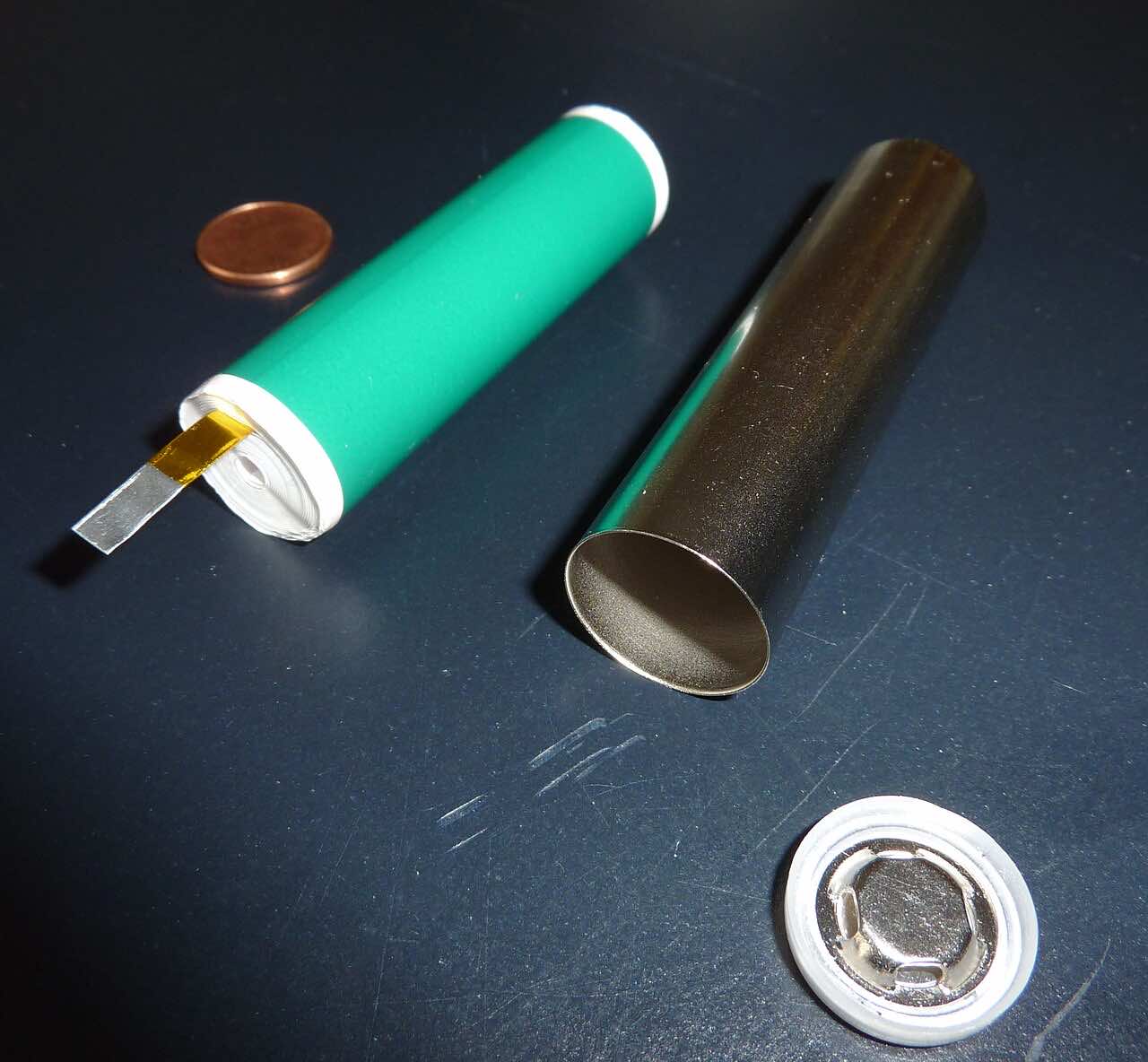
- Battery cell: photo via Wikimedia Commons (File:Lithium-Ion Cell cylindric.JPG), CC license. Illustrative of battery technology.
Sources
- 36Kr (English) — China/Japan/Korea solid-state 2030 plans, company timelines: https://eu.36kr.com/en/p/4024227042070659
- SMM / 10jqka — China all-solid-state pilot lines, BYD/CATL: https://m.10jqka.com.cn/20261015/c680726985.shtml
- pedaily — Korea roadmap, Samsung SK LG timelines, market-share context: https://m.pedaily.cn/news/570267
- ifeng — Korea roadmap and K-GX strategy: https://h5.ifeng.com/c/vivo/v002ZYqIm-_FnI6GXVuWELNO--ynya--bGYNVw1PGqlQYAm--Rg__?isNews=1
- EET-China — Samsung SDI SolidStack, 900 Wh/L, Suwon pilot, Ulsan 2027: https://www.eet-china.com/mp/a529444.html
- Battery-Design.net — Samsung SDI / global solid-state timelines, cautionary read: https://www.batterydesign.net/solid-state-production-timelines/
- Toutiao — semi-solid already in cars, GB/T 48093.1-2026 standard: https://www.toutiao.com/a7695650912802554410
- SNE Research — Global EV battery usage H1 2026: 608.5 GWh total, 7 Chinese makers = 72.4% share: https://www.sneresearch.com/en/insight/release_view/706/page/7
中文简报
2026年9月下旬至10月初,韩国发布国家层面的固态电池路线图:9月22日产业通商资源部联合三星SDI、LG新能源、SK On发布《电池产业技术路线图》,目标2027年出试制品、2030年商用;10月7日李在明总统发布K-GX绿色转型战略,十年约1000万亿韩元投入。三星SDI最激进,硫化物无负极"SolidStack"目标2027下半年蔚山量产、体积能量密度约900–1000Wh/L,水原中试线已向客户送样;SK On定2029年商用、800Wh/L;LG新能源同样定2029年,并转向北美储能市场。背景是韩国电池全球市占率已从2023年23–25%降至2025年约15.3–16%,而中国六家头部企业合计约67%,韩国寄望固态"换牌"。但2027仍是目标而非承诺,量产前仍有良率与成本关口。中国方面,工信部等七部门9月28日发布《新型电池产业发展十五五规划》,明确全固态初步规模化应用锚定2030年;比亚迪深圳坪山2GWh硫化物中试线2026年2月投产、重庆璧山规划20GWh;宁德时代1GWh中试线、目标2027小批量,半固态已量产交付;奇瑞芜湖0.5GWh中试线。真正装车的是半固态(蔚来150kWh、上汽MG4),全固态截至2026年尚无任何量产车搭载。
Back to all articles · View comments & share on the interactive page