Cambodia EV Road Trip 2026: Phnom Penh–Sihanoukville Expressway and the Real Cross-Border Charging Reality
Cambodia's intercity EV travel is finally becoming practical in 2026, led by the Phnom Penh–Sihanoukville Expressway (PPSHV) — the country's only tolled motorway and its first real "charging corridor." This owner's guide covers how to plan a coastal road trip, where to plug in, how to size your range buffer, and the honest truth about driving your Cambodian EV across the border into Thailand.
Plan your route: the PPSHV Expressway
The Phnom Penh–Sihanoukville Expressway (concession name PPSHV) is the backbone of any Cambodian EV road trip. It runs about 187 km and cuts the capital-to-coast drive from 5–6 hours on National Road 4 to roughly 90 minutes, with a 120 km/h car speed limit.
A few things that are specific to Cambodia and catch first-timers out:
- It's a toll road. Expect about US$15 one-way for a car (~$30 round trip), collected on a closed distance-based system at the exit. Pay with a free ETC/OBU tag, via ANPR plate top-up (ABA, KB PRASAC apps), or cash/card at the manual booth. Motorcycles under 500cc are barred.
- It's the only expressway that charges today. The Phnom Penh–Bavet (Vietnam-border) route is still under construction and the Phnom Penh–Siem Reap–Poipet (Thailand-border) expressway is only in feasibility study — so for now, your reliable fast-charging corridor is PP↔Sihanoukville.
- Toll-free fallback exists. National Road 4 runs parallel and free, but doubles your travel time. Keep it as a backup if a charger on the expressway is down.
Charging on the Phnom Penh–Sihanoukville corridor
As of 2026, public DC fast-charging is reported at expressway service areas — most consistently cited at Kampong Speu (~63 km from Phnom Penh), Veal Renh (~156 km), and Prey Nob (near the coast). Treat these as "verify on the day" rather than guaranteed, because Cambodia's network is young and a handful of operators have struggled with transformer-cost rules.
Practical owner advice for this corridor:
- Carry your own CCS2 cable for AC, but DC is plug-in. Cambodia's public grid runs CCS2 (and GB/T at some Chinese-brand sites). Most DC fast chargers are CCS2 plug-in; many AC points expect you to supply your own Type-2 cable.
- Use the national app. The Electricity Authority of Cambodia (EAC) launched a national EV-charging app that locates, starts, and pays across networks (EDC, BYD, private operators) — one app instead of juggling providers.
- Budget the tariff. Regulated 2026 public rates: AC ≈ 1,050 Riel/kWh (~$0.26), DC fast ≤250 kW ≈ 1,350 Riel/kWh (~$0.34), and DC "super" >250 kW ≈ 1,450 Riel/kWh (~$0.46). A ~400 km round of mixed driving typically costs a few dollars in an EV versus $8–9/100 km for a petrol SUV.
- Watch the rollout. BYD's "Flash Charging" 10-minute stations (18 of them) are targeted for Phnom Penh, Sihanoukville and Siem Reap by end-2026, and ZO Motors/EDC plan 200+ new fast chargers this year — so the corridor will only get easier.
Range planning: how much buffer to carry
Cambodia is not yet a "charge anywhere" country, so plan like an early-adopter, not like a European or Chinese driver:
- Top up before you leave Phnom Penh. The capital is the densest charging hub; provincial coverage is uneven.
- Don't cut it below 20%. Heat (often 35–40°C) and A/C load shrink real-world range, and a downed expressway charger means a detour to National Road 4.
- Know your car's plug. Official BYD/Chinese-brand models plug straight into CCS2. Many Teslas in Cambodia are parallel imports and may need a CCS2 adapter — verify yours before a road trip.
- For Siem Reap or up-country, route through known corridors and confirm the nearest DC fast charger to your destination first; the PP–Siem Reap expressway isn't built yet, so that trip is still largely on ordinary highways with spottier coverage.
The real cross-border-into-Thailand charging reality
This is where hype meets Cambodian reality. Technically, charging is easy; driving across is the hard part.
- Plugs match. Thailand has standardized on CCS2 as its primary DC standard (ASEAN is harmonizing on CCS2 by 2026), so your Cambodian CCS2 car physically charges there without adapters.
- Roaming exists. The Charge+ app already roams onto Thailand's EGAT network, and Charge+'s 5,000 km "EV charging highway" links Cambodia, Thailand, Malaysia, Singapore and Vietnam under one account — no new app, multi-currency billing handled.
- But you'd be driving on the wrong side. Cambodia drives on the right; Thailand drives on the left. A Cambodian left-hand-drive car is legal in Thailand only as a temporary import with paperwork, and it's genuinely awkward to pilot for hours. Most Cambodian owners therefore don't actually drive their cars into Thailand — they charge near the Poipet border and let Thai-registered EVs (or Thai rentals) do the Thai leg.
- If you do cross, charging isn't your worry. Thailand leads ASEAN with 10,000+ public charging stations, so once you're over the border, finding a charger is far easier than in Cambodia. The friction is the border formalities and the opposite traffic side, not the plug.
- Bottom line: plan your "cross-border" as charge-up-and-turn-around at the border, or rent/use a Thai-registered EV for the Thai side. Don't assume a seamless cross-border drive yet.
What to carry on a Cambodia EV road trip
- Your CCS2 readiness (and a Type-2 AC cable if your car uses detachable AC).
- The EAC national charging app plus a backup like Charge+ (covers Thai roaming if you cross).
- A CCS2 adapter if you drive a US/EU-spec Tesla.
- A physical RFID/toll tag or enough ABA/cash for the expressway exit.
- A 22 kW-capable portable cable and patience — coverage outside PP is still growing, so a buffer of range and time saves the trip.
China Angle
From where I sit in China, reading about Cambodia's first EV road trips feels like watching our own 2016–2018 highway era. Here, a long-distance EV drive is almost boring now: on the Jinghu, G4 and G15 highways you'll find 250–480 kW ultra-fast chargers every 30–50 km, and NIO's 换电 (battery-swap) stations let you swap a depleted pack for a full one in about three minutes — no plugging, no waiting. Apps like 高德 (Amap) and 百度地图 show real-time charger availability, queue length and price before you even leave the garage, so "range anxiety" on a Beijing–Shanghai run is basically solved.
Cambodia is at the very beginning of that curve. The PPSHV is getting its first charging nodes, the national app just launched, and a cross-border plug-in still means wrestling with left/right-hand traffic and border paperwork. My advice to Cambodian owners is the same patience Chinese early-adopters needed: carry more buffer than the spec sheet suggests, lean on the national app, and treat the expressway corridor as your one proven route — the dense, swap-station-everywhere future is coming, just not this year.
Sources
- TollGuru — Cambodia Toll Roads Complete Guide (PPSHV rates, distance, payment, 2026): https://www.tollguru.com/toll-wiki/cambodia-toll
- ASEAN NCAP — ASEAN Unifies EV Charging Standards with CCS-2; cross-border roaming (2026): https://www.aseanncap.org/tag/asean-ev-charging
- Charge+ — 5,000 km EV Charging Highway across 5 ASEAN countries (Cambodia/Thailand roaming): https://www.chargeplus.sg/post/announcement-from-charge-the-launch-of-5-000km-ev-charging-highway-in-southeast-asia
- People's Daily / Xinhua reporting on Cambodia EV policy, EDC charging rollout and BYD Sihanoukville plant (2025–2026): https://world.people.com.cn/n1/2026/0116/c1002-40646257.html
Image credits
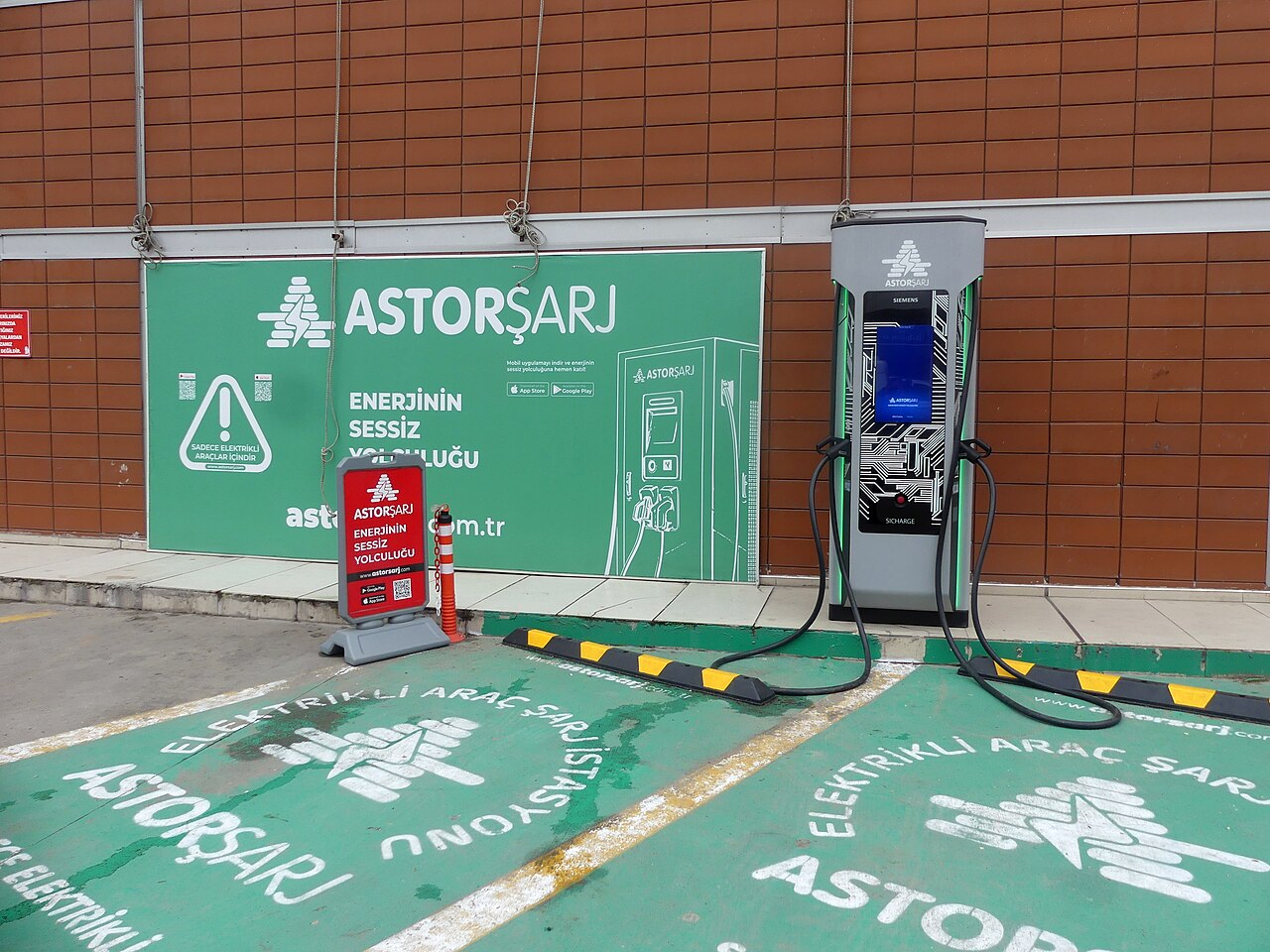
Cover photo: "Electric car charging station, Batman (Turkey)" by Zalasem1, via Wikimedia Commons (CC). File page: https://commons.wikimedia.org/wiki/File:Electric_car_charging_station,_Batman_(Turkey).jpg
Back to all articles · View comments & share on the interactive page