From Ladder Frames to Monocoques: How China's Off-Roader Body Tech Is Splitting in Two
In the off-road world, there is an unwritten rule: a real hard-core 4x4 must have a ladder frame. A real ladder frame — what engineers call a body-on-frame construction — is a separate, rigid steel chassis that the body sits on top of, like a passenger cabin riding a flatbed. In theory, even without the body, the bare frame can drive down a road.
Why ladder frames ruled off-road for half a century
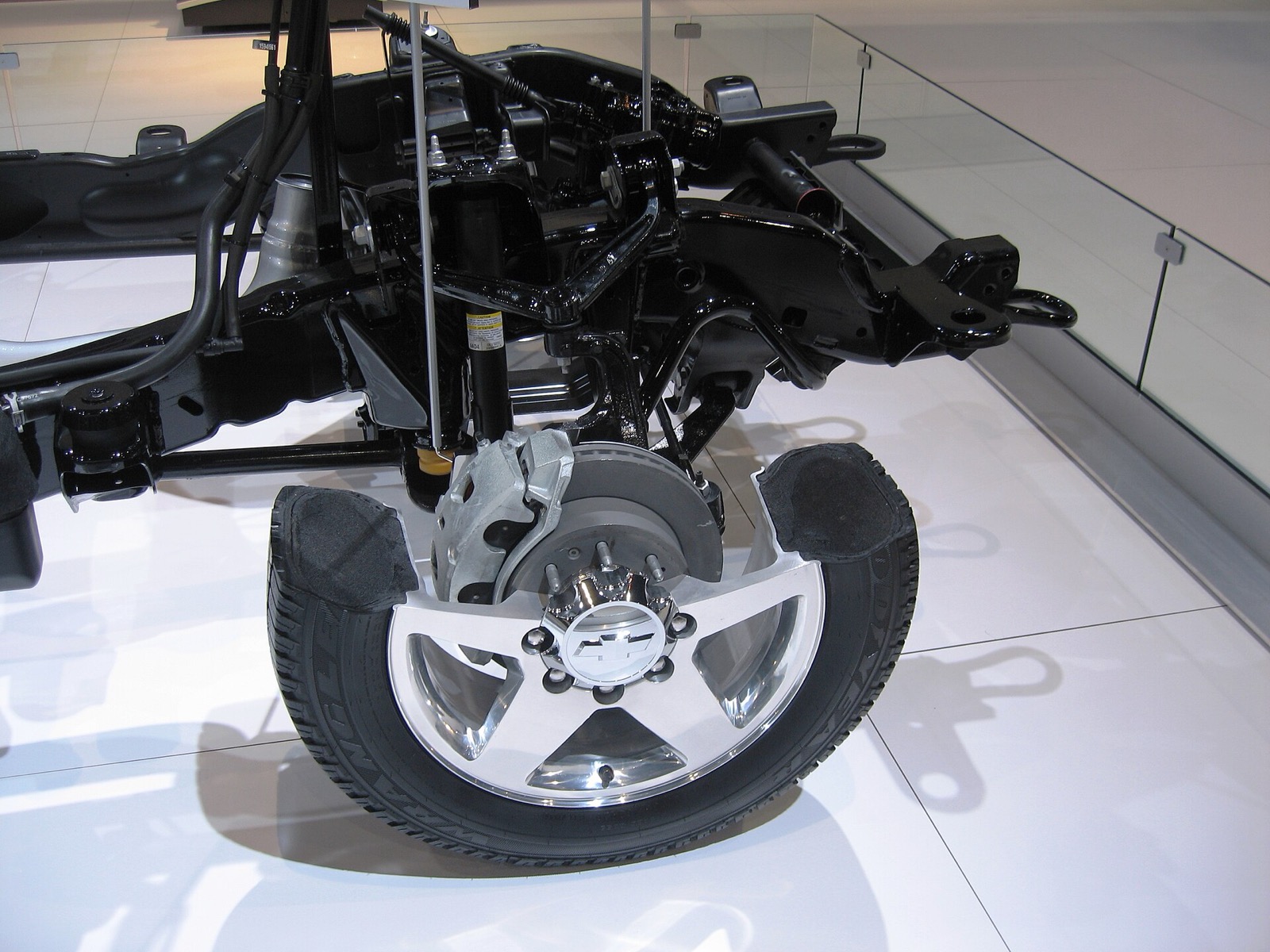 A cutaway of a body-on-frame ladder chassis — two longitudinal rails carry the powertrain and the body sits on top. The kind of structure every traditional hard-core off-roader still relies on. (Image: Wikimedia Commons, CC BY 2.0)
The frame's job is to resist twisting. When an off-roader crosses an axle-twister or drops into a hole, the four wheels are loaded in wildly different directions and the body wants to twist like a wrung-out rag. A typical body-on-frame SUV has a torsional stiffness of 20,000–30,000 N·m/°, which is high enough to keep the body and the powertrain aligned through the worst the trail can throw at them. If the frame is too soft, doors won't shut, panels crack, and major powertrain components shift enough to cause real damage. This is why the Toyota Land Cruiser, the Mercedes G-Wagen, the Jeep Wrangler and the Land Rover Defender all use ladder frames.
A ladder frame also gives a tall floor and big approach and departure angles, and it lets the body be mounted on soft bushings, which — on a properly engineered vehicle — can cut the vibration that reaches the cabin by more than half. That is the second reason off-roaders have always felt more comfortable on long-distance gravel than unibody SUVs.
But the ladder frame has a tax: it is heavy, it is high, and it is clumsy on a paved road. The body and the frame are two separate structures in two separate materials; the centre of gravity is high, the cornering roll is large, and the whole vehicle feels heavy-handed on a highway or in a city. In short, the ladder frame is what lets you conquer the wild, but it is also what you pay for every day on the commute.
 A 2024 Toyota Land Cruiser Prado on a Philippine street. The Prado is one of the vehicles that made the body-on-frame "ladder frame" the default choice for serious off-roaders, and it is the kind of vehicle Chinese buyers have long associated with the "real" off-roader image. (Image: Wikimedia Commons, CC BY-SA 4.0, Captainmorlypogi1959)
The workarounds that still need a ladder frame
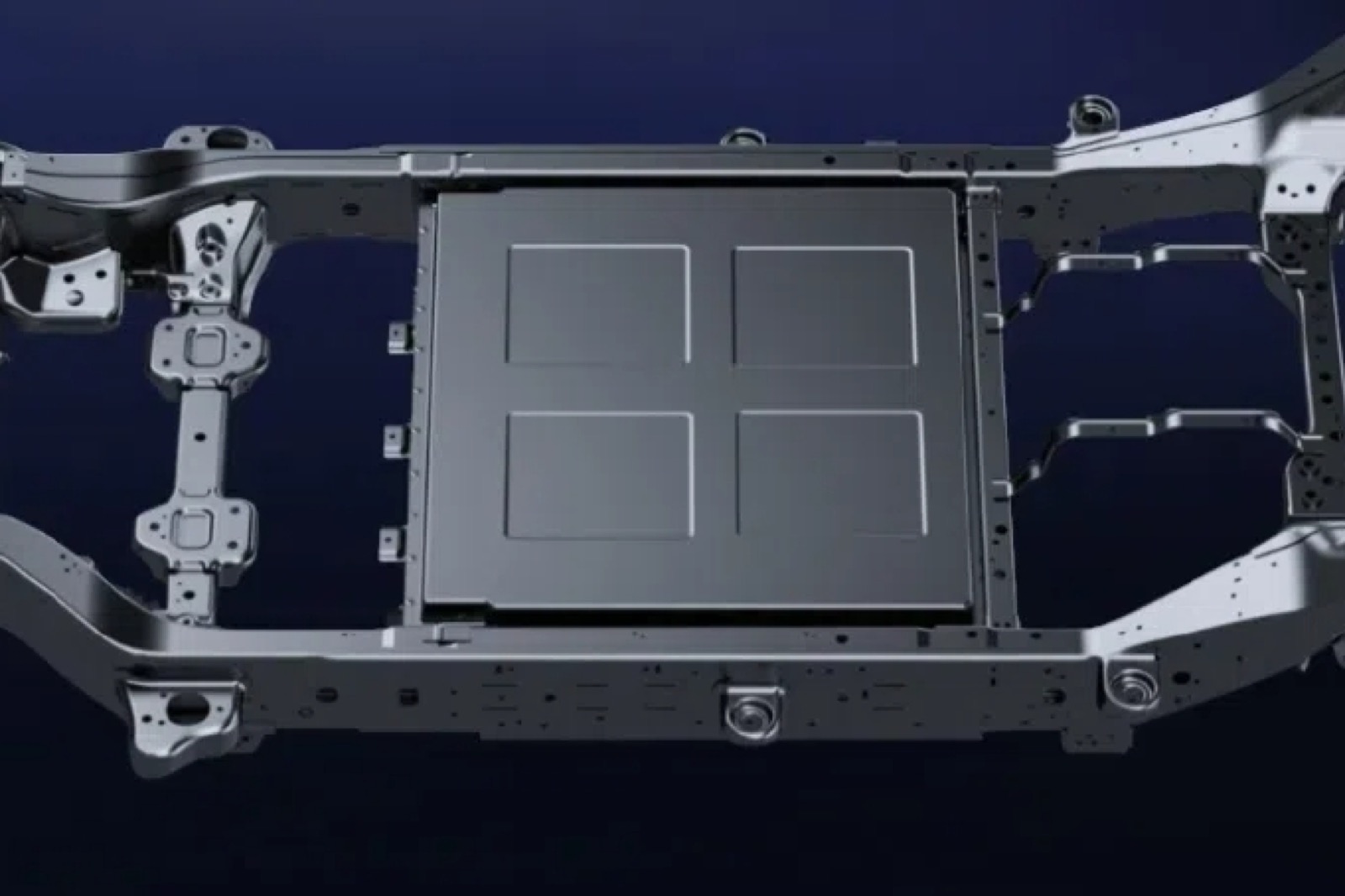 BYD Fangchengbao Bao 5 DMO platform — the Blade Battery pack is integrated between the two ladder-frame rails as a structural member via CTC (cell-to-chassis) technology. (Image: Fangchengbao / BitAuto official product material)
For a long time, the only way for a Chinese car maker to enter the off-road segment was to follow that rule. That is why the first two products of BYD's Fangchengbao brand — the Bao 5 and the Bao 8 — are still built on a body-on-frame structure. They are not "old-fashioned" for the sake of it: when the customer is genuinely going to take the vehicle over axle-twisters and rock gardens, ladder-frame torsional rigidity remains the physically best answer.
What the Bao 5 and Bao 8 do differently is pair the frame with BYD's DMO (Dual Mode Off-road) Super Hybrid Off-Road Platform, which fuses the frame with the Blade Battery via a CTC (cell-to-chassis) battery-chassis integration. The Blade cells become a structural part of the chassis, not just an energy source. The frame's torsional stiffness is reportedly 38% higher than a conventional luxury off-roader's, the centre of gravity sits closer to the golden middle of the wheelbase, and the car achieves a 50:50 axle-load distribution. The vehicles also drop in a "Leopard Turn" function that uses opposite-direction torque on the front and rear wheels to cut the turning radius to 3.4 m.
In other words: where the user really does want to take the vehicle off-road, the ladder frame is still the right baseline. DMO + CTC just removes some of the trade-offs that used to come with it.
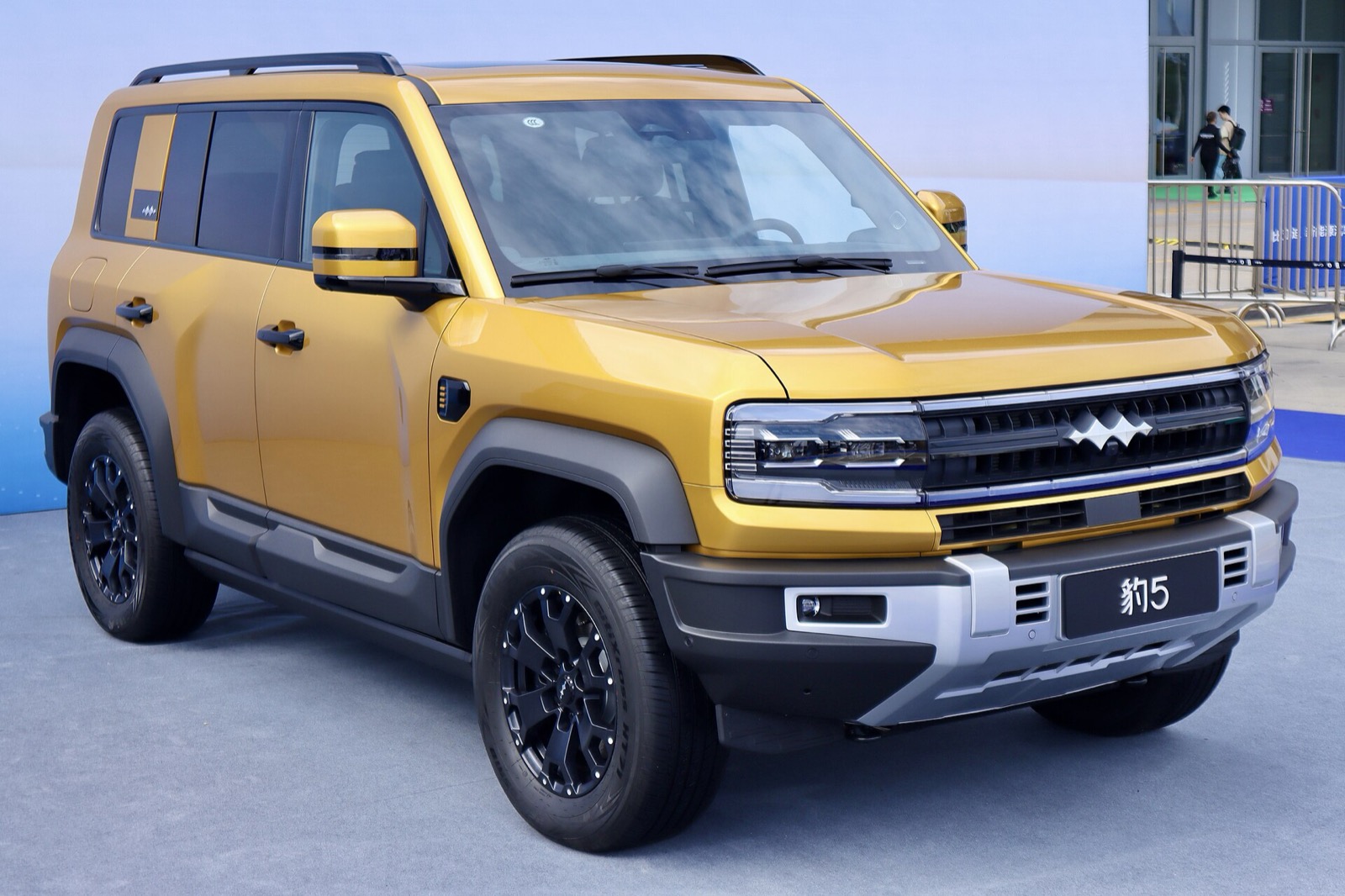 A 2024 Fangchengbao Bao 5 at an auto show, the first production vehicle on BYD's DMO platform. The body-on-frame is still there, but the Blade battery has been turned into a structural member of the chassis via CTC, taking some of the weight and centre-of-gravity penalty out of the traditional ladder frame. (Image: Wikimedia Commons, CC BY-SA 4.0, User3204)
A sharper insight: most buyers do not actually need a ladder frame
The thing that the off-road industry is only now admitting is that most of the people who buy an off-roader never go off-road.
The typical buyer falls into two camps. The first wants the look — the boxy silhouette, the upright glass, the chunky bumpers, the "I-could-go-anywhere" energy, which works just as well on a city street as it does on a trail. The second wants the idea of "out there" — driving the car to a meadow, a lake, a campground at the base of a hill, with the family and the dog, and not much else. Neither of those buyers really needs 20,000 N·m/° of torsional rigidity. They need a vehicle that looks like it can go anywhere, can handle a gravel road, and is comfortable and easy to live with on the way.
Both of those demands point to the same kind of car: an SUV that looks like an off-roader, can handle a light gravel road, but drives like a city SUV. The key metric is not "how steep a slope can it climb" — it is "how does it feel on Monday morning".
That is exactly the gap that the Fangchengbao Tai 7 (钛7) — launched in April 2026 at the Beijing Auto Show at 17.98–23.98万元 — fills. The Tai 7 wears a boxy off-roader shape and offers real mild off-road numbers (24° approach, 25° departure), but it is built on a monocoque (load-bearing) body without a separate frame. The weight is about 15–30% lighter than a ladder-frame equivalent, the centre of gravity is lower, the cabin is more spacious, and the on-road handling is closer to a city SUV. The trade-off — slightly less extreme torsional rigidity — does not matter, because the buyers were never going to use the 9,000 N·m/° they were paying for.
The other end of the spectrum: keeping the frame, owning the segment
At the other end of the spectrum, the Chinese off-road industry is also doubling down on the traditional ladder frame for the buyers who really do use it. At the same 2026 Beijing Auto Show, Beijing 212 (the brand that has been making 4x4s in China since 1965) unveiled two new technical platforms.
- The Xiake (侠客) platform is the pure-off-road school. Five-link solid axles at both ends, body-on-frame, supports petrol, diesel, and hybrid powertrains, and can be built as a 3-door, 5-door, or pickup. The first product on it is the Tanjingzhe 01 (探境者01) pickup, priced at 17.99万元 with a 2.3T diesel, 254 mm ground clearance, 850 mm wading depth, and a ZF 8-speed automatic.
- The Yuanzheng (远征) platform is the future-facing one. It keeps a body-on-frame layout but adds a front-mid engine position for better mass distribution, and uses Horizon Robotics' driver-assistance stack and an AI large-model cabin. Its first SUV is "the brand's first mid-to-large SUV".
212 is the most explicit statement yet of the philosophy that, in the part of the market where the user really is going to take the vehicle to a desert, a frame is non-negotiable.
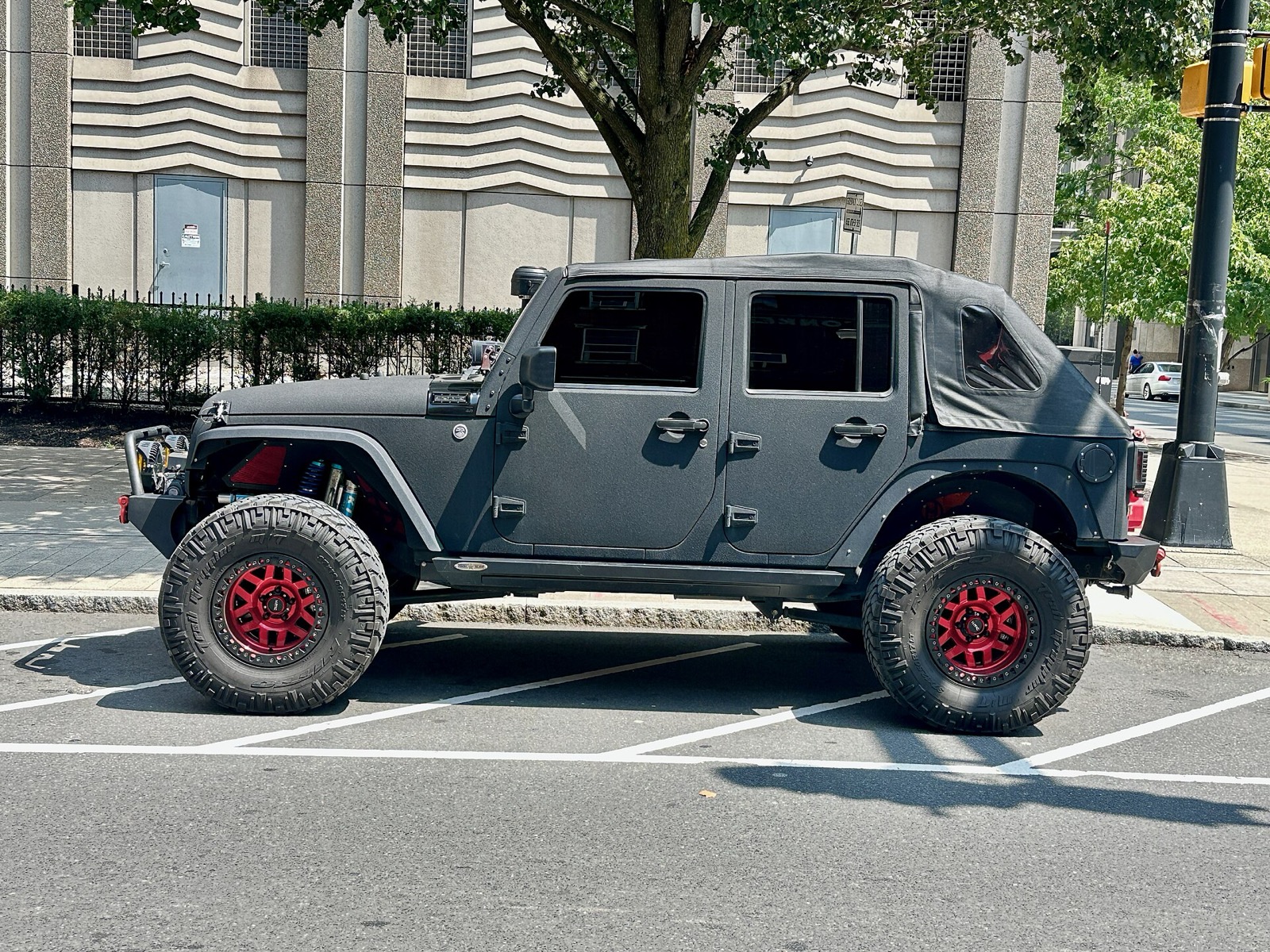 A Jeep Wrangler, the global archetype of the "we kept the ladder frame" school of off-roader design. China's 212, the Bao 5 and the Bao 8 sit in the same structural tradition: when the customer genuinely needs to leave the road, the body-on-frame is still the right baseline. (Image: Wikimedia Commons, CC BY-SA 4.0, Oleg Yunakov)
Two paths, one market
The next generation of Chinese off-road body technology is not converging on a single answer. It is splitting into two:
- The ladder frame stays for vehicles that will genuinely be taken off-road. The Bao 5 / Bao 8 and the 212 侠客/远征 are the loudest statements of that. CTC battery-chassis integration, DMO, and 2.0T powertrains make the frame less of a compromise than it used to be.
- The monocoque takes over for vehicles whose buyers want the off-roader look without the off-road use. The Fangchengbao Tai 7 is the first Chinese car maker to put a hard-core off-roader design on a load-bearing body, and it has become one of the most talked-about new SUVs of 2026.
The deeper shift is what this says about the off-road customer. For half a century, the "real off-roader" was defined by its frame. In 2026, it is being redefined by what the buyer actually does with the car. Most of them are not driving into the desert. They are driving to the supermarket, the office, and the campground. A vehicle does not need a ladder frame to do any of those three things, and a smart industry is now starting to give the customer a more honest, more comfortable, more efficient tool for the job — while keeping the original ladder-frame tool for the customer who genuinely needs it.
The "iron rule" of the off-roader is not disappearing. It is being divided into two: an iron rule for the 10% of buyers who will actually use the vehicle in the desert, and a different rule — equally disciplined, but built around a monocoque and a focus on daily comfort — for the 90% who will not.
China-only context: Bao 5, Bao 8 and Tai 7 are China-market products of the BYD Fangchengbao brand. 212 is a separate China-only off-road brand. The Toyota Land Cruiser Prado and Jeep Wrangler are referenced purely as the established global benchmark for the body-on-frame design language; the article is not about those vehicles.
Back to all articles · View comments & share on the interactive page