Under the Skin of a Modern PHEV: Why Range Extenders Are Flattening and Exhaust Systems Are Disappearing
Plug-in hybrids carry a quiet structural contradiction that nobody talked about in the era of the petrol car. The traction battery — by far the most expensive component in the powertrain — is being enlarged every model year, while the engine and the exhaust system it requires are still occupying huge amounts of chassis space. In an internal-combustion layout, the engine is the protagonist and the exhaust is the necessary supporting cast; the rest of the floor is built around them. In a plug-in hybrid, the battery is the protagonist. The two design philosophies now collide on the same platform.
Once the battery crosses the 40 kWh mark, this contradiction stops being something engineers can work around and becomes something they have to solve.
The range-extender: smaller, and flatter
The clearest line of attack is to make the range-extender itself physically smaller and — more importantly — physically flatter.
Yangwang U7: a flat-four for a flat battery
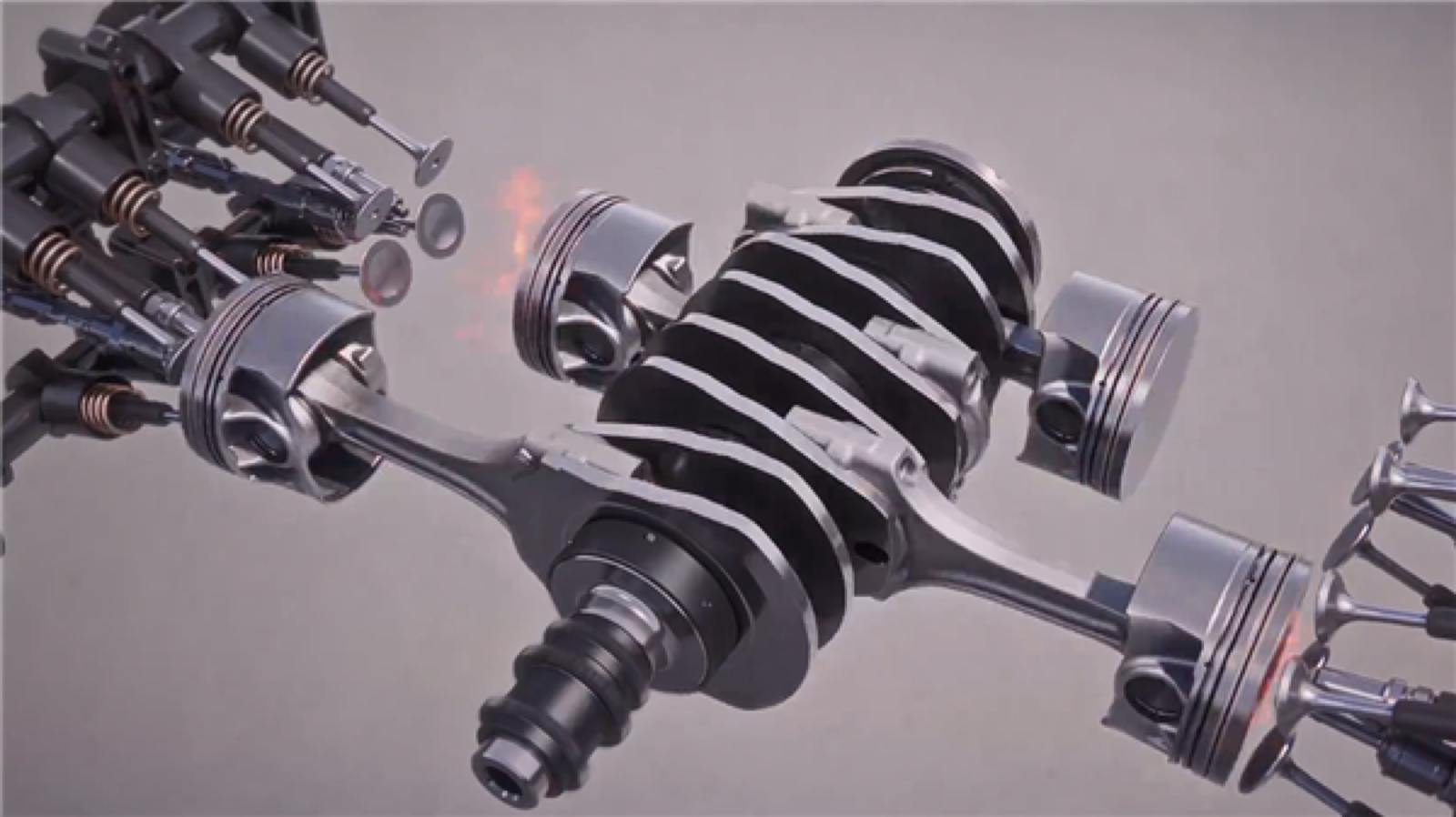 Crank-and-piston render of BYD's 2.0T boxer — two pairs of pistons face each other horizontally across the crankshaft, cutting the engine height to 420 mm (40% lower than an inline four). (Image: BYD / '全网首拆' video still)
In late 2025 BYD became the first Chinese car maker to put a production horizontally opposed 2.0-litre turbocharged four-cylinder under the bonnet of a passenger car. The engine debuts in the Yangwang U7 PHEV, which sits on BYD's e⁴ (易四方) four-motor platform and a very tight front bay.
The reason for the boxer layout is not horsepower. It is height. The U7's front compartment has to host a generator, two drive motors and two DiSus (云辇) suspension motors in what BYD calls a "six-core" front module. A conventional inline four simply will not fit, and would have raised the car's centre of gravity. A flat engine is roughly 420 mm tall, compared with the typical 700 mm-plus of an inline — about 40% shorter than a Porsche 911's flat-six, according to the BYD teardown video released in November 2025. The horizontally opposed layout also gives BYD what it called, in the video, "only 1 dB above the electric motor" at idle and low load, because the opposing pistons cancel each other's primary and secondary inertial forces. The engine itself is a 180 kW / 380 Nm unit used primarily as a series-generator; in some conditions it can also drive the front wheels directly.
A boxer engine is not a new idea — Porsche and Subaru have been building them for decades. What is new is putting one on a purpose-designed EV platform as a range-extender. The 420 mm height is the part that matters: it gives back enough vertical space under the bonnet for the rest of the e⁴ hardware and lets BYD keep the front floor as low as the battery underneath it needs it to be.
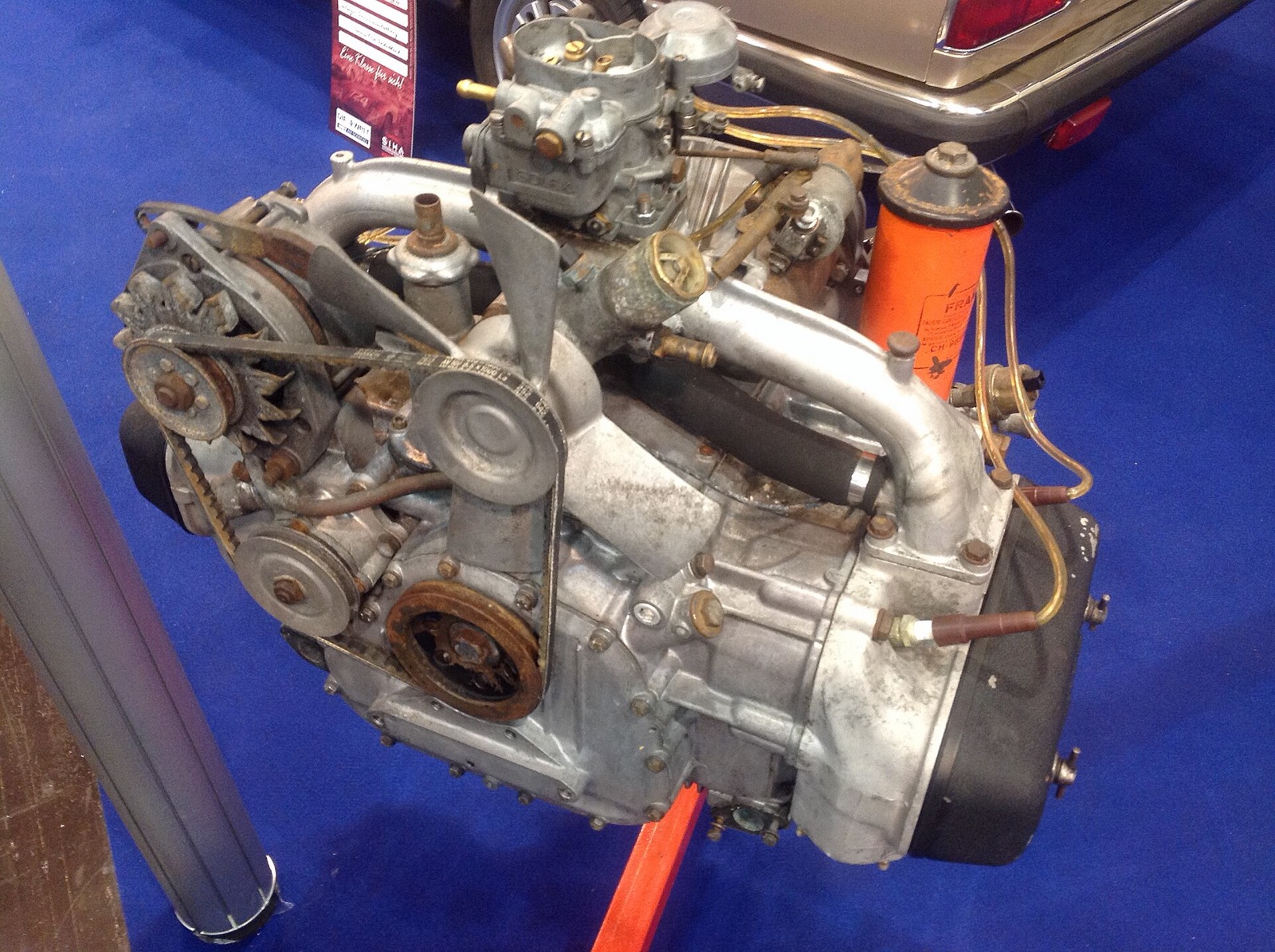 A Lancia Flavia flat-four (boxer) engine, a 1960s-70s example of the same horizontally-opposed layout BYD has now put on a modern EV platform. The defining feature of a boxer — and the reason it frees up vertical space — is that the pistons move sideways, not up and down, halving the engine's height. (Image: Wikimedia Commons, CC BY 2.0, Andrew Bone)
Horse Powertrain Gemini: a sub-one-litre range-extender
If the U7's flat-four serves a six-figure luxury sedan, the other end of the market is being served by a different kind of "flat". At the 2025 Shanghai auto show, Horse Powertrain (浩思动力 — the Geely–Renault powertrain joint venture) showed its Gemini micro range-extender: a 0.999-litre horizontally-opposed twin, naturally aspirated, available with petrol or methanol fuel. Compared with a conventional inline engine of equivalent output, the Gemini is 40% smaller in both volume and height. Horse says it can be packaged under the floor or even in the boot of a small car, and is paired with the company's own "Ice Blade" (冰刃) gallium-nitride power module for the generator side. The whole package is designed around the same idea: in a typical extended-range EV, more than 70% of miles and more than 90% of operating time are pure-electric, so a big, powerful engine is performance overkill in the role of "just make some electricity when the battery is low". A 1.0-litre twin that fits anywhere is enough.
The exhaust: now part of the chassis
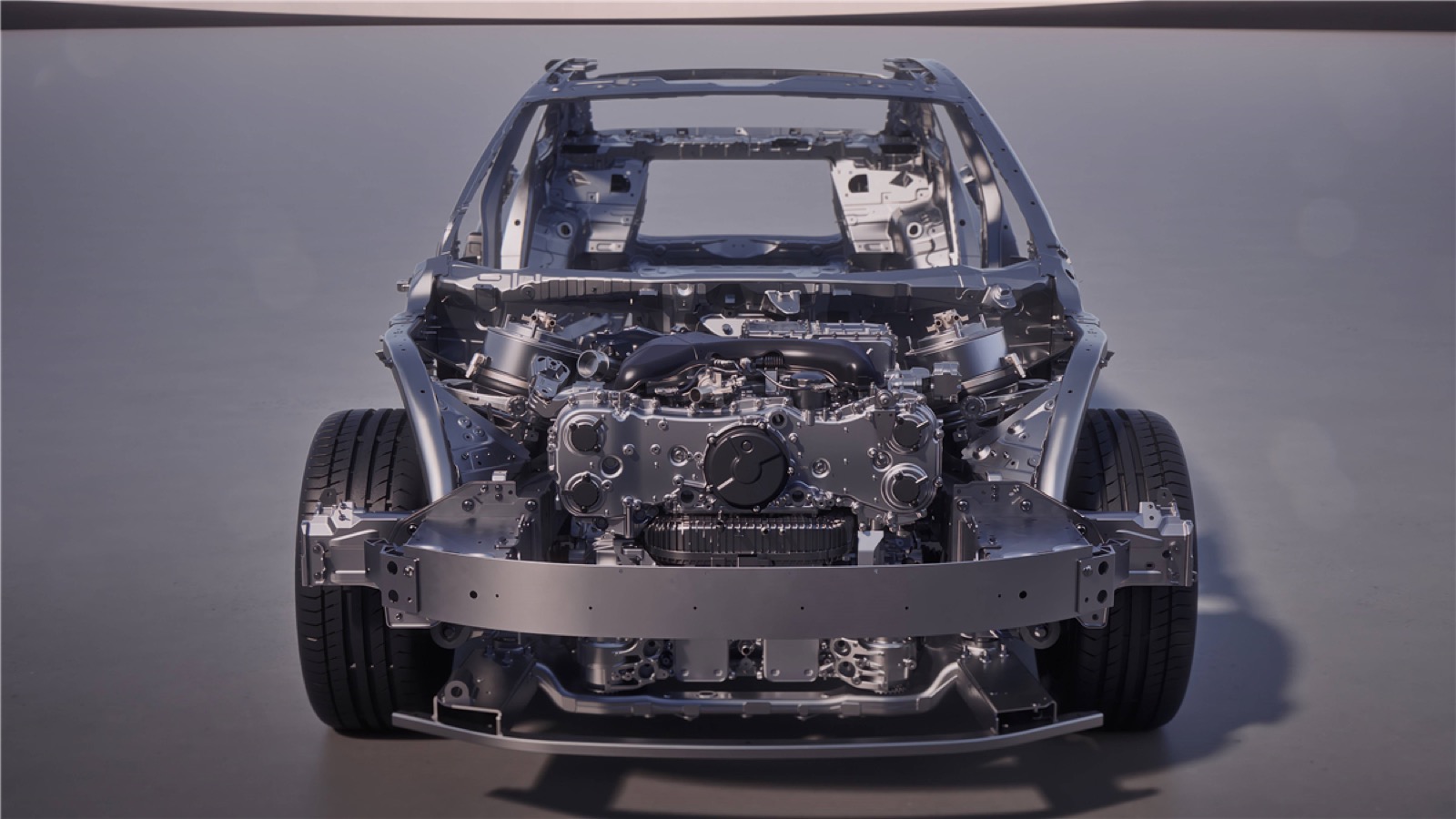 Bodyless Yangwang U7 PHEV: the 2.0T boxer engine sits flat under the front-axle dual motors, forming the front-bay '6-core' architecture with two Cloud-Z suspension motors and one ISG. (Image: Yangwang Auto)
The second structural nuisance is the exhaust system — the long sausage of downpipe, three-way catalyst, GPF, mid-silencer and rear silencer that traditionally hangs underneath the floor and is in the way of any large flat battery.
Between 2025 and 2026, BYD filed two patents that point in the same direction: integrate the exhaust channel into the chassis structure itself.
- Subframe-integrated exhaust passage (CN122426308A, filed 20 Jan 2025, published 21 Jul 2026). The patent describes a subframe whose internal cavity forms the exhaust passage — i.e. one of the subframe's longitudinal members is no longer a simple steel beam but a sealed tube that carries the exhaust gas. The benefit, per the patent text, is that the front cross-member of the subframe no longer has to be pushed forward to make room for the exhaust, and the rest of the subframe can be laid out for stiffness rather than clearance.
- Variable-diameter exhaust manifold (CN120487344A, filed Aug 2024, published Aug 2025). When the exhaust manifold's size and shape are constrained by packaging, the patent adds a variable-diameter section to recover pressure loss and reduce exhaust noise — i.e. the manifold can be bent around the battery while still delivering the right exhaust flow.
The net effect of these two patents — and they are not the only ones — is that exhaust hardware stops being a long, separate "string of sausages" hanging under the floor, and becomes part of the load-bearing structure of the chassis. The continuous flat space underneath is then available for the battery.
What the next PHEV chassis will look like
Putting the two trends together, the next generation of plug-in hybrid chassis is heading away from "an EV platform with an engine bolted in" and toward "an EV platform where the engine and exhaust have been reshaped to give the battery back its floor".
| Layout dimension | Current PHEV | Next-generation PHEV |
|---|---|---|
| Range-extender | Inline 4-cylinder, tall, dominates front bay | Horizontally opposed or micro twin, ~40% shorter, 0.999–2.0L |
| Exhaust system | Separate pipe running front-to-rear under the floor | Integrated into subframe / variable-diameter manifold |
| Battery pack | Constrained by exhaust routing | Flat, continuous under the cabin |
| Front bay | Limited | Engine + 4 motors + active suspension fit in |
The clearest early signal of this layout in a mass-market China PHEV is the Dongfeng-Nissan NX7, filed for regulatory approval in August 2026. It is built on the new Tianyan (天演) 2.0 native-NEV architecture — explicitly not an oil-car conversion — and ships with a 40.95 kWh CATL LFP pack delivering 220–225 km of CLTC electric range. The fact that the front engine and the front motor still fit on the same platform is exactly because the 1.5L NR15 engine is small and the floor is reserved for the battery, with no long exhaust pipe to dodge.
The Yangwang U7 sits at the other extreme of the same logic: a flagship sedan that uses a 2.0T boxer to keep the front bay flat, and uses subframe-integrated exhaust architecture to keep the floor flat. The two cars are very different products, but they are both built around the same answer to the same question — how to make an EV-native chassis that still tolerates an internal-combustion engine and exhaust, by reshaping the engine and the exhaust to fit the chassis, instead of reshaping the chassis to fit them.
China-only context: the Yangwang U7 flat-four and the Horse Powertrain Gemini micro range-extender are China-market programmes, as is the Dongfeng-Nissan NX7 (a China-only joint-venture model on the Tianyan 2.0 platform). The BYD subframe-integrated exhaust and variable-diameter manifold patents are filed in China. The Porsche and Subaru flat-engine layouts referenced for context are unrelated to BYD's product; they are cited only as the historical precedent for the boxer architecture that BYD has now put on a production EV platform.
Back to all articles · View comments & share on the interactive page