PHEV vs EREV: Why Plug-in Hybrids Dropped Their Gearboxes — and Range Extenders Never Had One
Plug-in hybrids (PHEVs) and extended-range electric vehicles (EREVs) look similar from the driver's seat — both plug in, both carry a petrol engine, both can drive on electricity alone — but underneath they take fundamentally different bets on one question: should the engine ever turn the wheels directly? The answer explains why early PHEVs shipped with multi-speed gearboxes, why BYD's DM-i made the gearbox mostly disappear, and why EREVs never had one at all. Here's the evolution, and how to choose between the two for your own driving.
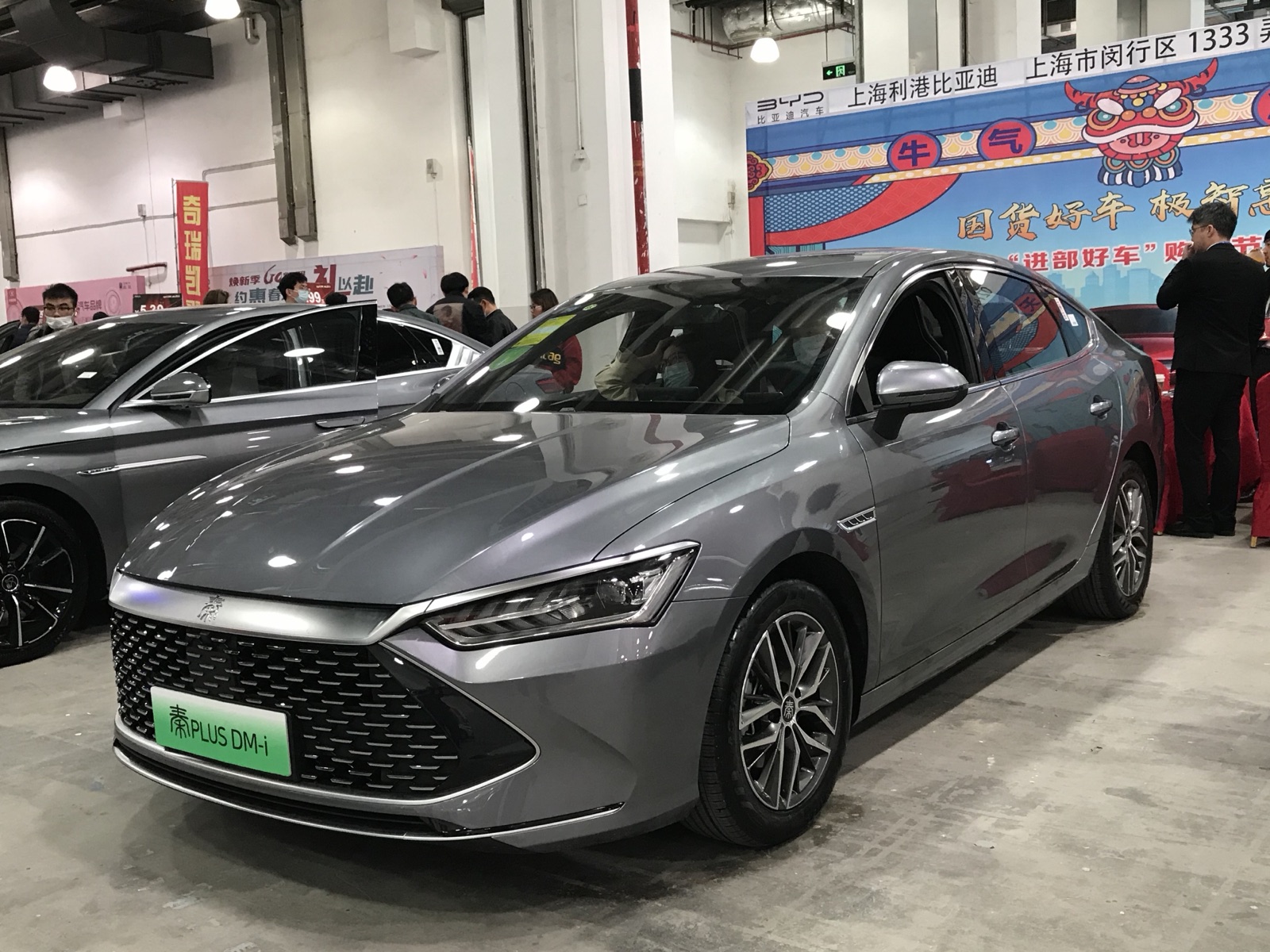
BYD Qin Plus (DM-i) — Jengtingchen, Wikimedia Commons, CC BY-SA 4.0
The core difference: can the engine touch the wheels?
- EREV (extended-range): the engine never drives the wheels. Its only job is to generate electricity; at every speed, the wheels are turned by an electric motor. An EREV is, in effect, a battery-electric car carrying a generator.
- PHEV (plug-in hybrid): the engine can generate electricity and, at mid-to-high speed, it can be mechanically clutched in to drive the wheels directly, removing one energy-conversion step.
The gap shows up most clearly in highway cruising. The EREV's energy path is "fuel → generation → electric drive" — two conversions, with roughly a 10% efficiency loss compared with a direct mechanical path. A PHEV in direct-drive mode skips one of those conversions, so its steady-speed highway consumption is lower. In the city, the two are nearly identical in feel: both run electrically at low speed, smooth and quiet.
Why early PHEVs leaned on multi-speed gearboxes
In the early 2010s, battery technology was the constraint: small packs, low discharge rates, and motors that could not carry the car across the full speed range on their own. The engine therefore had to be the "main actor," covering everything from launch to highway speed. Designers grafted conventional-vehicle technology onto the hybrid, pairing an engine with a DCT or AT-style gearbox plus an electric motor, and leaning on multiple ratios to keep the engine inside its efficient band.
Multi-speed DHTs (dedicated hybrid transmissions) could cover the full speed range, but they inherited the cost: shift shock. Changing gears means interrupting and re-engaging torque, which shows up as a jolt, and the whole system carries the mechanical complexity of an internal-combustion drivetrain into the electrified era.
What battery progress unlocked: the single-speed PHEV (BYD DM-i)
Once packs got bigger and charge/discharge rates rose, the electric motor could independently carry the car across a much wider speed window, and the engine no longer had to "do everything." That rewrote the architecture logic.
The canonical example is BYD's DM-i, whose EHS system integrates two motors, two controllers, a single-speed reduction gear and a direct-drive clutch into one compact unit, with an electric-first operating strategy:
- Low-speed city driving: the direct-drive clutch is open; the engine starts only when needed to charge; the wheels are driven by the P3 motor — a near-BEV experience.
- Mid/high-speed cruising (typically above ~70 km/h): the clutch engages and the engine drives the wheels through the single fixed-ratio gear, with the motor assisting or resting as needed.
This keeps the motor's low-speed smoothness and efficiency where it excels, while on the highway the engine takes over mechanically and sidesteps the "generate-then-drive" energy loss. Compared with the early multi-speed DHTs, single-speed direct drive eliminates shift shock entirely, and the simpler architecture is more reliable and cheaper to build.
EREV: deleting the mechanical link entirely
While PHEVs were simplifying their gearboxes, EREVs made the more radical choice: remove the clutch and reduction gear between engine and wheels completely. In an EREV there is no mechanical connection between the engine and the wheels under any condition.
- The engine is a pure "generation unit": in every operating mode it runs only to charge the battery, at its most efficient steady point.
- Full-time electric drive: the driving experience is always that of an EV — smooth, quiet, with no engine-intervention moment.
- Simpler hardware: no clutch, no reduction gear, no complex mode-shifting mechanisms — lower development cost and lower maintenance.
The trade-off is the one named at the top: on sustained highway cruising, the EREV cannot bypass the double conversion, so its fuel consumption at steady speed is usually higher.
Which should you buy? It depends on your highway share
With batteries now large — mainstream PHEVs offer 100–200 km of electric range, EREVs often 150 km or more — both types are effectively EVs for daily commuting. The real fork in the road is how much of your mileage is long-distance highway.
Scenario 1: mostly city commuting, occasional road trips There is no meaningful difference between a single-speed PHEV and an EREV in daily use: in town both drive electrically, smooth and quiet. If anything, the EREV's always-electric feel has a slight refinement edge in the city. Choose on price, space and equipment.
Scenario 2: frequent highway driving, or limited charging A single-speed PHEV is the better answer. In highway cruise the engine drives directly and skips one conversion, so depleted-battery fuel consumption is typically 1.5–2 L/100 km lower than a comparable EREV. Doing the arithmetic on 15,000 km/year with 6,000 km of highway: at ¥8/L, the PHEV saves roughly ¥700–1,000 (about $100–140) a year in fuel alone. The PHEV also copes better when you cannot charge for a long stretch — its state-of-charge behaviour and power delivery degrade less gracefully than an EREV's in continuous low-battery driving.
China angle
As a writer based in China, I get a front-row seat to both technologies at industrial scale: China is the only market where PHEVs and EREVs are both mass-produced and mass-marketed, with BYD pushing single-speed DM-i/DM 5.0 and Li Auto, AITO/Seres and Deepal championing EREVs. The interesting export nuance is perception: Europe tends to treat PHEVs as a transition technology (and is now taxing them more strictly), North America barely knows the EREV, and Japan's hybrid culture is built around Toyota's power-split HEV rather than either plug-in family. Chinese buyers, by contrast, are increasingly choosing by use case — city-biased buyers drift to EREVs for the EV feel, highway-biased buyers to PHEVs for the efficiency — a segmentation that is only beginning to reach overseas markets. South Korea, home to Hyundai and Kia's E-GMP 800 V plug-in and hybrid lineup, still treats both PHEVs and EREVs as niche next to its dominant HEVs — another market where the Chinese use-case logic has barely arrived.
Sources
- BYD — official DM-i / EHS super-hybrid system documentation (byd.com)
- Wikipedia — Plug-in hybrid and Series hybrid (EREV) architecture references
- Wikimedia Commons — BYD Qin Plus (photo: Jengtingchen, CC BY-SA 4.0); Li Auto L9 (photo: Evnerd, CC BY-SA 4.0)
Back to all articles · View comments & share on the interactive page