The Next Five Years: Solid-State Batteries, Full Autonomy, and Why Chinese Automakers Will Become Home-Robot Companies
In five years, the EV industry's core technical race — batteries and self-driving — will effectively be over. Solid-state batteries will be standard, full autonomy will be a commodity, and the marginal difference between one Chinese EV and another will shrink toward the price sticker. When that happens, the capabilities Chinese automakers spent two decades building — precision manufacturing, batteries, and the AI stack that makes a machine understand the world — will have nowhere left to compound inside the car. The most logical place for them to go is the home robot. This essay makes that case: what the next five years look like, why the transfer is not speculative but structural, and which companies are already moving.
Sources: solid-state battery industry timelines (CATL, BYD, Toyota, Samsung SDI, 2026 GB/T 43568 standard); autonomous-driving industry surveys (McKinsey Center for Future Mobility, 2025-26); robotaxi expansion data (Waymo, Tesla, Pony.ai, Apollo Go, WeRide); humanoid-robot programs at BYD, XPeng, Xiaomi, Chery, GAC, Li Auto, Tesla (2026). Cover image is an AI-generated illustrative concept.
Chapter 1: The battery race ends around 2030
The first leg of the EV technical race is battery chemistry, and it has a finish line. Industry timelines across China, Japan, Korea, and Europe now converge on the same three steps.
2026 is the semi-solid year. Semi-solid cells — a hybrid that still contains some liquid electrolyte — have already entered production cars. NIO's 150 kWh pack using WeLion semi-solid cells delivers around 930 km of range at 300-350 Wh/kg, and Gotion's G-Dome semi-solid cells have passed nail-penetration tests, with a 12 GWh production line planned.
2027 is the first full-solid-state cars. The industry roadmap treats 2027 as the small-batch year: Toyota (with Idemitsu Kosan) targets its first solid-state EVs, CATL plans small-batch production, and BYD will fit demonstration solid-state packs in its top-end Yangwang models. China's first automotive solid-state battery national standard, GB/T 43568-2026, took effect in July 2026, formally defining "all-solid-state" as liquid electrolyte content below 5 percent — which sets the technical boundary that everyone now builds toward. BYD has already completed vehicle-grade certification testing on its sulfide-route cells at around 400 Wh/kg, and its 2 GWh pilot line in Shenzhen Pingshan has been running since February 2026.
2030 is scale and "solid-liquid price parity." By 2030 both CATL and BYD target a cost of roughly RMB 0.7/Wh — essentially parity with today's liquid cells — and energy density around 500 Wh/kg. At that point the chemistry debate ends: solid-state becomes the default, and the battery becomes a solved, commodity component. The differentiating power of "we have better cells" collapses, because everyone has good cells at similar cost.
The user's premise — that solid-state batteries become universal within five years — is not optimistic; it is the consensus roadmap. The more interesting consequence is what happens after the finish line.
Chapter 2: Full autonomy becomes a service, then a feature
The second leg is self-driving, and it is running on a similar clock.
Now (2026): robotaxis are already commercial in both China and the US. Waymo operates fully driverless service in 11 US cities with roughly 3,000 vehicles and over 500,000 paid rides per week. Tesla runs an unsupervised Robotaxi service in Austin, has begun volume production of the Cybercab, and has pivoted to marketing "full autonomy" as a service rather than a beta. In China, Apollo Go (Baidu), Pony.ai, and WeRide all operate fleets above 1,000 vehicles; Pony.ai reached positive unit economics per vehicle in Guangzhou in late 2025, and WeRide launched fully driverless commercial service in Dubai in March 2026. China's first batch of L3 access permits was issued at the end of 2025, and L2 driver assistance passed 70 percent penetration in new cars in 2026.
2027-2030: the map fills in. McKinsey's latest survey pushes broad global commercialization of L4 robotaxis to 2030 (roughly a year later than previously forecast), with personal-vehicle L4 pilots starting around 2030-2032. In practice the deployment is regional: China and the US lead everywhere, Europe trails, Japan is near zero. But the direction is unambiguous — within five years, "the car drives itself" stops being a differentiator in Chinese cities and becomes an expected capability, the way power windows became expected in the 1990s.
The consequence is the same as the battery. Once every serious Chinese automaker ships a competitive autonomous stack (and most will, because the software is being commoditized by end-to-end models trained on massive Chinese fleets), autonomy stops being a moat. The marginal feature race is over. That is precisely when the third shift begins.
Chapter 3: When the car is done, the automaker becomes a robot company
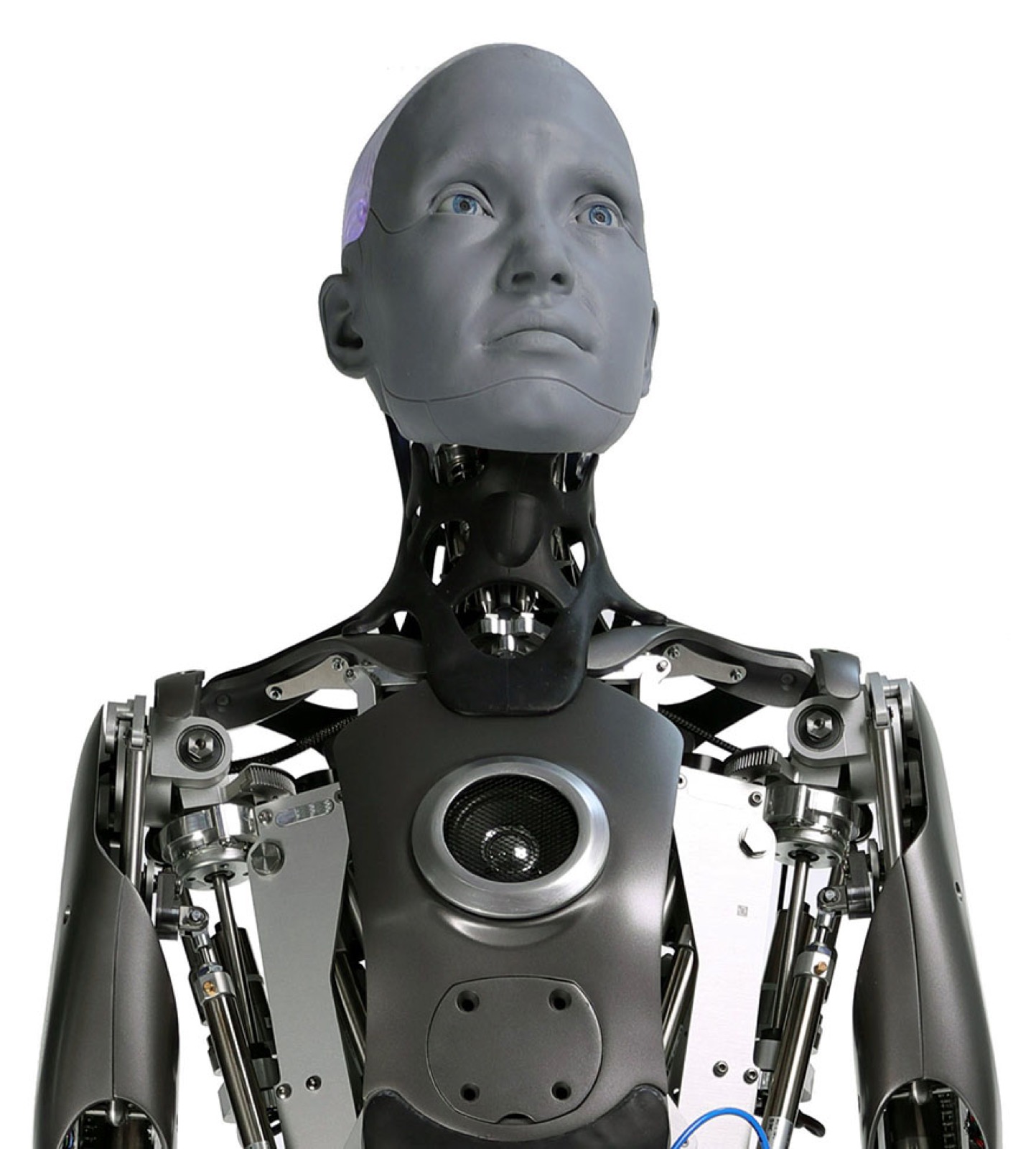 Humanoid robots — where Chinese automakers see their next act. (Image: Wikimedia Commons, CC BY-SA 4.0, Willy Jackson)
Here is the core argument, and it is not a metaphor: the capabilities that win the EV race are the same capabilities a home robot needs, in the same proportions, and Chinese automakers already hold them.
Manufacturing. The EV industry built the world's most cost-effective precision manufacturing supply chain — permanent-magnet motors, reducers, automotive-grade chips, high-voltage wiring harnesses, die-cast chassis. Humanoid robots need the same things at smaller scale. When BYD applies its vertical-integration playbook (30-40 percent cost reduction in EVs) to robots, the cost gap vs. Tesla's US-built Optimus is structural: analysts put Chinese production at roughly $12,000-15,000 per unit vs. Tesla's ~$20,000 target.
Batteries and power. BYD's Blade battery is already being used in its in-house humanoid robot prototypes, solving the two pain points that kill robots in the home — short endurance and fire risk. XPeng's robot endurance benefits directly from its EV battery-management experience. The battery companies that win the car race are, by definition, the battery companies that win the robot race.
The AI stack: perception, semantics, and world models. This is the deepest transfer. A self-driving car's perception stack — camera-based object recognition, semantic segmentation, scene understanding, path planning, end-to-end world models — is the same stack a home robot needs to navigate a living room, recognize a cup, understand a command, and plan a trajectory around a child. XPeng explicitly shares its VLA (Vision-Language-Action) large models and core perception technology between car and robot. GAC reports that sharing vehicle-end chips and lidar across its auto and robot divisions has materially cut R&D cost. BYD says its 700 TOPS "Xuanji" autonomous-driving chip is designed to transfer to robot platforms, and its automotive AI and robot AI share "homologous" foundations. Li Auto's founder puts it bluntly: "the ultimate form of the car is a robot."
The semantic layer is the real prize. The user's insight is sharp here: full autonomy does not just teach a machine to drive; it teaches a machine to understand the world semantically — to parse a scene, identify objects and their affordances, understand spatial relationships, and follow natural-language instructions in a physical environment. That is exactly the capability a home robot needs, and it is far harder to build from scratch than to inherit from a fleet of cars already generating billions of kilometers of real-world scene data. Chinese automakers will not be starting from zero on semantics in 2030; they will be porting a mature system.
Chapter 4: It is already happening
This is not a prediction about the distant future; it is a description of the present.
- XPeng — CEO He Xiaopeng personally took over the robotics division in June 2026, signaling a promotion of robots from "exploration project" to "core strategy." The next-generation IRON (1.7 m, ~80 kg, high-compute) is scheduled for mass production and first deliveries in Q4 2026, with an annual capacity target of 50,000 units. IRON's first deployment is as a tour guide and sales assistant in XPeng's own showrooms — a controlled, high-value environment.
- BYD — the quietest but potentially most disruptive. BYD is targeting 20,000 units of its own robot deployments (initially industrial — warehouse logistics and factory assembly at its Shenzhen battery plant) in 2026, has established a dedicated embodied-intelligence lab, and is investing in third-party humanoid players (Unitree, Ubtech) while its in-house semiconductor unit supplies the power chips.
- Xiaomi — the consumer price anchor. After showing CyberOne in 2022, Xiaomi has upgraded robots from "concept validation" to "product readiness" and is deploying 2,000+ CyberOne units in its own Yizhuang EV plant (die-casting, final assembly) with a 90.2 percent success rate on a live production-line task.
- Chery — the most commercially aggressive: its AiMOGA "Mornine M1" humanoid is already on sale on JD.com at RMB 285,800 (~$41,400), deployed in dealerships across 30+ countries.
- GAC, Changan, Li Auto — GAC spun off its embodied-intelligence business (Huilun Technology), plans small-batch production in 2026 and scale in 2027; Changan targets 2027-2028; Li Auto entered humanoid robots in early 2026 as an extension of its "human-car-home" ecosystem.
- Tesla — the benchmark the Chinese industry is chasing: Optimus Gen 3, using FSD technology transfer, with mass production planned for 2026.
The pattern across all of them is identical: start in the factory and showroom (controlled environments where ROI is measurable), then move outward. The home is the last mile, not the first.
Chapter 5: Why this matters and what could slow it
If this thesis holds, the next five years look like this: solid-state batteries go standard (2027-2030); full autonomy becomes an expected feature in Chinese cities (2027-2030+); the EV technical race plateaus; and the marginal dollar of engineering talent, R&D, and factory capacity shifts from the car to the robot. The car stops being the frontier product and becomes the platform — the cash cow that funds the robot, the testbed that trains its AI, and the factory that builds it.
Three risks are worth naming honestly:
1. Home robots are harder than showroom robots. The factory and showroom deployments of 2026 are controlled environments. A home is unstructured, cluttered, unpredictable, and safety-critical around children and pets. The jump from "works in our factory" to "works in your living room" is the hardest engineering gap in the entire thesis. This is why the capability transfer matters so much: the semantic understanding trained by autonomous driving is exactly what closes that gap.
2. The consumer market timing is uncertain. Even if Chinese automakers can build a $12,000-15,000 humanoid, whether families buy one in 2030 is a demand-side question. The industrial and commercial markets (warehouses, factories, showrooms, hospitals) will scale first, as they did with robots in every prior wave. The home market may take longer than the five-year window.
3. The "technical race is over" premise is a phase, not a state. Solid-state and autonomy commoditize the current race. There will be new races — energy, chip architectures, or something none of us can name yet. The thesis is not that Chinese automakers stop innovating; it is that the specific innovation frontier they are best equipped to win next is the embodied AI home robot.
The takeaway. Five years from now, the question "which Chinese EV should I buy" will be a boring question — the cars will all be good, solid-state, and self-driving. The interesting question will be "which automaker is becoming a home-robot company," because the answer will determine the next decade of these companies. The EV was the training ground. The home is the arena.
This is an opinion/analysis essay in our Story series, reflecting a personal thesis about the trajectory of China's EV industry, not a news report. Industry timelines cited are as of mid-2026 and subject to change.
Back to all articles · View comments & share on the interactive page