My Story With BYD: How Wang Chuanfu's Three Strategic Bets Built an EV Giant
I have followed BYD for years, but what keeps pulling me back isn't any single car — it's the discipline behind the company. Wang Chuanfu bet on batteries, then on electric vehicles, then on a chemistry most of the industry had written off. Each bet looked premature. Each one turned out to be right. This is my attempt to trace that logic, and what it taught me about building in a fast-moving industry.
The first bet: batteries before cars
Wang Chuanfu founded BYD in Shenzhen in 1995 with a narrow focus — rechargeable batteries. At the time, the market was dominated by Japanese giants making nickel-cadmium cells on heavily automated lines. Wang's counterintuitive move was to replace expensive automation with skilled labor and tight process control, driving costs down fast enough to win global customers. Within a few years BYD became one of the world's largest makers of rechargeable batteries, and it listed on the Hong Kong Stock Exchange in 2002.
What strikes me is the sequence. BYD did not start as a car company that dabbled in batteries. It started as a battery company that later decided cars were the ultimate application of its core competency. That order matters: the battery was never a purchased component, it was home turf.
The second bet: electric vehicles when almost nobody believed
In 2003 BYD acquired Qinchuan Automobile and entered the auto industry. To outside observers this looked like a distraction at best, a mistake at worst. The prevailing wisdom was that electric cars were a science project — slow, expensive, and years from relevance. BYD pushed anyway, rolling out early plug-in hybrids like the F3DM (2008) and electric models like the e6.
The validation came in 2008, when Berkshire Hathaway invested roughly $230 million for a stake in BYD — a rare vote of confidence from some of the most patient capital in the world. But even then, battery-electric cars were a tiny slice of the market. Wang was playing a longer game than the quarterly chart allowed.
The third bet: lithium iron phosphate, the chemistry everyone doubted
Here is the bet I admire most. As the industry chased nickel- and cobalt-heavy chemistries (NMC) for maximum energy density, BYD kept faith in lithium iron phosphate (LFP) — lower energy density per kilogram, but fundamentally different economics and physics.
Two properties of LFP have aged extraordinarily well:
- Raw-material control. LFP is built from iron and phosphate — abundant, cheap, and geopolitically uncontroversial. It needs no cobalt and no nickel, the two materials whose prices and supply chains have swung wildly with politics and demand. That means BYD's battery costs are not held hostage by a handful of mines or trading desks. In a decade when everyone suddenly cared about supply-chain security, this bet looked less like a compromise and more like foresight.
- Fast charging. LFP's thermal stability and long cycle life make it friendly to high-rate charging. BYD turned that into a headline in March 2025 with its Super e-Platform: a 1,000-volt architecture, a Blade Battery capable of a 10C charge rate, and peak charging power of 1,000 kW — enough to add roughly 400 km of range in about five minutes. The "charge as fast as you refuel" goal stopped being marketing and started being a spec sheet. None of that is an accident; it is the LFP bet, compounded over fifteen years.
LFP's one real weakness is energy density. Cell for cell, it stores roughly 30 to 40 percent less energy per kilogram than NMC — and for years that was the fair criticism of the chemistry: range is energy density. BYD's answer was not a better material but better packaging, and it is the clearest proof of why owning the whole stack matters. The Blade Battery eliminated the conventional module housing: long, thin cells slot straight into the pack (Cell-to-Pack), packing far more active material into the same volume. Then, on the Seal, BYD went further with Cell-to-Body — the top of the battery pack is the floor of the car, so the pack becomes a structural part of the body instead of a heavy box bolted underneath. When Japan's Nikkei BP disassembled a Seal, they measured the pack at 147.4 Wh/kg. Volkswagen's ID.3, built on NMC, came in at 154.8 Wh/kg. A chemistry that trails by 30 to 40 percent at the cell level ends up within 5 percent at the pack level. That closing of the gap is not a materials breakthrough — it is what happens when one company designs the battery and the body as a single system. A legacy carmaker that buys its cells from a supplier cannot simply relocate the floor of the car to shed weight; BYD, making both, did.
The invisible advantage: vertical integration
The thread connecting all three bets is control of the stack. BYD makes its own batteries, motors, power electronics, and even the automotive-grade silicon carbide chips that sit between the pack and the wheels. When the company wanted a 1,500-volt SiC device for the megawatt charger, it designed one.
For a slower industry that would be a nice-to-have. For this industry — where chemistry, voltage, and charging standards shift every couple of years — it is the whole game. Vertical integration means BYD can change its mind quickly: redesign a cell, rewire a platform, and ship it without waiting on a supplier's roadmap. In a fast-changing era, the ability to pivot is itself a moat.
What I take from this
I am not a battery engineer and I don't run a car company. But the BYD story reorganized how I think about my own work. The lesson isn't "bet on EVs" — that part is obvious in hindsight. The lesson is to place bets on first principles (where is the material actually abundant? where is the physics actually forgiving?) and to own the parts of the stack that let you adapt when the future arrives faster than expected.
Wang Chuanfu's three bets — battery, electric, LFP — looked conservative, even stubborn, at the time. Together they added up to the one thing every fast-moving industry rewards: being right early, and being able to move once you are.
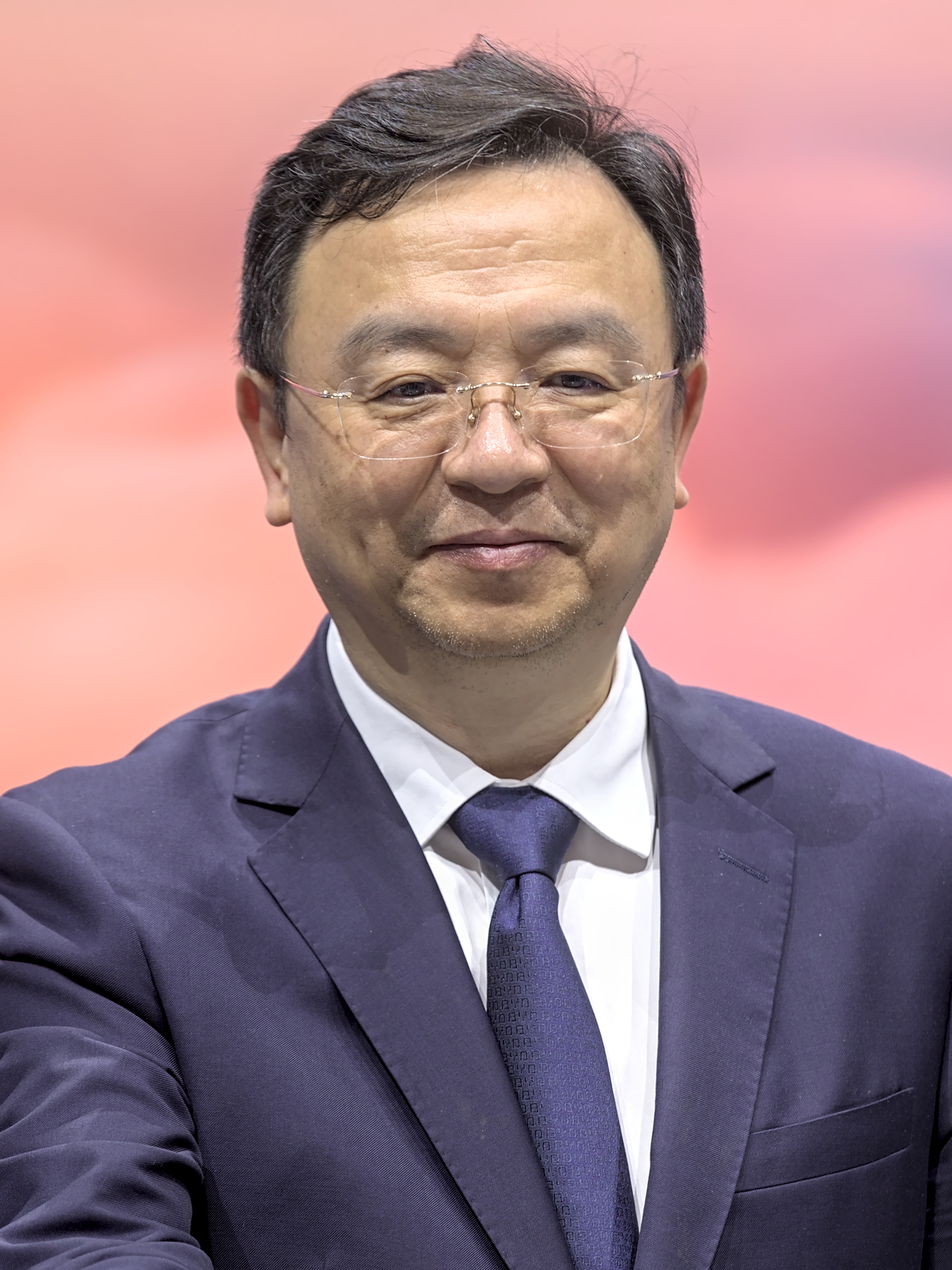
Sources: BYD Super e-Platform launch materials (March 17, 2025); Berkshire Hathaway 2008 investment disclosure; BYD corporate history (founded 1995, HK listing 2002, Qinchuan Automobile acquisition 2003); Nikkei BP BYD Seal teardown (pack energy density measurements, 2023). Cover photo: Wang Chuanfu portrait by Alexander-93, Wikimedia Commons, CC BY-SA 4.0.
Back to all articles · View comments & share on the interactive page