Charging an EV With No Home Charger: A Practical Region-by-Region Guide
One of the most repeated questions in EV owner communities — from r/electricvehicles threads to practical guides like "How to Charge an EV Without a Driveway" — is simple: "I live in an apartment / rent / have no driveway. Can I even own an EV?" The answer in 2026 is increasingly yes. Public, workplace, and destination charging have matured enough that a home plug is no longer a hard prerequisite. This guide lays out a workable routine and what it looks like across five key markets.
The core routine: stack small charges, don't hunt for one big one
The mistake new owners make is treating charging like refueling — driving to a station, waiting, leaving. Without home charging, the winning strategy is to accumulate charge incidentally:
- Workplace charging (best case): 8+ hours parked = a full battery on a slow AC charger, often free or cheap.
- Destination charging: supermarkets, malls, hotels, and gyms with chargers turn errands into top-ups.
- Public DC fast charging: reserved for road trips or the occasional weekly fill, not daily use.
- Occasional Level 1: a standard household outlet near a parking space can still add 30–50 km overnight with the portable charger most EVs include.
Apps like PlugShare and A Better Route Planner (ABRP) are the universal starting point for finding and planning around chargers in every market below.
United States
- Networks: ChargePoint, EVgo, Electrify America, and Tesla Superchargers (now open to many non-Tesla EVs, often via NACS port or CCS adapter).
- Right-to-charge: Many states, including California and Colorado, have laws requiring HOAs and landlords to permit reasonable charging installations — worth citing if your building says no.
- Curbside: Several cities are adding streetlight- and bollard-integrated chargers for residents without off-street parking.
- Note: The U.S. is mid-transition to NACS; check whether your car is CCS1 or NACS and carry the right adapter (see our companion tech explainer).
Europe
- Connectors: CCS2 is the standard (Tesla Superchargers in Europe also use CCS2, not NACS).
- Networks: Ionity, Fastned, Allego, and Tesla, plus dense supermarket and municipal chargers.
- Workplace & curbside: Workplace and on-street charging is common in cities like Amsterdam, London, and Oslo; many municipalities prioritize resident permits for near-home curbside points.
- Tip: AC destination charging is extremely widespread at retail parks and restaurants — ideal for apartment dwellers.
Australia
- Networks: Chargefox, Evie Networks, Ampol, and Tesla; coastal highway corridors are well covered, cities less uniformly.
- Apartments: "Right to charge" rules vary by state; body corporates are increasingly required to consider requests, but installation can be slower than in the U.S. or Europe.
- Tip: If you can secure even one shared or visitor AC charger in your building's garage, that alone covers most weekly driving.
Thailand
- Networks: EA Anywhere, EV Station PluZ (PTT), Bangchak, and others are expanding rapidly with government backing.
- Connectors: Newer EVs are mostly CCS2; some Chinese-brand models use GB/T, so confirm your plug type.
- Condos: Many new Bangkok condos now include AC chargers in basements — a major enabler for city EV owners without a house.
Indonesia
- Networks: PLN ICON+ (state utility), Shell Recharge, and growing private operators; coverage is early-stage and concentrated in Jakarta and Bali.
- Connectors: A mix of GB/T and CCS2 depending on brand (many Chinese EVs use GB/T), so verify before relying on a public stall.
- Tip: For now, treat public charging as supplementary; a PHEV or range-extended model is especially practical here given the thinner network.
If you drive a PHEV or range-extended EV
Plug-in hybrids and EREVs have much smaller batteries (roughly 15–60 kWh) than long-range BEVs, so a single weekly AC top-up often covers most local driving — and you can fall back to the engine on trips. You are far less dependent on fast-charging infrastructure than a pure-EV owner, which makes "no home charger" dramatically easier to live with. The trade-off: you still want occasional plugging-in to actually realize the fuel savings.
Battery care when you rely on public fast charging
Frequent DC fast charging is fine, but a few habits protect battery health:
- Keep daily charging in the 20%–80% band; reserve 100% for trips.
- Every month or two, do one full slow (AC) charge to help the battery management system recalibrate.
- Avoid sitting at 100% on a fast charger for long periods; unplug when done.
Bottom line
No driveway is no longer a dealbreaker. Build the habit around workplace + destination + the occasional fast charger, learn your local apps, and — if you can — nudge your building toward a shared AC point. In most major cities across the five regions above, that is enough to own an EV comfortably today.
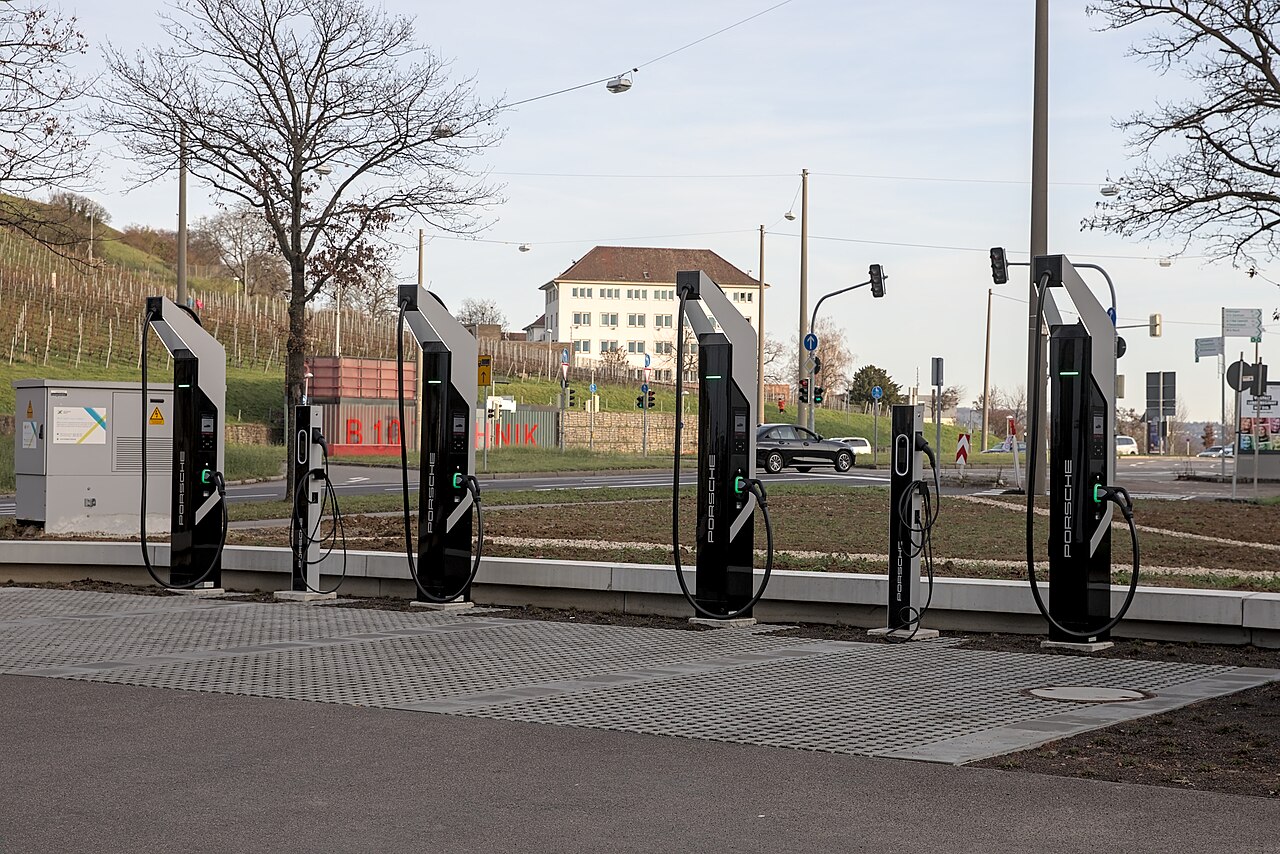
Image: Electric vehicle charging stations in Stuttgart — photo by Alexander Migl, CC BY-SA 4.0, via Wikimedia Commons.
Back to all articles · View comments & share on the interactive page