Bidirectional Charging & V2G in Germany in 2026: How Vehicle-to-Grid Works, the ISO 15118-20 Reality, and Why So Few Cars Qualify
Germany's electric cars are finally allowed to sell their stored electricity back to the grid — but the technology, the standard, and the paperwork are only now lining up. This explainer breaks down how vehicle-to-grid (V2G) actually works in 2026, what the ISO 15118-20 standard really delivers, the regulatory catch that held it back for years, and why only a handful of models can do it today.
What "bidirectional charging" actually means
Bidirectional charging simply means an EV battery can take energy in and push energy back out. Three flavours matter:
- V2L (vehicle-to-load): the car powers devices directly, like a camping socket. Many cars already do this (up to ~3.6 kW).
- V2H (vehicle-to-home): the car backs up or supplements your house, typically paired with home solar.
- V2G (vehicle-to-grid): the car talks to the energy market and feeds the public grid, earning money when the grid needs flexibility.
V2G is the headline because it turns a parked car into a small, mobile power plant — but it is also the hardest to deliver, since it needs the car, the wallbox, the smart meter, and the grid billing system to all speak the same language.
How vehicle-to-grid works in practice
In a working V2G setup, a parked, plugged-in EV does the following automatically:
- Charges cheaply overnight or from your own solar during the day.
- Holds reserve so you can still drive to work in the morning (you set a minimum charge level in an app).
- Discharges back to the grid during evening peak demand or when renewables are scarce.
- Recharges later in cheaper off-peak hours.
The intelligence lives in the car, not the wallbox. Thanks to the ISO 15118-20 standard, the vehicle negotiates charge/discharge with the charger; the wallbox stays relatively "dumb" and just needs to be compatible. A Home Energy Management System (HEMS) ties the car, solar, battery, and heat pump together, while a smart meter (iMSys) records quarter-hourly flows so the energy supplier and grid operator can bill and credit correctly. Without that smart meter, there is no V2G at home — a point we return to below.
The ISO 15118-20 reality in 2026
ISO 15118-20 is the communication standard that makes CCS2-based bidirectional charging possible in Europe. It was finalised in 2022 and is now reaching series production, but the rollout is staged:
- The DC bidirectional part of the standard is already published; the AC bidirectional profile was still being completed through 2026 (industry bodies such as VDE have targeted AC completion around the end of 2026 and DC around the end of 2027).
- The EU's AFIR regulation makes EN ISO 15118-2 (Plug & Charge) mandatory for new or modernised public chargers from 1 January 2026, and EN ISO 15118-20 (smart charging + V2G) mandatory from 1 January 2027.
- On the grid side, Germany's connection rule VDE-AR-N 4105:2026-03 (in effect since March 2026) sets unified, simplified requirements for hooking a bidirectional wallbox to the low-voltage grid for the first time.
In plain terms: the standard exists and is being baked into cars and chargers, but the full AC/DC bidirectional ecosystem will not be mature until late 2026–2027.
The regulatory catch: double grid fees, MiSpeL, and the smart-meter gap
For years, V2G in Germany was killed by economics, not technology. The blocker was the "double burden": an EV paid grid fees when charging, and paid them again when recharging after feeding energy back to the grid. That penalised the very drivers who stabilised the grid.
Two 2025–2026 reforms changed this:
- EnWG amendment (Energy Industry Act): passed by the Bundestag on 13 November 2025 and effective 1 January 2026, it ends double grid fees and the electricity-tax trap for stored-then-fed-back energy. EVs are now treated like stationary storage.
- MiSpeL (Marktintegration von Speichern und Ladepunkten): the Federal Network Agency's framework that lets bidirectional charging points be billed as storage without a second meter. Simplified process rules took effect on 1 April 2026, and the final ruling was targeted for mid/late 2026 (a near-final draft appeared in August 2026). Full automated market communication between grid operators and suppliers is expected from 2027.
One important caveat remains: the electricity-tax relief currently applies most cleanly to households with their own PV. Drivers without solar still face a small residual cost (around 2 cents/kWh), which the Finance Committee has been asked to review — not enough to break the business case, but a reminder that the rules are still settling.
The deeper catch is infrastructure: only about 3% of German households have a smart meter. V2G at home is impossible without one, and Germany's rollout has lagged far behind the Netherlands, France, or the Nordics. The 2026 "GNDEW" acceleration law makes smart meters mandatory for new buildings, major renovations, and controllable devices (including wallboxes) from 2026 — but closing the gap will take years.
Which cars support V2G in Germany today
The list is short but growing, and almost all entries are brand-new or 2026-model cars — because the bidirectional hardware must be built in at the factory:
- BMW iX3 (Neue Klasse, 6th-gen eDrive) — the anchor of Germany's first commercial V2G offer (see below).
- Renault 5 E-Tech (52 kWh) — V2G-capable; Mobilize and The Mobility House launched a customer V2G service in France, with Germany/Netherlands/UK expansion planned for 2026. The upcoming Renault Twingo E-Tech (sub-€20k) lists V2G as an option.
- Kia EV9 and Hyundai IONIQ 9 — V2G service launched in the Netherlands in late 2025.
- VW ID. models with large batteries — Elli (VW's energy arm) ran a bidirectional pilot in Germany, with a broader offering signposted for late 2026.
- Mercedes-Benz electric GLC (2026) — via MB.CHARGE Home with The Mobility House.
- Cupra Born — works with the Wallbox Quasar 2 over CCS2.
- Nissan Leaf — the long-time V2G pioneer, but via the older CHAdeMO connector, which is being phased out in Europe.
As of early 2026, Germany had just over 2 million battery-electric cars on the road, but only an estimated 200,000+ were technically capable of bidirectional charging — and true V2G is available in far fewer models. Most cars sold before ~2025 lack a bidirectional on-board charger, so they simply cannot feed the grid regardless of the standard.
The money: what you can actually earn
The first real German offer sets the benchmark. BMW and E.ON opened Germany's first commercial V2G package on 9 February 2026 for the iX3:
- A time-based bonus of up to €720/year (€0.24 per plugged-in hour, capped at €60/month) just for keeping the car connected with V2G active.
- An additional €0.40 per kWh for energy actually discharged to the grid.
- BMW estimates this can cover up to 14,000 km/year of driving at no charging cost.
- The first 100 customers got a €700 discount on the 11 kW bidirectional Wallbox Professional.
Beyond bonuses, studies (e.g. a Fraunhofer ISI/ISE study for Transport & Environment, 2024) estimate household savings of up to ~€700/year from optimised charging/discharging, plus network-charge savings in the roughly €110–190/year range. The catch: you need the right car, a compatible bidirectional wallbox, a smart meter, and a V2G tariff — a far bigger lift than plugging into a normal charger.
China Angle
As a Chinese writer watching Germany's slow V2G ramp-up, the contrast is striking. In China, V2L (vehicle-to-load) is already standard on a huge share of EVs — even an entry-level BYD like the Seagull (海鸥) ships with it — and bidirectional charging is governed by a single, nationally unified standard family (GB/T 20234 connectors plus the GB/T 27930 communication protocol, with bidirectional extensions). China also launched national vehicle-to-grid (车网互动, V2G) demonstration pilots starting in 2023, rolling out across a batch of cities through 2024, with utilities and automakers (BYD, NIO and others) running grid-interaction trials at scale.
So while Germany spent 2025–2026 untangling double grid fees, MiSpeL billing rules, and a 3%-smart-meter problem, China's challenge is less about regulation and more about turning a mature hardware base into mass-market grid services. Europe's ISO 15118-20 / CCS2 path is elegant and interoperable, but Germany shows that standards alone don't make V2G real — the meter, the tariff, and the car all have to arrive at the same time.
Sources
- BMW Group PressClub — "First bidirectional vehicle-to-grid (V2G) charging offer in Germany from BMW Group and E.ON" (9 Feb 2026): https://www.press.bmwgroup.com/global/article/attachment/T0455460EN/643828
- The Mobility House — "German Parliament removes key barrier to bidirectional charging" (Nov 2025): https://www.mobilityhouse.com/int_en/our-company/newsroom/article/german-parliament-removes-key-barrier-to-bidirectional-charging-vehicle-to-grid-becomes-possible
- VDE dialog — "Bidirectional charging: V2G for all": https://dialog.vde.com/bidirectional-charging
- AMPECO — "August 2026 EV charging policy update" (MiSpeL working draft): https://ampeco.com/blog/august-2026-ev-charging-policy-update
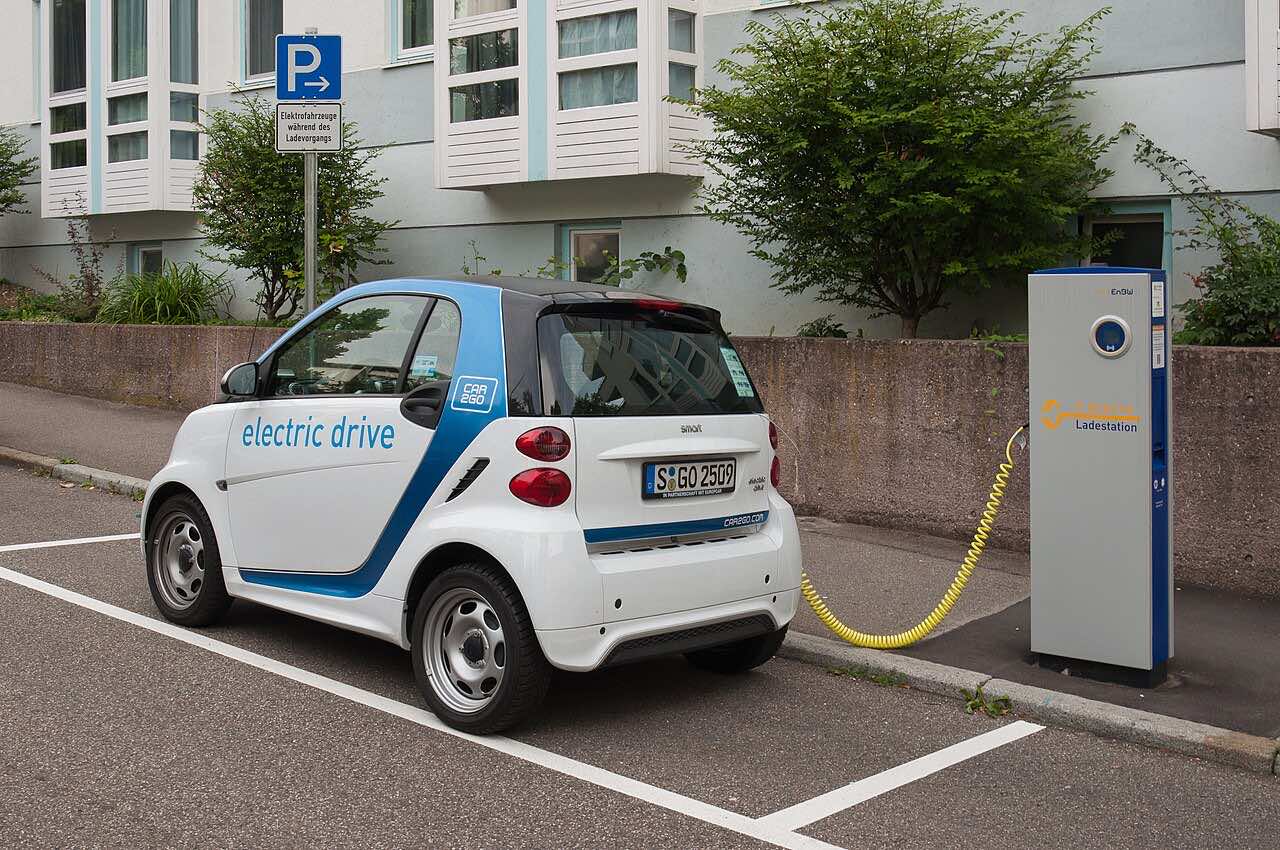
Image credits: Cover photo "Car2Go Charging Station, Stuttgart" by Julian Herzog, licensed CC BY 4.0, via Wikimedia Commons (https://commons.wikimedia.org/wiki/File:Car2Go_Charging_Station_Stuttgart_2013_01.jpg).
Back to all articles · View comments & share on the interactive page