How EV Heat Pumps Win Back Winter Range: The 2026 Thermal-Management Reality
Cold weather has long been the easiest way to scare someone off an electric car. The old story was simple: turn on the heater, watch the range number drop. In 2026 that story is mostly outdated. The unsung hero is the heat pump — and how a car manages heat across the battery, motor, and cabin now matters as much as battery size. Here is what the technology actually does, how much range it recovers, and what to check before you buy.
Why winter range drops in the first place
An EV loses winter range for two reasons, not one. The first is chemistry: a cold battery is less willing to deliver and accept current, so usable capacity dips. The second is cabin heating. Early electric cars used resistive (PTC) heaters that work like a giant hair dryer, pulling 3–4 kW straight from the traction battery. On a two-hour motorway run that can eat 6–8 kWh just for warmth — a 10–15% range penalty before you count the cold itself.
What a heat pump does differently
A heat pump is a refrigeration cycle running in reverse. Instead of creating heat with resistance, it moves low-grade heat from the outside air — and, crucially, from the car's own waste streams (motor, power electronics, battery) — into the cabin or the battery loop. Even at 0°C there is usable thermal energy in the air.
The efficiency payoff is large. A resistive heater has a coefficient of performance (COP) of exactly 1.0 — one unit of electricity becomes one unit of heat. A modern EV heat pump runs at COP 2–4 at typical winter temperatures (roughly 0–10°C), so every kWh of electricity delivers 2–4 kWh of heat. Most 2026 models treat the whole vehicle as one thermal network, routing heat between battery, drivetrain, and cabin through a set of valves and heat exchangers.
How much range it actually recovers
Real-world testing lands in a consistent band. The UK's What Car? found EVs with heat pumps missed their official winter figure by about 25% on average, versus 34% for those without — for a 300-mile WLTC car, the difference between roughly 225 and 198 miles of practical winter range. Broader industry write-ups put the winter-range recovery from a well-integrated heat pump at about 10–30% depending on temperature, speed, and how the system is calibrated.
There is a hard floor. As ambient temperature falls below roughly −10°C (14°F), the available heat in outside air shrinks and the compressor has to work harder, so a heat pump's COP converges toward that of a resistive heater. That is why cars sold in cold climates keep a small PTC element as backup for the coldest starts — the two work together rather than one replacing the other.
Preconditioning: the "free" range trick
The single biggest winter win in 2026 is software, not hardware. Preconditioning warms the cabin and battery while the car is still plugged in, using grid power instead of the battery. You set a departure time, the car warms itself, and when you unplug the heat pump only has to maintain temperature. The same logic applies before a DC fast-charge stop: a warm battery charges faster, and several makers credit preconditioning with meaningfully shorter cold-weather charge times.
Not all heat pumps are equal
A heat pump's benefit is not a single number. It depends on the full thermal circuit: refrigerant choice, fin spacing and coatings on the outdoor heat exchanger (frost management), compressor durability on cold starts, and control software that decides where heat is collected and released. A system tuned for −5 to +15°C (most of Europe, much of the US) will behave differently from one engineered for −20°C. Short, cold-soaked trips also flatter the apparent efficiency, because the system spends energy just reaching steady state.
What to look for when buying in 2026
- Assume it is standard on mid- and upper-tier EVs, but verify — a missing heat pump is increasingly a budget-category cost cut, not a deliberate engineering choice.
- Check for battery preconditioning, not just cabin heating. The charge-speed benefit matters more than the cabin number on road trips.
- Use seat and steering-wheel heaters over full cabin heat in cold weather; they warm you with far less energy.
- Precondition while plugged in every winter morning — it is the cheapest range you will ever buy.
China Angle
China was an early and aggressive adopter of heat-pump and battery self-heating technology, in part because its climate spans tropical Hainan to −30°C winters in Heilongjiang — no single thermal strategy fits the whole country, and northern winters make cabin and battery heating a core usability issue rather than a footnote. BYD, Li Auto, Xiaomi, IM Motors (智己), and others fit heat pumps or proprietary battery self-heating across much of their lineups. Reported examples (Sina Auto, 2026): Li Auto states its heat-pump-equipped EREV models recover more than 40 km of winter pure-electric range; IM Motors claims its low-temperature heat pump operates down to −18°C with about a 15% range gain; BYD's patent pulse self-heating warms the pack through motor-winding oscillation rather than an external heater. The same sources also note the flip side — extreme cold still forces supplemental resistive heating, and China's fast model cadence means thermal software calibration varies widely between brands, so real-world winter performance is best confirmed per model rather than assumed from the spec sheet.
Image credits
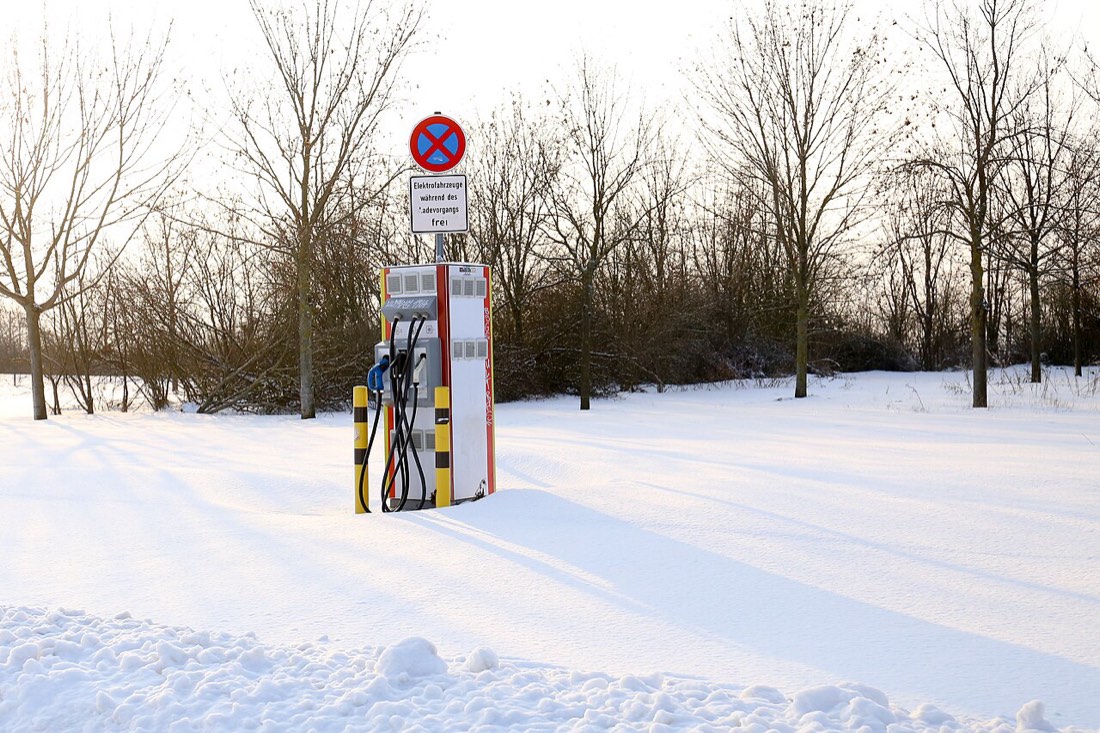
- Winter EV scene — photo via Wikimedia Commons, CC license.
Sources
- EV Compared, "How Does the Heater Work in an Electric Car? Heat Pumps Explained": https://www.evcompared.co.uk/news/ev-heat-pump-and-why-matter/
- ONEEV, "Heat Pump Heroes: How 2026 EVs Are Beating Winter Range Loss": https://oneevgroup.com?p=4551/
- Sector Panorama, "How EV Automotive Heat Pump Systems Affect Winter Range and Energy Use": https://www.sectorpanorama.com/news/NEV_Thermal_Management/Heat_Pump_Systems/How_EV_Automotive_Heat_Pump_Systems_Affect_Winter_Range_and_Energy_Use.html
- Factlen, "Scavenging the Drivetrain: How EV Heat Pumps Recover Waste Thermal Energy": https://factlen.com/news/scavenging-the-drivetrain-how-ev-heat-pumps-recover-waste-thermal-energy-to-offs-31808-05da3df3
- Sina Auto (China heat-pump adoption examples, 2026): https://k.sina.com.cn/article_7880068201_1d5b04c6906802356s.html
中文简报
2026年电动车热泵已成主流热管理方案:热泵通过逆卡诺循环从外界空气与电驱/电池废热中"搬运"热量,COP 达 2–4(电阻加热仅 1.0),可将冬季因座舱制热损失的续航回收约 10–30%(What Car? 实测带热泵车型冬季续航偏差约 25%,无热泵约 34%)。效率硬下限约 −10°C,更冷时仍需 PTC 辅助加热。插电预热能用电网电温暖电池与座舱,是冬季最划算的"免费续航"。选购时确认具备热泵+电池预热情景,并多用座椅/方向盘加热替代全舱制热。中国视角(含比亚迪/理想/智己等本土化案例与北方严寒挑战)见正文 China Angle。
Back to all articles · View comments & share on the interactive page