How EVs Keep Their Cool: Liquid Cooling vs Air Cooling, and Why Heat Pumps Beat Resistance Heaters
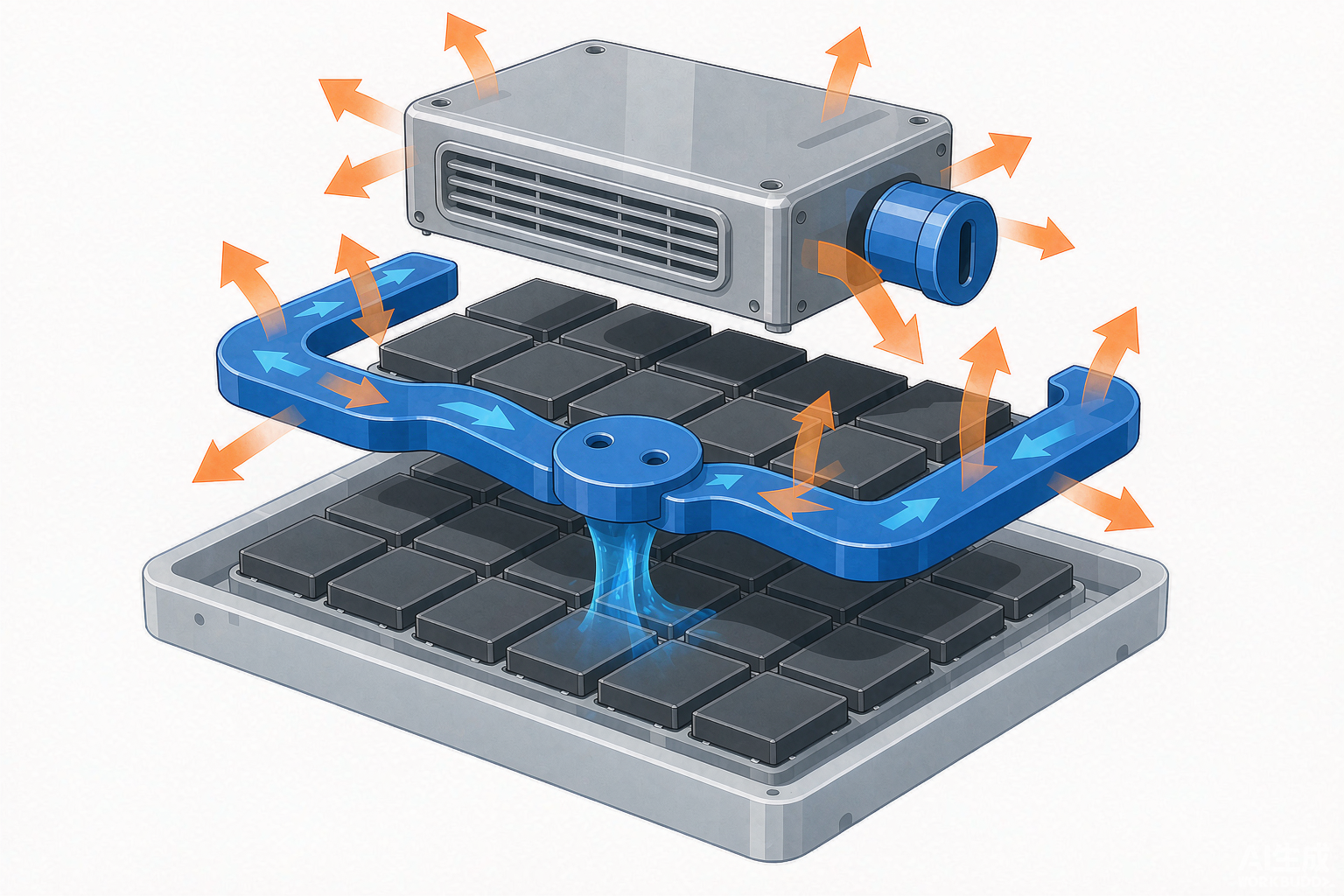
When people talk about EV performance, they usually mean 0–100 km/h times, range, or charging speed. But there is a quieter system working underneath all of it: thermal management. Batteries, power electronics and motors are surprisingly fussy about temperature. Get it right and you get fast charging, long life and consistent range. Get it wrong and you get throttled power, faster degradation and a pack that quietly loses capacity year after year. This article breaks down the two big decisions every EV platform makes — how to cool the battery, and how to heat the cabin — and why the modern answers (liquid cooling + heat pump) are winning.
Why temperature is the whole game
A lithium-ion cell is happiest in a narrow window. Most manufacturers aim to keep the pack between roughly 20 °C and 35 °C. Below that, internal resistance climbs, power delivery drops and charging speed falls off a cliff. Above it, the cell protection electronics start limiting current to protect the chemistry, and sustained high heat accelerates calendar aging.
That single fact drives everything else. An EV's thermal system has to do four jobs at once: cool the battery during hard acceleration and DC fast charging, warm the battery in winter so it can charge and discharge quickly, heat the cabin without stealing too much range, and reject heat from the motor and inverter. How a platform handles those jobs splits into two clear schools for cooling, and two clear options for heating.
Cooling the pack: liquid vs air
Liquid cooling — the mainstream standard
In a liquid-cooled pack, a water-glycol coolant is pumped through metal "cold plates" or channels underneath or between the cells. The coolant absorbs heat and carries it to a radiator (or, during charging, to a chiller linked to the air-conditioning loop), where it is dumped to the ambient air.
The big advantage is uniformity. Because the coolant flows in a controlled circuit, cell-to-cell temperature differences can be held to roughly ±2 °C, according to thermal-engineering references. That even temperature means every cell ages at the same rate and the pack can safely accept higher charge and discharge currents. Tesla, BYD and the Volkswagen ID family all use liquid cooling for exactly this reason — it is what makes 250 kW+ peak charging and repeated hard launches survivable for the battery.
The trade-off is complexity: you need a pump, a reservoir, a radiator, coolant lines and often a chiller. That adds weight, cost and a maintenance fluid (the coolant does eventually need replacing).
Air cooling — simpler, but limited
Air-cooled packs skip the coolant loop entirely. Fans push cabin or ambient air through ducts and around the modules. It is lighter, cheaper and easier to build — there are fewer parts to fail.
The problem is uniformity and ceiling. Air is a poor heat-transfer medium compared with liquid, and the cells closest to the fan inlet stay cool while cells farther away run hotter. That温差 (temperature spread) means the pack as a whole must be derated to protect its hottest cell. The Nissan Leaf is the best-known example: it uses passive and fan-assisted air cooling, and that simpler approach is a big reason the Leaf is more sensitive to heat and fast-charging stress than liquid-cooled rivals. For low-power, modest-range city cars, air cooling is still a perfectly reasonable choice. For anything that fast-charges regularly or packs in high energy density, liquid cooling wins.
Heating the cabin: heat pump vs PTC
Keeping the battery happy is only half the story. In cold weather the bigger range thief is the cabin heater, and here there are two very different technologies.
PTC resistance heaters — simple but thirsty
A PTC (positive temperature coefficient) heater is essentially a glorified toaster: it passes electricity through a resistive element and converts it directly to heat. Its coefficient of performance (COP) is about 1.0 — one unit of electrical energy becomes roughly one unit of heat. That energy comes straight out of the battery, which is why a PTC heater can crater winter range by 20–40% depending on outside temperature.
Heat pumps — moving heat instead of making it
A heat pump works like a refrigerator in reverse. Instead of generating heat, it moves it — harvesting warmth from the ambient air, from motor/inverter waste heat, and even from the battery itself, then pumping it into the cabin. Because it relocates heat rather than creating it, its COP lands around 2–4. Real-world data shows heat pumps cut HVAC energy use by roughly 40–70% compared with PTC heaters. The payoff is range: where a PTC car might lose 20–40% of its range in winter, a heat-pump car typically loses only 10–20%.
There is one catch. A heat pump's efficiency drops in extreme cold (below about −10 °C the ambient air simply does not hold much heat to harvest), so most heat-pump EVs keep a small PTC element as backup for the coldest days. That hybrid approach is now the default on modern platforms from Tesla, BYD, Hyundai-Kia, Volkswagen and others.
How it all ties together
The clever part of a modern EV is not any single component but the integrated thermal loop. Premium platforms run the battery, motor, inverter and cabin off one shared circuit, so waste heat from the motor warms the battery in winter, and the cabin AC helps cool the pack in summer. This is also why "pre-conditioning" matters so much: if you heat or cool the battery and cabin while the car is still plugged in, you spend grid energy instead of battery energy, and you arrive at a DC charger with the pack already in its happy 20–35 °C window — which means faster charging and less stress.
Practical takeaways
- Pre-condition while plugged in. Warm or cool the cabin and battery on shore power before you leave. It is free range.
- Avoid DC fast charging a hot pack. If you arrive at a charger after hard driving on a hot day, let the car manage a short cool-down; many EVs do this automatically.
- Park in shade in summer and, in winter, keep the car plugged in so it can maintain pack temperature.
- LFP vs NMC tolerance differs. LFP chemistry is more forgiving of heat and full charging, but it still prefers the same 20–35 °C window for longevity — the cooling system still matters.
- Listen for thermal throttling. If charging speed drops on a hot day, it is almost always the pack protection system, not a broken charger.
Thermal management is the difference between an EV that feels identical in year one and year eight, and one that quietly loses its edge. Liquid cooling plus a heat pump is the combination that lets today's best EVs charge fast, survive climates from Phoenix to Harbin, and keep their batteries healthy for the long haul.
Sources
- Sheen Thermal — liquid cold plate cooling principles for EV batteries: https://www.sheenthermal.com/
- Ai Eco EV — heat pump vs PTC cabin heating efficiency: https://aiecoev.com/
- Tone Cooling — battery thermal management system comparisons: https://www.tonecooling.com/
- AEVA (Australian EV Association) — heat pump and range discussion: https://www.aeva.asn.au/
- CarXplorer — EV thermal and range analysis: https://carxplorer.com.au/
- Ingener — battery cooling architectures: https://ingener.by/
- EV-Insight — heat pump COP and winter range impact: https://ev-insight.com/
- Bitauto (Malaysia) — regional EV heat and cooling notes: https://www.bitauto.my/
Back to all articles · View comments & share on the interactive page