800V vs 400V: Why High-Voltage Architecture Is Quietly Reshaping EV Charging
When Porsche launched the Taycan, its 800-volt architecture was a supercar party trick. In 2026 it has become a mainstream differentiator that directly changes how fast you charge and how heavy your car is. Yet most buyers still shop on peak-kilowatt headlines without understanding why two cars at the same "350 kW" stall can finish at very different times. This explainer breaks down what 800V actually does, where the real-world gains show up, and why China has pushed the technology further and faster than anywhere else.
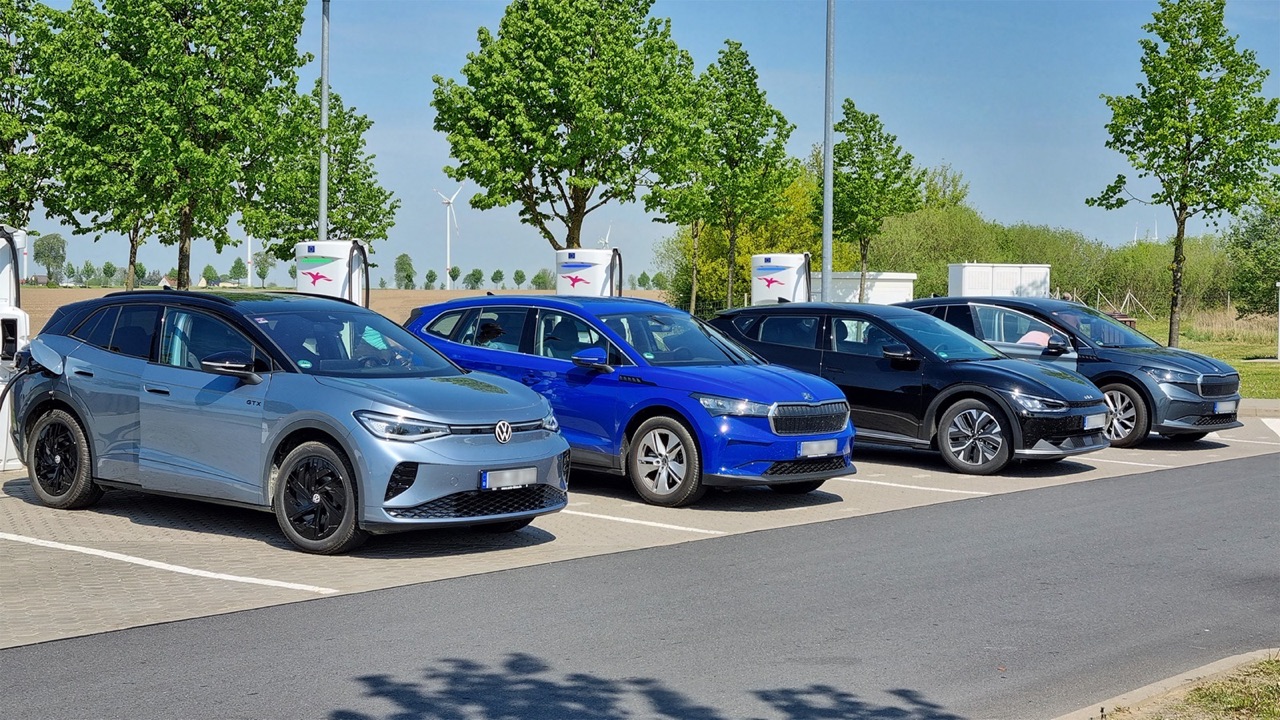
Photo: Wikimedia Commons / Michael32710, CC BY-SA 4.0
The simple physics: power = voltage × current
A battery's charge speed is limited by how much power (in kilowatts) can flow into it. Because power equals voltage multiplied by current, you can deliver the same power two ways: push more current at low voltage, or push higher voltage at lower current.
The 400V systems used by most Teslas (pre-Cybertruck), Chevrolet's Ultium vehicles and many others typically accept 50–150 kW of DC fast charging, peaking around 100–150 kW. An 800V platform — Hyundai's E-GMP (Ioniq 5/6, Kia EV6/EV9), Porsche's PPE, GM's Ultium 800V, Lucid, Rivian's R1T/R1S and the 2026 Polestar 3 — can accept 250–350 kW from a compatible stall.
The payoff of higher voltage is lower current for the same power. That means thinner, lighter cabling (published teardowns cite roughly 15–20 kg of wiring savings), less heat to manage, and better sustained efficiency — benefits that show up in both charging and performance, not just on a spec sheet.
What it means at the plug
The headline number is charging time from 20% to 80% state-of-charge:
- Hyundai Ioniq 6 Long Range (77 kWh, 233 kW peak): ~18 minutes
- Tesla Model Y Long Range (75 kWh, 250 kW peak): ~22 minutes
- Ford F-150 Lightning Extended Range (131 kWh, 150 kW peak, 400V): ~41 minutes
- Chevy Equinox EV (85 kWh, 150 kW peak, 400V): ~28 minutes
(Figures from Axis Intelligence's 2026 Level 1/2/3 charging breakdown; your result varies with temperature, state of charge and station health.)
The critical nuance: a 400V car plugged into a 350 kW Electrify America stall will draw what its pack can accept — often 100–150 kW — not 350 kW. You are not "wasting" the faster stall, but you are not unlocking its speed either. Conversely, an 800V car at a 150 kW stall still caps at the station's limit.
Why peak watts lie: preconditioning and consistency
Two caveats matter more than the peak number. First, battery preconditioning: an 800V pack charges fastest only when it is already warm. Navigation-guided preheating (standard on most 800V cars) can cut warm-up delay substantially. Second, sustained power beats peak power. Industry analyses of a 2023–2024 NREL–JRC study note that only about a third of advertised 250+ kW sessions actually sustained above 200 kW for more than five minutes, usually because of voltage sag, ambient temperature or failed preconditioning. As one Fraunhofer ISE engineer put it, a charger that holds 280 kW steadily for 18 minutes beats one that spikes to 450 kW for 90 seconds then drops to 120 kW.
There is also a compatibility trick: Hyundai and Kia's E-GMP platform is natively 800V, but at a 400V station the motor inverter doubles as a boost converter, stepping voltage up so the pack still charges — typically at 150–200 kW rather than 230+ kW.
The China Angle: fastest deployment on the planet
China did not just adopt 800V — it industrialized it. BYD's new Sealion 08 (launched September 2) and most recent Dynasty/Ocean flagships, Zeekr, XPeng (the 2025 G9 "5C" refresh claims ~445 kW), Xiaomi, Li Auto's 5C-capable MEGA, and NIO all ship 800V-class platforms. The GB/T 20234.3 connector natively supports up to 1,000V, and analyses estimate that roughly 40% of China's new high-power stations are now dual-protocol (GB/T + CCS). For a Western buyer, the practical takeaway is that 800V is no longer a premium-only feature — it is becoming the default for any EV expected to do long-distance driving without route anxiety.
Bottom line
If your driving is short urban commuting, a 400V EV is perfectly adequate and often cheaper. But if you want road trips that feel like gasoline stops, 800V is the single most important charging specification after battery size — and it is worth verifying both the car's peak and whether your local fast-charging network actually delivers high power consistently.
Image: brand placeholder used; diagram to be added on media pass.
Sources:
- Axis Intelligence, "Level 1 vs. Level 2 vs. Level 3 EV Charging" (2026)
- EV Charger Scout, "800V EVs 2026: Fastest-Ready Networks"
- Linkpower Charging, "Are all EV car chargers the same?" (NACS/J3400 transition)
- TIJ Express Automotive, "2026 EV Charging Speed and Infrastructure Compatibility" (NREL–JRC reference)
- KEDCars, "800V Electrical Architecture" (wiring-weight and V2X context)
Back to all articles · View comments & share on the interactive page