EV Road Trips in 2026: A Practical Charging-Stop Playbook
Range anxiety in 2026 is less about whether an EV can do a long trip and more about whether you planned the stops. With 800V cars now adding ~300 km in 15–20 minutes and public fast-charging networks denser than ever, the skill that matters is sequencing your charging like a logistics manager. This playbook covers the rules that work in the US and Europe, with notes for other markets.
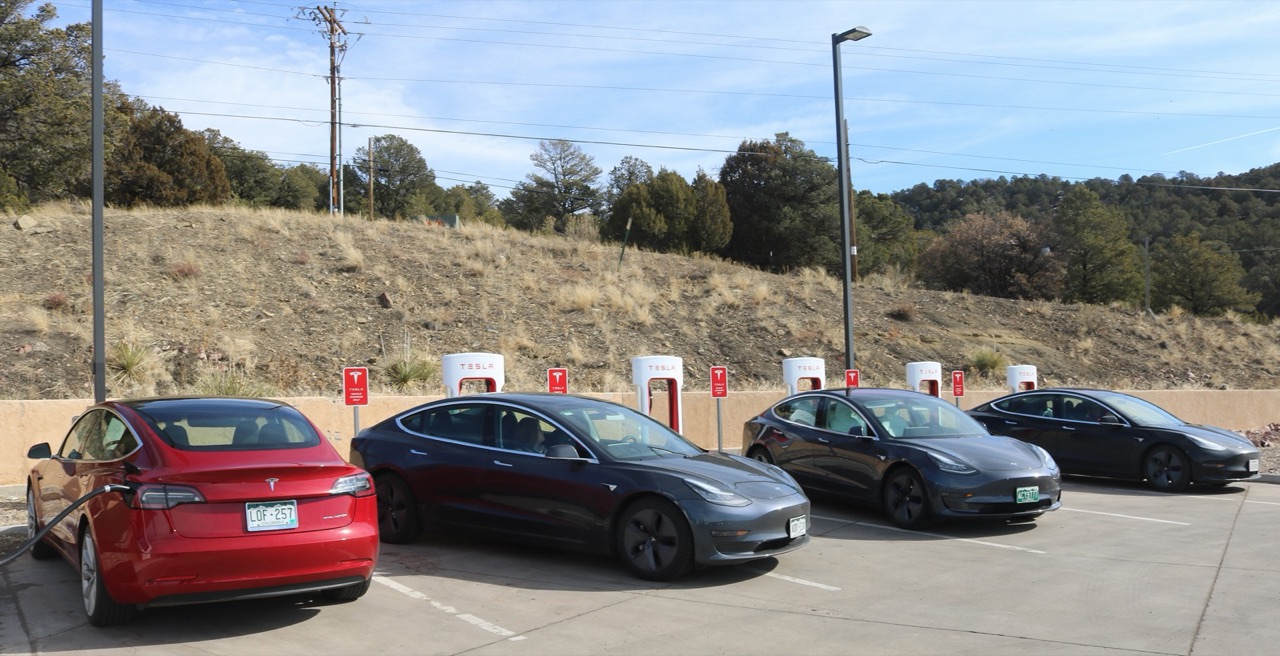
Photo: Wikimedia Commons / Jeffrey Beall, CC BY 4.0
Rule 1: The 80/20 rule beats 100%
Charge from 20% to 80%, not to 100%. The 20–80% window is the fast part — typically 20–30 minutes at a 150+ kW stall. The final 20% to 100% takes almost as long again, because the battery's charging curve deliberately slows to protect cell health. On a road trip, leave at 80% and plan your next stop before you fall below 15–20%.
Rule 2: Space your stops 150–200 miles apart
Plan a DC fast-charging stop roughly every 150–200 miles (240–320 km). That leaves buffer for detours, traffic, cold weather and the occasional broken charger. Most major US interstates (I-5, I-95, I-40, I-10) now have DC fast chargers every 50–80 miles; Europe's Ionity corridor runs 350 kW stations across 24 countries. A 25-minute stop is the perfect length for a coffee or restroom break — build it into the day rather than fighting it.
Rule 3: Precondition and slow down
In winter, use your navigation to precondition the battery before arrival; a warm pack charges dramatically faster than a cold one. On the highway, cruising at 65–70 mph instead of 80 mph can add 15–20% to your real-world range. Both are free range you are leaving on the table otherwise.
Rule 4: Use the right apps — and a backup
- PlugShare: real-world station reviews, photos and check-ins — your best "is this actually working?" filter.
- A Better Route Planner (ABRP): optimizes stops for your specific car model, accounting for speed and elevation.
- ChargeMap / Tesla Navigation: large station databases with offline modes.
Always have a backup network. If ChargePoint is full, EVgo or a Supercharger may be a mile away. Before relying on a remote charger, check recent reviews — maps show stations that have been removed or are offline.
Rule 5: Keep a real buffer
Highway driving and cold weather both shrink range. Plan as if you have about 60% of the window sticker's range in winter, and keep at least 100 km (~60 mi) in reserve. If a service area is jammed on a holiday, drop off the highway to a city fast-charger — it is usually faster than queuing.
When a plug-in or range-extender is the smarter tool
For routes with uncertain charging — remote areas, mountain towns, cross-border trips — a PHEV or EREV removes the worry entirely: drive on electricity locally, switch to fuel for the long haul. Several 2026 Chinese models (e.g. BYD's DM-i lineup, Li Auto's range-extenders, the new FREELANDER 神行者8) are built exactly for this "best of both" use case.
The China Angle
China's charging network has passed 300,000 stations, and in dense regions (the Yangtze Delta, Beijing–Tianjin–Hebei) parking garages routinely have dozens of plugs. Route planning there leans on Amap (高德) and Baidu Maps' EV modes plus apps like 特来电 and 国网e充电. A uniquely Chinese option is battery swap: NIO and the CATL-led swap alliance now run roughly 2,000 swap stations across 31 provinces, turning "charging" into a 3–5 minute pit stop. The principle is the same everywhere, though: plan stops, keep a buffer, and have a backup.
Bottom line
Road-tripping in an EV in 2026 is straightforward if you treat charging like fuel planning with a slightly longer coffee break. Charge to 80%, stop every 150–200 miles, precondition in the cold, and always know your next two options before you unplug.
Image: brand placeholder used; route diagram to be added on media pass.
Sources:
- ChargeMap24, "EV Road Trip Planning: How to Charge Across the USA & Europe"
- Axis Intelligence, "Level 1 vs. Level 2 vs. Level 3 EV Charging" (2026)
- Sina Auto / Sina Lifestyle, "电动车长途充电规划" series (2026, China-market planning data)
Back to all articles · View comments & share on the interactive page